

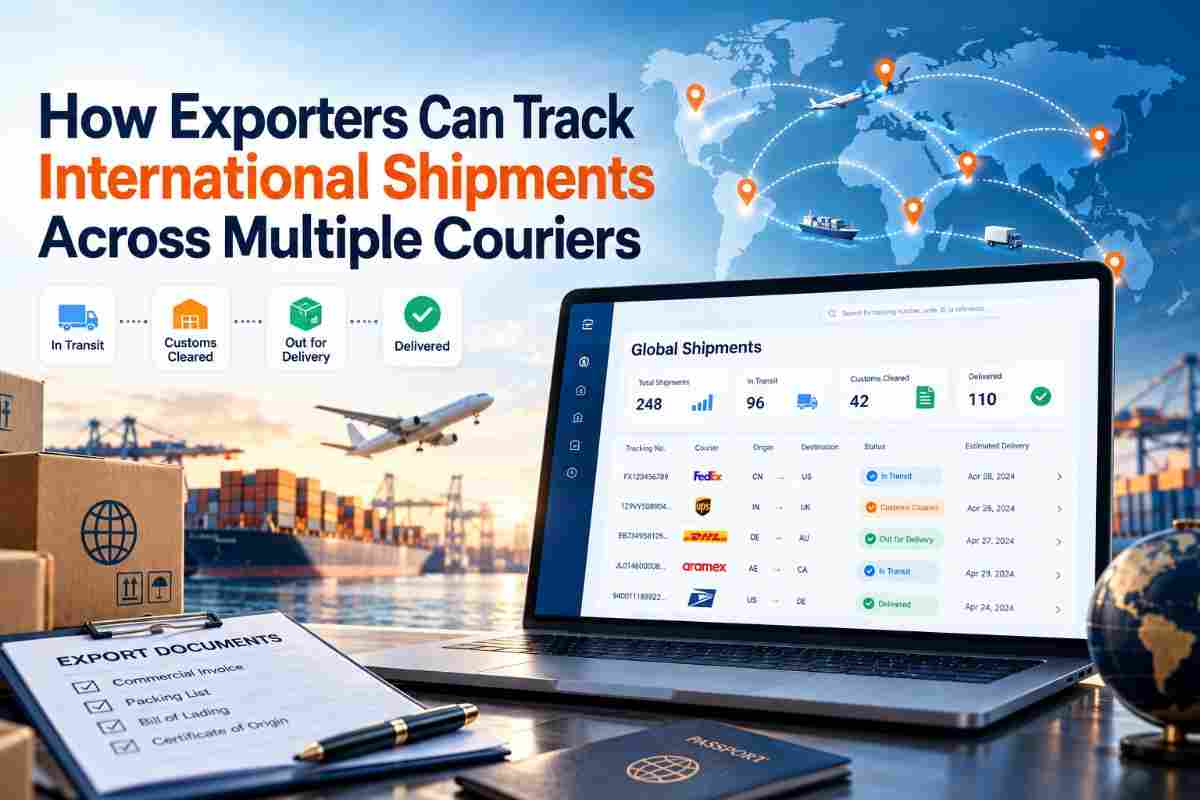
Checking individual courier portals may work for a small number of consignments, but it becomes inefficient when an export business manages regular orders across several countries. Customer service teams may not know whether a parcel is awaiting customs clearance, has been handed to a destination carrier, or is delayed at the last mile. Exporters also risk missing exceptions when a status is updated on one carrier's system but not reflected in their internal records.
A centralised tracking workflow brings the shipment record, courier reference, latest scan, delivery milestone, and exception details into one view. It does not remove customs or carrier-related uncertainty, but it gives teams a clearer basis for action. This guide explains how the process works, what information should be monitored, and how exporters can build a dependable multi-carrier tracking routine.
For a broader look at cross-border carrier selection and operating models, see this guide to international shipping aggregation.
Tracking international shipments across multiple couriers means monitoring consignments handled by different logistics partners through a consolidated process rather than checking each carrier separately. The exporter uses the shipment's order number, airway bill, tracking number, or courier reference to retrieve movement updates and connect them to the correct customer order.
International shipments rarely move through one uninterrupted network. A parcel may be picked up by an origin carrier, processed at an export facility, transferred to an airline, held for customs review, and then passed to a destination delivery partner. Each stage can generate a different event. Some carriers use terms such as “in transit,” while others distinguish between line-haul movement, customs processing, gateway arrival, and last-mile handover.
A consolidated approach normalises these different events into practical milestones. For example, “label created,” “picked up,” “departed origin,” “customs clearance,” “arrived at destination,” “out for delivery,” and “delivered” are easier for operations teams and customers to understand than a long list of carrier-specific codes.
International logistics involves more handovers and dependencies than domestic delivery. A shipment can be physically moving even when no new scan appears for several hours or days, particularly during air transit, customs processing, or a transfer between carrier networks. Without a consistent tracking process, teams may treat normal gaps as lost shipments or fail to act when a real exception requires attention.
Visibility also matters because different stakeholders need different information. An exporter wants to know whether the shipment has cleared export and import controls, a customer wants a clear delivery estimate or current status, and a finance or compliance team may need evidence of delivery. Pulling these answers from separate portals creates avoidable delays and inconsistent communication.
Centralised monitoring supports decisions at several operational levels:
Tracking should not be treated as a post-dispatch activity owned only by customer service. It is part of the export operating process. The right update can trigger a customs follow-up, a consignee contact, a delivery reattempt, or an internal review of the shipping lane.
Businesses that are already dealing with growing order volumes may also benefit from reviewing how to manage multiple couriers in one dashboard. The underlying principle is the same: reduce fragmented operational work and make every shipment easier to locate.
A multi-carrier tracking process is valuable when it improves decisions, not merely when it displays more status updates. Exporters should evaluate the workflow based on how quickly teams can identify a shipment, interpret its position, communicate with the consignee, and take the next action.
Teams can search shipments by order ID, tracking number, customer, country, or courier instead of opening several carrier portals. This reduces the time spent reconciling records and makes handovers between warehouse, logistics, and customer support teams more reliable.
Carrier-specific language can be translated into practical milestones. A customs-related scan should not be treated the same way as a routine transit update. Grouping events into meaningful stages helps teams identify which shipments need attention and which are progressing normally.
Customers usually do not need every technical scan. They need to know where the parcel is, whether an action is required, and what may happen next. A consistent tracking record allows support agents to answer these questions without waiting for a separate courier response.
Delayed scans, customs holds, incomplete addresses, failed delivery attempts, and delivery refusals should be placed into an exception queue. A central workflow makes it easier to assign ownership, record contact attempts, and review whether the issue was resolved.
When tracking data is stored consistently, exporters can review courier performance by destination, mode, product category, and service level. The purpose is not to select a single carrier for every shipment. It is to understand where each partner performs well and where a routing change may be worth testing.
Customers are more likely to trust an exporter when tracking updates are understandable and timely. A branded tracking page can also keep the customer within the seller's communication journey rather than sending them through multiple unfamiliar courier websites.
The following process can be used by exporters handling parcels through two or more courier partners. The exact screens and status names will differ by platform, but the operating logic remains consistent.
For businesses using an online store or order management system, connecting order data with shipping and tracking records reduces manual copying. A practical shipping integration workflow should pass the correct order reference to the courier process and return the tracking status to the system where the team works.
Reliable tracking depends on process discipline as much as technology. Even a centralised dashboard will provide poor results if shipment references are incomplete, statuses are misunderstood, or exceptions have no owner. Exporters should establish a small set of operating rules and apply them consistently across couriers.
Keep the customer order, courier name, tracking number, package details, and latest status together. Avoid maintaining separate spreadsheets for warehouse staff and customer support unless there is a clear reconciliation process. Duplicate records often create conflicting answers.
International consignments may move from one network to another. Record the handover date and the new reference when available. If a destination partner uses a different number, customer support should still be able to find the shipment through the original order ID.
Customs processing is not the same as ordinary transit. Check whether the delay relates to duties, missing invoices, restricted goods, recipient information, or a government inspection. Do not tell a customer that a parcel is “lost” simply because it has remained at a gateway without a delivery scan.
Every exception should have a next action and an owner. For example, logistics may contact the courier, the documentation team may review export papers, and customer support may request information from the consignee. Without ownership, status monitoring becomes passive reporting.
Useful updates include dispatch confirmation, departure from origin, customs processing, arrival in the destination country, out-for-delivery movement, and delivery completion. Too many technical notifications can confuse customers, while too few can create avoidable “where is my order” requests.
Analyse delays by country, postal region, courier, product type, and shipping service. A partner may perform well on one corridor but experience repeated exceptions on another. Lane-level review is more useful than judging a courier from a general average.
Define when a shipment moves from “no recent scan” to formal investigation. Collect the booking details, packing information, last confirmed location, and customer communication history before opening a claim. This makes the process clearer for both the exporter and the courier. The lost shipment handling process should be documented before an incident occurs.
International tracking problems are often caused by small process gaps rather than a complete absence of tracking. The following mistakes can make a shipment appear less visible than it actually is and can delay the response when intervention is needed.
Both approaches can provide shipment updates, but they differ significantly in how much operational work is required. The right choice depends on shipment volume, number of courier partners, destination coverage, and the level of customer communication an exporter needs.
Manual checks still have a role when a carrier dispute, customs investigation, or unusual handover requires deeper detail. However, they should be an escalation method rather than the default process for every open consignment.
Exporters that track international shipments multiple couriers through disconnected portals often spend too much time searching, interpreting, and reconciling updates. A centralised workflow makes each shipment easier to locate and gives teams a clearer way to manage customs holds, carrier handovers, delivery exceptions, and customer questions.
Shipmozo supports exporters with relevant logistics capabilities including International Shipping, B2B Shipping, and B2C Shipping. These services can help businesses organise cross-border movement according to shipment type and customer model while working with a broader logistics operation.
Start by standardising shipment references, mapping courier events into common milestones, assigning exception ownership, and retaining delivery evidence. Then review performance by lane instead of assuming that one courier is suitable for every destination.
Start Shipping Today
Yes. Exporters can use a consolidated tracking workflow that connects each order with its courier name, tracking reference, latest scan, and standard shipment milestone. This reduces the need to search every courier portal separately, although carrier-specific portals may still be needed for detailed investigations.
The essential information includes the order ID, airway bill or tracking number, courier name, destination country, postal code, service type, and package details. If the shipment changes carrier during transit, the destination partner's reference should also be recorded against the original order.
A scan gap may occur during air transit, customs processing, weekends, or a handover between carrier networks. Exporters should compare the gap with the route and service expectations. A customs hold, incomplete documentation, address issue, or extended lack of movement may require escalation.
Customs statuses should be treated separately from normal transit updates. The exporter should identify whether the issue involves duties, invoices, restricted goods, recipient information, or inspection, then assign the relevant team to follow up. Delivery dates should not be promised while the shipment remains subject to customs action.
Share meaningful milestones such as dispatch, departure from origin, customs processing, arrival in the destination country, out for delivery, and delivery completion. Explain any required customer action and avoid overwhelming recipients with technical courier scan codes or unsupported delivery promises.


Neha Pant works in business development at Shipmozo, where she focuses on helping eCommerce and D2C brands simplify their logistics and scale operations efficiently. She is passionate about understanding real shipping challenges and connecting businesses with the right solutions.





.webp)