

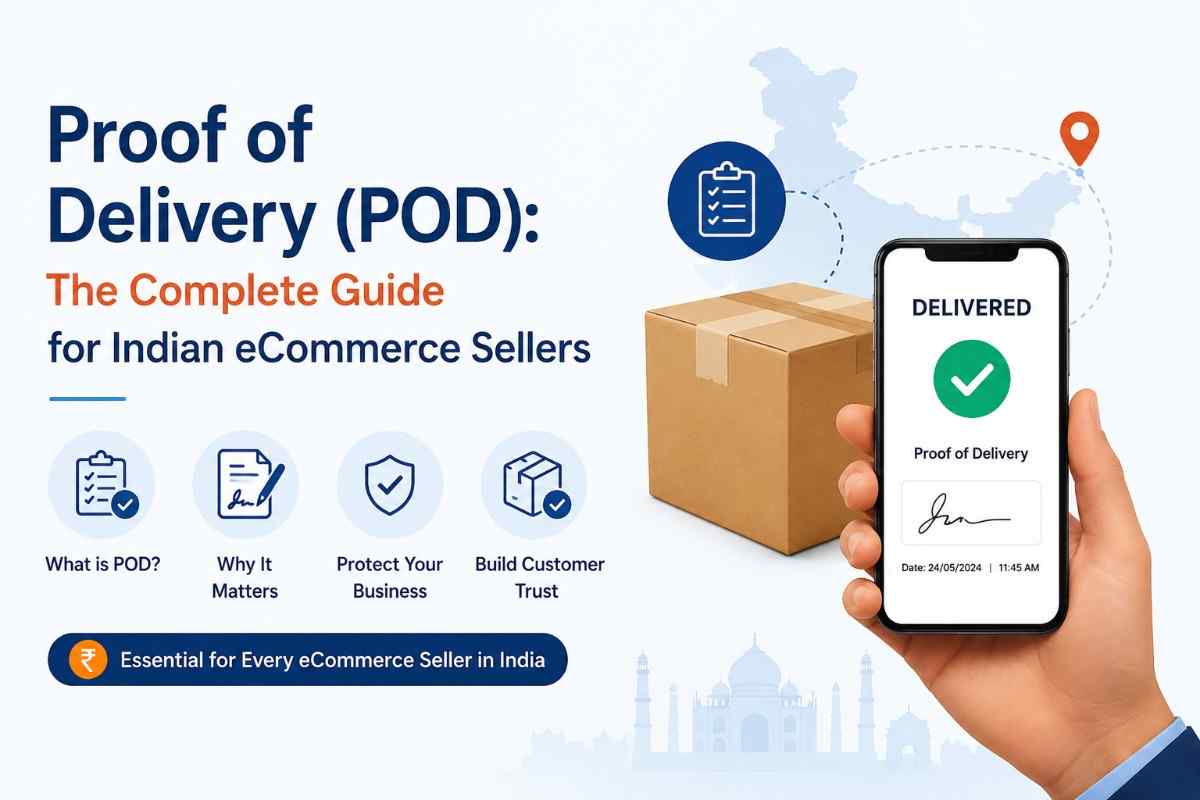
Proof of Delivery (POD) is an official document or digital record that confirms a shipment has been successfully handed over to the buyer. It is the courier's evidence that the delivery took place, and it is the single most important piece of documentation when a customer says, "I never received my order."
In Indian e-commerce, the term "POD" is used interchangeably with "delivery confirmation," "deliveryreceipt, and consignee acknowledgment. Whatever you call it, its job is the same: prove that the right product reached the right person at the right time.
Every day, thousands of Indian sellers face a version of this problem:
Without a valid POD, the seller almost always absorbs the cost — whether that means a refund, a replacement shipment, or a chargeback.
The stakes are particularly high in India because
Platforms like Shipmozo are built with this reality in mind, integrating multi-carrier shipping with tools designed to help sellers capture and access delivery proof quickly—rather than chasing individual courier partners after a dispute is already open.
Not all PODs are created equal. Understanding which type your courier provides — and how reliable it actually is — directly affects how well protected you are.
The traditional form. The delivery executive carries a physical run sheet and collects the consignee's signature at the time of handover. The courier keeps this document, and the seller must request it later.
Strengths: Universally accepted as legal evidence.
Weaknesses: Signatures can be illegible, forged, or disputed. Physical papers get lost. Most couriers have a strict 24–72 hour window to request a POD—miss it, and the document may be unrecoverable. Retrieval can take days or weeks.
Many courier partners in India have upgraded to digital POD. The delivery executive captures a photo of the delivered parcel and collects an electronic signature on their handheld device. This is stored digitally and retrievable through the courier's portal or via your shipping aggregator dashboard.
Strengths: Faster to retrieve. Less risk of the document being lost. Creates a timestamped photo record.
Weaknesses: Still dependent on the delivery executive completing the step properly. Does not eliminate the risk of fake deliveries where the parcel is never actually handed over.
The most reliable and increasingly preferred method in Indian eCommerce. With OTP-based delivery, the courier system sends a one-time password to the customer's registered mobile number. The delivery executive can only mark the shipment as delivered after entering the OTP the customer provides in person.
No OTP entered = no delivery confirmation in the system.
This makes fake deliveries nearly impossible to execute, and the OTP itself serves as incontrovertible evidence of delivery. Leading logistics companies in India, including Delhivery and Xpressbees, have rolled this out for prepaid B2C shipments.
If you ship through a platform like Shipmozo, OTP-verified delivery can be enabled directly from your dashboard for eligible shipments—removing the need to contact carriers individually.
Some modern delivery management systems capture the GPS coordinates of the delivery executive's device at the moment of delivery. This location stamp, combined with a photo or OTP, creates a robust audit trail.
This type of proof is increasingly being referenced in platform dispute resolutions.
Not issued by the courier — but critical for product condition disputes. If a customer claims they received a damaged or wrong item, the unboxing video they record at the moment of opening establishes the product's condition at that exact moment.
Without it, damage and mismatch claims become a word-against-word dispute that sellers consistently lose.
Best practice: Include a small card inside every parcel asking customers to record an unboxing video for electronics, high-value items, and fragile products before opening.
These two are frequently confused, and confusing them can be costly.
The most common scenario. Customer claims they didn't receive the order. Tracking says delivered. Request POD immediately — do not wait to see if the customer responds again.
POD alone won't resolve this. You need the POD (to confirm delivery was completed) combined with your pre-dispatch packaging photos and, ideally, the customer's unboxing video.
If you've purchased shipping insurance for a high-value shipment and it goes missing, the insurance claim process requires POD documentation. For a lost shipment, you need the courier to confirm that no POD exists—meaning delivery was never completed.
Marketplace disputes and credit card chargebacks almost universally require POD as supporting evidence. Filing without it dramatically reduces your chance of a favorable outcome.
The process varies by carrier, but the general steps are:
Waiting too long to request POD. Many sellers wait to see if the dispute resolves on its own. By the time they request the document, the 72-hour window has closed, and the courier's records are unavailable.
Not pre-photographing parcels. Photographing the sealed parcel with the AWB label visible before handover takes 10 seconds. It creates your own dispatch-side visual record to complement the courier's delivery-side POD.
Assuming digital tracking equals POD. A "Delivered" status on a tracking portal is not POD. It confirms the system was updated — not that a verified handover took place.
Not enabling OTP verified delivery for high-value orders. For prepaid shipments above a certain value, OTP verification adds near-zero cost but eliminates an entire category of delivery disputes.
Managing POD across multiple courier partners manually is a bottleneck for growing sellers. Shipmozo addresses this at the platform level:
Before dispatch:
After delivery:
Customer communication:
Proof of delivery is not a bureaucratic formality—it is your last-mile financial protection as an eCommerce seller. The difference between a resolved dispute and an absorbed loss often comes down to whether you had a valid POD and whether you requested it in time.
The shift toward OTP-verified delivery, GPS timestamping, and digital POD is making this easier—but only if you use courier partners and shipping platforms that support these formats. Tools like Shipmozo make it practical for sellers at any scale to manage POD across carriers without making it a full-time job.
Get your POD setup right, and an entire category of customer disputes stops being a problem.
POD stands for Proof of Delivery. It is the document or digital record that confirms a shipment was successfully handed over to the consignee.
Yes. OTP-verified delivery is accepted as a stronger form of POD than a physical signature in most courier systems and platform dispute processes in India, because it provides cryptographic evidence that the registered recipient was present.
With digital POD systems, retrieval can take a few hours to 1–2 business days. Paper POD can take 3–10 business days and is only available if requested within the carrier's window (usually 24–72 hours from delivery).
For a lost shipment claim, you need the courier to confirm that no delivery was recorded (i.e., no POD exists). For a damage claim, you typically need POD showing delivery was completed, combined with photographic evidence of the damage.
If you are within the request window and the courier cannot produce POD, document this in writing. This response itself becomes evidence for platform disputes and insurance claims. If you use a shipping aggregator like Shipmozo, escalate through the platform's carrier relations team, which often has faster resolution channels than seller-level courier contacts.







.webp)