

Lost shipments are one of the most frustrating experiences for any eCommerce seller or D2C brand in India.
You packed the order carefully. You dispatched it on time. The customer is waiting. And then the tracking stops updating. The courier has no clear answer. And you're left stuck between an angry customer and an unresponsive logistics team.
Here's the hard truth: lost shipments happen more than most sellers realize. And the bigger problem isn't just the lost product—it's not knowing how to file a lost shipment claim, missing deadlines, submitting incomplete documentation, and ultimately losing money you were entitled to recover.
The good news? With the right process, you can handle lost shipment claims efficiently, recover compensation, and protect your business from repeat losses.
This guide walks you through the complete 5-step process to handle a lost shipment claim in India — from the moment you suspect a shipment is lost to the moment compensation lands in your account.
A lost shipment claim — also called a courier claim or freight claim — is a formal request filed with a courier company seeking compensation when a shipment goes missing during transit and cannot be traced or delivered.
In the Indian eCommerce context, a shipment is typically considered lost when:
Every major courier company in India—Delhivery, DTDC, Xpressbees, Blue Dart, and Ekart—has a formal claims process. But each has its own deadlines, documentation requirements, and compensation policies. Missing any of these can result in your claim being rejected — even if the shipment was genuinely lost.
This is why having a structured, step-by-step claim process is not optional. It is essential.
Before diving into the process, it's important to understand why so many legitimate claims are rejected:
Understanding these pitfalls is the first step to avoiding them. Now let's walk through the process.
Before filing a lost shipment claim, confirm that the shipment is genuinely lost — not just delayed or held at a hub.
How to confirm a lost shipment:
Key timeframe: If tracking has not updated for 7+ days and the courier cannot locate the shipment after raising an inquiry, treat it as lost and move to Step 2 immediately.
Shipmozo Tip: If you ship through Shipmozo, all your shipments are tracked in real time from a single dashboard. Stalled or delayed shipments are flagged automatically—so you spot potential lost shipments faster than checking individual courier portals manually.
Documentation is everything in a lost shipment claim. Incomplete paperwork is the single biggest reason valid claims get rejected in India.
Pro tips for documentation:
Shipmozo Tip: Shipmozo generates a detailed shipment record for every booking — including the AWB number, courier name, pickup confirmation, and invoice details — all accessible from your dashboard. This significantly reduces the time spent gathering documentation when a claim needs to be filed.
This is the most time-critical step. Every courier company in India has a strict claim filing window — and missing it means losing your right to compensation entirely.
Claim filing deadlines for major Indian couriers:
Important: These deadlines are from the shipment booking date — not from the date you confirmed the shipment was lost. Always file as early as possible.
How to file a lost shipment claim:
Option 1 — Online Claim Portal Most major couriers have an online claims portal. Log in using your registered account, navigate to the claims or dispute section, enter your AWB number, fill in shipment details, upload documentation, and submit.
Option 2 — Email Claim Submission Send a formal claim email to the courier's claims team. Include all documentation as attachments. Use a clear subject line: "Lost Shipment Claim — AWB [Number] — [Your Company Name]." Request a claim reference number by reply.
Option 3 — Branch / Regional Office For high-value claims, visiting the courier's regional office in person with physical copies of all documents often results in faster processing and clearer communication.
What to include in your claim:
Shipmozo Tip: For sellers using Shipmozo, the platform provides direct support for claim filing — with your complete shipment records already available in one place. Instead of logging into multiple courier portals for different shipments, your claim documentation is centralized, making the filing process significantly faster.
Filing the claim is not the end of the process. It is the beginning.
Many couriers in India take 15–30 working days to process lost shipment claims—and some will go silent unless you follow up actively. Sellers who follow up consistently recover compensation significantly faster than those who wait.
Follow-up best practices:
When to escalate beyond the courier:
If the courier rejects your claim unfairly or stops responding after repeated follow-ups:
Once your claim is approved, compensation is typically processed within 7–15 working days via bank transfer or account credit. Verify the compensation amount matches what was agreed upon—if there is a discrepancy, raise it immediately before accepting the final settlement.
Understanding compensation limits:
Most courier companies in India have standard liability caps for lost shipments:
This is why declaring accurate shipment value and opting for insurance at the time of booking is critical — especially for high-value products.
Shipmozo Tip: Shipmozo's smart courier allocation engine routes each shipment to the best-performing courier for that specific pin code based on real delivery performance data. This proactively reduces the probability of lost shipments by avoiding carriers with poor track records in certain zones. Combined with real-time tracking and centralized shipment records, Shipmozo gives eCommerce sellers the tools to both prevent losses and handle claims efficiently when they do occur.
Use this checklist every time you handle a lost shipment:
A lost shipment claim is a formal request filed with a courier company asking for compensation when a shipment goes missing during transit and cannot be traced or delivered. It is also called a courier claim or freight claim. To file one successfully, you need the AWB number, proof of dispatch, product invoice, and customer communication—submitted within the courier's claim deadline.
Most couriers in India conduct an internal trace for 3–7 working days after a formal inquiry is raised. If the shipment cannot be located within this period, it is officially declared lost. However, sellers should not wait for this declaration to start gathering documentation — preparation should begin the moment tracking stops updating for 7+ consecutive days.
Claim deadlines vary by courier — typically 7 to 30 days from the shipment booking date. Delhivery, DTDC, and Blue Dart generally allow 30 days. Ekart windows can be as short as 7–15 days. Always check your specific courier's claim policy and file as early as possible—missing the deadline results in automatic rejection regardless of the validity of the claim. Ekart serves primarily Flipkart marketplace sellers. If you are a Flipkart seller, file claims via the Flipkart Seller Hub, not directly with Ekart.
The essential documents for a lost shipment claim in India are the AWB number, courier booking receipt, tax invoice showing product value, proof of dispatch or pickup confirmation, shipping label copy, product photographs, customer communication confirming non-receipt, and the reference number from your courier inquiry. Missing any of these significantly reduces the chance of claim approval.
Compensation depends on whether you declared a shipment value at booking and whether you opted for insurance. Without insurance or declared value, most Indian couriers limit compensation to ₹100–₹500 regardless of actual product value. With a declared value, compensation is based on that declared amount. With insurance, you can recover up to the full insured value of the product. Always declare accurate value and opt for insurance on high-value shipments.
Yes. If you booked through a courier aggregator like Shipmozo, the claim is filed against the actual courier partner who handled the shipment, but Shipmozo provides full shipment records, AWB details, and booking documentation to support your claim. This makes the process significantly easier than managing records across multiple courier portals independently.
The most effective ways to reduce lost shipments are: choosing couriers with strong delivery performance in specific pin codes, opting for insurance on all high-value shipments, tracking shipments in real time and catching stalled deliveries early, maintaining a claims log to identify high-loss couriers, and using a courier aggregator like Shipmozo that routes shipments to the best-performing carrier for each zone automatically.
Yes. An undelivered shipment (RTO—Return to Origin) is one where delivery was attempted but failed—the customer was unavailable, refused delivery, or gave a wrong address. The shipment is returned to the seller. A lost shipment is one where the courier loses physical custody of the package during transit—it neither reaches the customer nor is returned. Lost shipments require a formal compensation claim; RTOs require a different operational response.
Yes. Shipment insurance specifically covers financial loss from lost, damaged, or stolen shipments during transit. For high-value products, insurance is strongly recommended. Without it, most Indian couriers cap compensation at ₹100–₹500 per shipment—far below the actual product value for most eCommerce sellers.
Lost shipments are an unavoidable reality of running an eCommerce business in India. But losing money on lost shipments is not.
With the right documentation, the right process, and the right platform, you can file lost shipment claims efficiently, recover compensation, and put systems in place that reduce future losses.
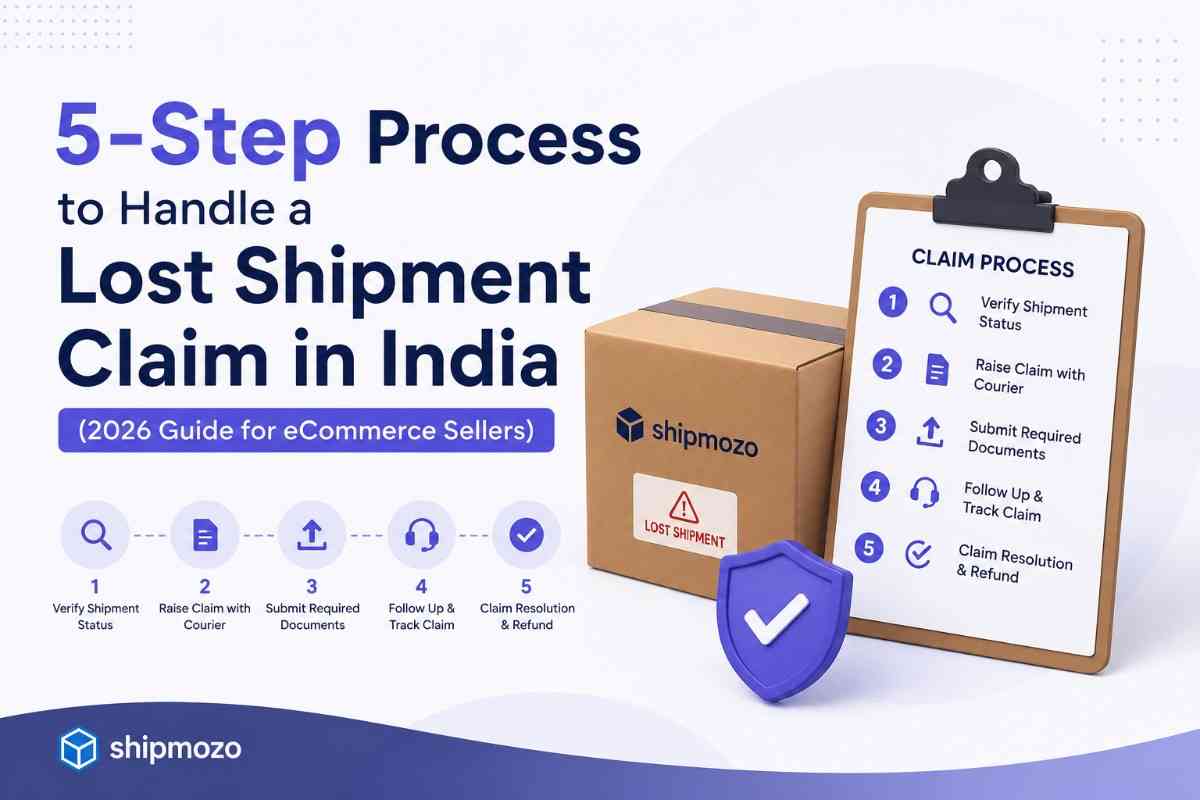
The 5-step process outlined in this guide—Confirm, Document, File, Follow Up, and Resolve—gives every eCommerce seller and D2C brand in India a structured framework to handle lost shipments professionally and recover what they're owed.
And for sellers using Shipmozo, the process becomes even smoother — with centralized shipment records, real-time tracking, smart courier allocation, and platform support that makes both preventing and handling lost shipment claims significantly easier.
Protect your shipments. Know your process. Recover your money.


Nisshdeep Kaur is a logistics-focused content specialist with 5+ years of experience in eCommerce shipping and delivery optimization. She shares actionable insights to help businesses improve delivery success rates and scale efficiently with platforms like Shipmozo.





.webp)