

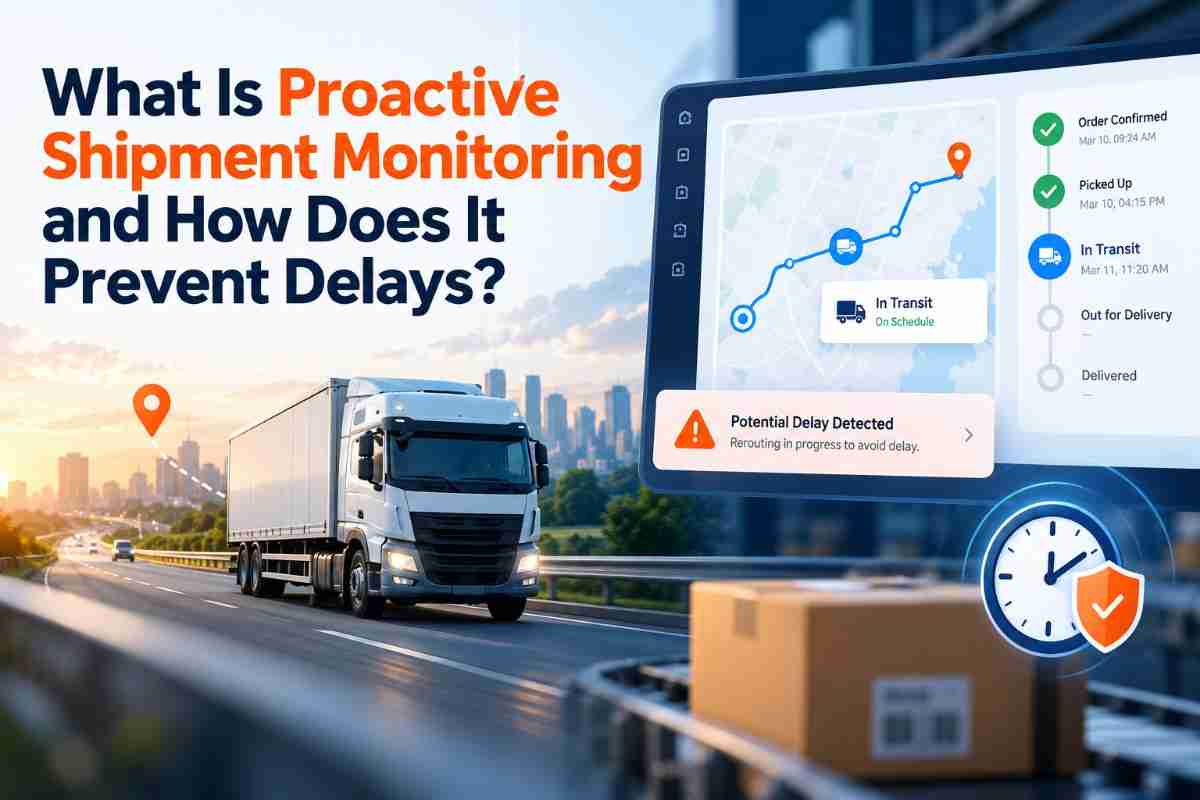
For an ecommerce business, a shipment delay rarely begins when a customer complains. It often starts earlier with a missed scan, an unsuccessful pickup, an address issue, a delayed handover, or a parcel that remains at one hub longer than expected. Proactive shipment monitoring meaning is the practice of watching shipment movement and operational signals continuously so that teams can act before a delivery problem escalates.
Traditional tracking tells a team what has already happened. Proactive monitoring goes further by identifying patterns that suggest what may happen next. This allows an operations team to contact the courier, correct order information, initiate an NDR workflow, or update the customer while there is still time to influence the outcome.
This approach is particularly useful for D2C brands, manufacturers, distributors, wholesalers, and ecommerce sellers managing orders across multiple cities and courier networks. It does not eliminate every external disruption. Weather, route restrictions, capacity issues, and incorrect customer details can still affect delivery. However, early visibility gives the business more options and reduces dependence on last-minute firefighting.
Proactive shipment monitoring is a structured process for tracking shipments, detecting exceptions, assessing their likely impact, and taking corrective action before the promised delivery experience is affected. It combines shipment status data with operational rules, team ownership, and customer communication.
A shipment is not considered healthy merely because it has an active tracking number. The operations team should assess whether the parcel is moving through the expected milestones: order processing, pickup, first scan, transit, destination hub, out for delivery, and delivery confirmation. A shipment that has not received a scan for an unusual period may require attention even if the courier has not officially marked it as delayed.
Common signals monitored by an operations team include:
The process is different from checking a tracking page only after a customer asks, “Where is my order?” A real-time tracking system provides the visibility required to move from reactive support to planned intervention.
Shipment performance directly affects customer trust, support workload, cash flow, and repeat business. In B2C orders, a delayed parcel can lead to cancellation, a negative review, or refusal at the doorstep. In B2B logistics, the consequences may include production interruptions, stockouts, missed retail replenishment windows, or receiving teams waiting for material that has not arrived.
Monitoring matters because delivery issues often become harder and more expensive to resolve as time passes. An address problem can be corrected before dispatch, but the same issue may require several calls after the parcel reaches the destination hub. A missed delivery attempt can sometimes be recovered through a timely customer confirmation. If the shipment is left unattended, it may move into return-to-origin processing.
It also creates a common operating view for different teams. Customer support can see the latest exception, warehouse staff can prioritise pending handovers, and logistics managers can identify whether a problem is isolated or linked to a courier, lane, pincode, or service type.
For growing businesses, this is important because shipment volume can increase faster than the size of the logistics team. A process that works with a few dozen daily orders may become unreliable when staff must monitor hundreds or thousands of shipments manually.
The main value of this approach is not simply better visibility. It is the ability to convert visibility into a specific action. A tracking update becomes operationally useful only when someone knows what it means, who owns the next step, and how quickly that step should be completed.
Early identification of incorrect addresses, unserviceable pincodes, missing contact details, and customer unavailability gives the team time to resolve the issue. This can improve delivery handling, although results depend on courier processes, customer response, and the quality of the original order data.
Non-delivery reports should not remain as passive tracking events. They need classification, customer outreach, reattempt decisions, and closure. A structured NDR management process helps teams separate recoverable cases from shipments that should be returned or investigated.
When a business knows which shipments are at risk, support agents can contact affected customers with a clear explanation and realistic next step. This is more efficient than responding to every “late delivery” ticket without access to the underlying exception.
Repeated delays become easier to identify when the business reviews pickup adherence, scan gaps, delivery attempts, hub dwell time, and return patterns by courier and lane. This helps inform allocation decisions and service reviews.
For B2B shipments, early alerts help receiving teams plan labour and stock availability. For COD-heavy businesses, better visibility into delivery and return movement supports more accurate cash-flow planning and reconciliation.
A practical programme does not require every shipment to receive manual attention. The objective is to create rules that identify exceptions, prioritise them by business impact, and route them to the right team.
A multi-courier environment makes this workflow more valuable because teams can compare service behaviour across carriers instead of relying on a single network. Businesses that need to manage different carriers from one operating view can also review multiple couriers through a consolidated process.
Monitoring becomes effective when it is designed around decisions rather than dashboards. A logistics manager should be able to answer three questions quickly: which shipments need attention, why do they need attention, and what action should happen next?
Do not ask employees to inspect every shipment manually. Build an exception queue around missed milestones, prolonged inactivity, repeated delivery attempts, address problems, and high-priority orders. This preserves human attention for cases where intervention can change the outcome.
Set different escalation rules for high-value products, time-sensitive consignments, B2B replenishment orders, perishable goods, and VIP customers. A delay that is acceptable for one parcel may be operationally serious for another.
Many delivery failures originate in order creation. Check the pincode, phone number, address completeness, package dimensions, weight, COD amount, and serviceability before handing over the parcel. Prevention at the order stage is usually easier than recovery after dispatch.
Use common definitions when comparing carriers. Useful measures include pickup success, first-attempt delivery, NDR rate, average transit duration, scan gaps, return rate, and response time to exceptions. The right courier metrics help distinguish a genuine network issue from a data-entry or warehouse problem.
Messages should state what has happened and what will happen next. For example, “The courier could not complete the first attempt; please confirm your availability for a reattempt” is more actionable than “Your order is delayed.” Avoid sharing internal speculation as a confirmed delivery promise.
Past performance can guide allocation and escalation, but it should not be treated as a guarantee. Service quality can vary by season, region, capacity, weather, and operational changes. Review recent data and retain human oversight for unusual shipments.
Businesses often invest in tracking visibility but fail to create an operating process around it. The result is a dashboard full of statuses with no consistent action. These mistakes are common across both ecommerce and B2B logistics operations.
For missing or potentially lost parcels, teams should follow a documented investigation and escalation procedure rather than relying on informal calls. A clear lost shipment process should cover evidence collection, courier coordination, customer communication, and closure.
Both approaches use shipment data, but they differ in timing, ownership, and the purpose of the information. Reactive tracking is useful when a customer needs a current status or a support agent must answer a question. Proactive monitoring is designed to identify a risk before the customer experiences the consequence.
The two methods should work together. Customers still need a tracking view, while internal teams need exception management. A business that uses only proactive alerts may miss a customer-specific question; a business that uses only reactive tracking may discover operational problems too late.
Understanding the proactive shipment monitoring meaning is important for any business that wants to manage delivery risk before it becomes a customer-facing failure. The process involves setting expected milestones, identifying unusual shipment behaviour, assigning timely actions, communicating clearly, and reviewing recurring patterns.
Shipmozo supports businesses across B2B Logistics and B2C Shipping, with service options including Surface, Air, and Rail. These capabilities can help businesses organise different shipment requirements while building a more disciplined approach to visibility and exception handling. Monitoring remains most effective when it is connected to accurate order data, accountable teams, and realistic customer communication.
For a practical assessment of your shipment workflows, Talk to an Expert
It means continuously reviewing shipment milestones and exception signals to identify delivery risks early, then taking corrective action before the issue becomes a major delay or customer complaint.
It identifies issues such as missed pickups, address errors, scan gaps, hub stagnation, and failed delivery attempts early. Teams can then contact the courier, correct information, arrange a reattempt, or update the customer.
Yes. B2B teams can use it to monitor time-sensitive consignments, replenishment orders, receiving schedules, and freight movement. Early visibility helps them coordinate warehouses and receiving teams before a delay disrupts operations.
Important events include pickup completion, first scan, transit movement, destination-hub arrival, prolonged inactivity, out-for-delivery status, failed delivery attempts, NDR creation, delivery confirmation, and return initiation.
No. External factors such as weather, route restrictions, network capacity, customer unavailability, and incorrect information can still affect delivery. Monitoring improves the opportunity to respond early, but it cannot control every event in the logistics network.


Nisshdeep Kaur is a logistics-focused content specialist with 5+ years of experience in eCommerce shipping and delivery optimization. She shares actionable insights to help businesses improve delivery success rates and scale efficiently with platforms like Shipmozo.





.webp)