

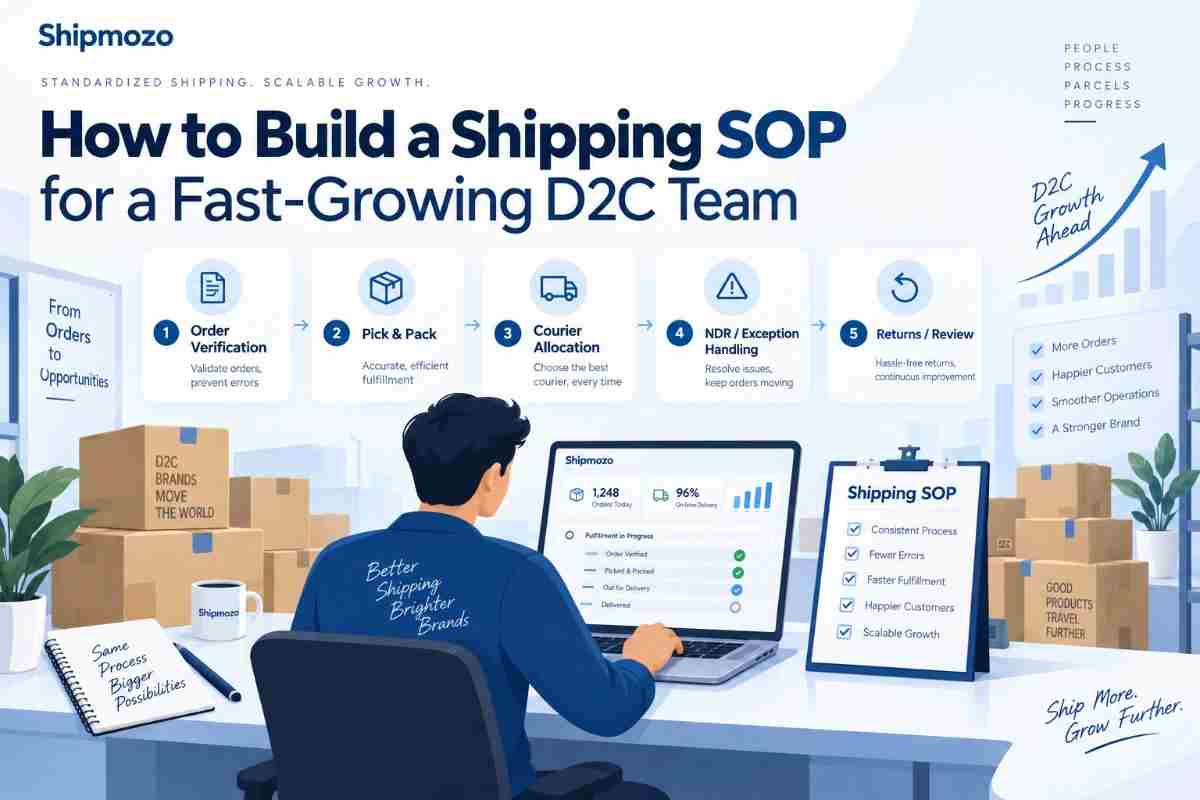
Growth can expose weaknesses in fulfilment faster than almost any other part of a D2C business. Orders increase, new team members join, product lines expand and customers expect accurate updates. Without a documented shipping sop d2c process, the team often relies on individual judgement, memory and informal messages.
That approach may work when a founder is checking every order. It becomes difficult when orders move through multiple people, warehouses, sales channels and courier partners. A missed address check, incorrect package weight or delayed response to a non-delivery report can create avoidable costs and customer complaints.
A shipping standard operating procedure gives the team a repeatable way to move an order from confirmation to delivery or return. It defines who does what, when each action is completed, which information must be recorded and how exceptions should be escalated.
This guide explains how founders and operations managers can build a practical SOP for a growing direct-to-consumer brand. The focus is operational clarity rather than complicated documentation. The process should be detailed enough to prevent mistakes but simple enough for a warehouse associate or customer support executive to follow during a busy dispatch cycle.
A shipping SOP for a D2C brand is a written set of instructions that governs the complete order fulfilment and delivery workflow. It usually starts when an order is received from a website or marketplace and ends when the shipment is delivered, cancelled, returned or escalated for investigation.
The document should translate business rules into clear operating steps. For example, it can specify how to verify an address, which orders require confirmation, how to select packaging, when a shipping label is generated and what action to take after a failed delivery attempt.
A useful SOP is not simply a list of courier names or packing instructions. It connects people, systems and decisions across the shipping lifecycle. It should cover order data, inventory handover, packaging, carrier selection, tracking, cash on delivery, customer communication, non-delivery reports and reverse logistics.
The SOP should be stored where the team can access the current version. A printed copy near the packing station can support floor operations, while a digital version should contain the detailed rules, templates and escalation contacts.
Shipping is a chain of dependent actions. If one step is unclear, the problem can appear much later. An incorrect product picked at the warehouse may become a return. An incomplete address may become a failed delivery. A missed handover scan may lead the support team to give the customer an inaccurate update.
When order volume grows, these errors become harder to identify manually. Founders may also lose visibility because different employees use different methods to process shipments. A documented process creates a common operating language across fulfilment, customer support, finance and management.
A good process also helps management distinguish a one-off issue from a recurring operational weakness. If packages are regularly reweighed by a courier, the team can inspect dimensions, packaging or the measurement process. If NDRs remain open for too long, the company can review its contact and reattempt workflow.
For a broader view of how brands organise fulfilment as volume increases, see this guide on scaling shipping operations.
The value of an SOP is not the document itself. Its value comes from making important decisions repeatable. A practical process allows the team to spend less time asking what should happen next and more time resolving genuine exceptions.
Order verification and packing checks reduce mistakes such as incorrect SKUs, missing accessories, wrong quantities and incomplete labels. The checks should be proportionate to the product. High-value, fragile or customised orders may need an additional verification step.
Instead of choosing a carrier based on personal preference, the team can use defined rules involving destination serviceability, package type, delivery requirement, weight and historical performance. A brand may use surface services for suitable standard shipments and air or express services where speed is commercially important.
Carrier selection can be supported by courier recommendation rules, but the SOP should still state when a human review is required. For example, an unusually large package or a remote pincode may need an exception.
Non-delivery reports should not sit in a shared inbox without an owner. The process can define how quickly the team checks the reason, contacts the customer, confirms the address or phone number and requests a reattempt where appropriate.
Cash-on-delivery orders require coordination between fulfilment, support and finance. The SOP should explain how COD orders are confirmed, how delivered orders are reconciled and how discrepancies are escalated. A documented process reduces confusion between shipment delivery status and the actual remittance record.
Once each step is standardised, the business can measure where time and errors are accumulating. Useful measures include dispatch turnaround time, first-attempt delivery rate, NDR ageing, return cycle time, weight discrepancy frequency and COD reconciliation status.
These benefits become more important when a brand works with multiple sales channels or courier partners. A multi-courier workflow can provide flexibility, but only when the team has clear operating rules.
Build the SOP around the actual movement of an order. Do not begin with a generic template and force the warehouse to follow steps that do not match its layout, systems or product requirements. Observe the current process, record the decisions people make and then convert those decisions into a controlled workflow.
Keep the frontline version practical. A packing associate needs a clear sequence and decision points, not a long explanation of logistics theory. Detailed policies, escalation contacts and reporting definitions can sit in linked supporting documents.
An SOP should change as the business changes. New SKUs, additional warehouses, different packaging, new sales channels and updated courier rules can all make an old process inaccurate. Treat the document as an operating control, not a one-time project completed during onboarding.
Use decision rules where the process branches. For example: “If the pincode is not serviceable, hold the order and contact the customer before dispatch.” This is more useful than saying “check serviceability.” Define what the employee should do with the order after the check.
The normal workflow should remain short and easy to scan. Place unusual cases in separate sections with clear links or references. Mixing every exception into the main checklist can make the standard process difficult to follow during routine dispatch.
Set internal targets for actions the team controls, such as time from order release to packing, time from NDR receipt to first contact and time taken to approve a return. These are operational checkpoints, not promises to customers. Review them by team, warehouse, product category and order type.
When a problem occurs, inspect the order record, scan history, package details, customer communication and courier event. Do not automatically blame the carrier or warehouse. The objective is to identify the process failure and add a preventive control where appropriate.
Prepare approved messages for dispatch, delivery delays, NDRs, return approvals and refunds. The language should explain the current status, the next action and any information needed from the customer. Avoid promising a delivery date that the team cannot control.
A monthly operational review is useful for a rapidly changing team. Check a sample of orders for address validation, correct packing, label accuracy, handover evidence, NDR action and return closure. A quarterly review can examine whether the process still matches the brand’s product mix and sales channels.
Tracking visibility should also be part of the operating design. A real-time tracking workflow helps support teams answer customer questions using shipment events rather than manual courier follow-ups.
Many shipping SOPs fail because they are either too vague to guide action or so detailed that employees stop using them. The best document focuses on operational risk and gives the team enough information to make the correct next decision.
For lost or damaged shipments, the SOP should also define what evidence must be retained and who communicates with the customer. A documented lost shipment process helps prevent inconsistent decisions when an investigation is required.
The operational difference becomes clearer when the two approaches are compared across daily activities. The comparison below is not about team size alone. Even a small brand can benefit from a documented workflow if it handles multiple SKUs, COD orders or delivery exceptions.
The documented approach still requires judgement. No SOP can eliminate every courier delay, address problem or customer dispute. Its purpose is to ensure that routine work is consistent and that exceptions are identified, recorded and escalated quickly.
A strong shipping sop d2c framework gives a fast-growing brand control over the details that are easy to miss during expansion. Start by mapping the actual order journey, assign ownership, define checkpoints and create separate playbooks for NDRs, returns, COD and shipment disputes.
Shipmozo can support this operating model with Channel Integration for connected order workflows, Multi Courier Shipping for structured carrier management, Courier Recommendation for allocation decisions and COD Reconciliation for finance visibility. These features do not replace a well-designed SOP; they help the team execute and monitor it with less manual coordination.
Review the process after launches, product changes and recurring exceptions. A shipping SOP should become a living operating system for fulfilment as the D2C business grows.
Talk to an Expert
It should include order verification, inventory allocation, picking, packing, weighing, label generation, courier allocation, handover, tracking, COD handling, NDR management, returns, lost shipments and escalation responsibilities. Each step should identify an owner and the evidence that confirms completion.
An operations manager should normally own the document, with input from warehouse, customer support, finance and technology teams. The owner should control revisions, collect feedback, remove outdated copies and review the process after operational changes.
Review it regularly, such as monthly for active operational issues and quarterly for a broader process review. Update it sooner when the brand adds a warehouse, product category, sales channel, courier service or packaging format.
The document should assign an owner for each NDR, define how quickly the reason is reviewed, explain how the customer is contacted, record when a reattempt is requested and state when the shipment is escalated or moved toward return.
No. Software can support channel integration, carrier allocation, tracking, labels and reporting, but the business still needs documented rules for ownership, product handling, exceptions, customer communication and approval decisions.







.webp)