

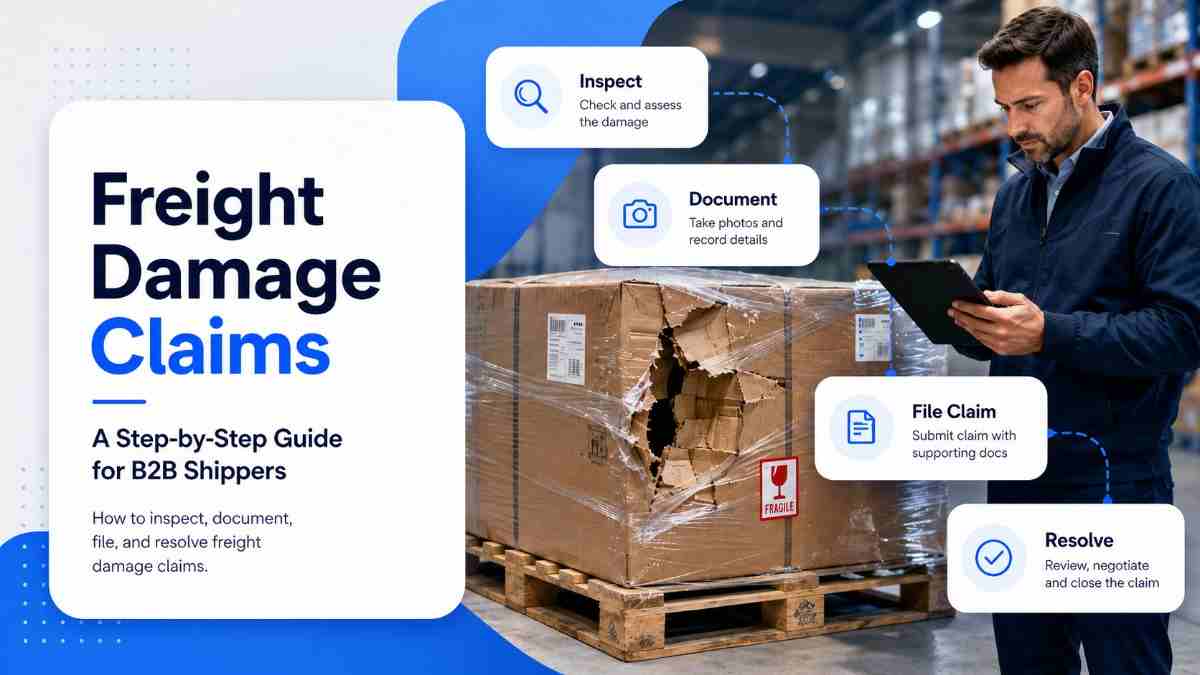
For a manufacturer, distributor, wholesaler, or B2B seller, damaged freight creates more than a replacement cost. It can delay production, interrupt inventory planning, affect retailer commitments, and create disputes between the shipper, carrier, consignee, insurer, and warehouse team. The freight damage claim process becomes much easier to manage when evidence is collected at the right time and responsibilities are clearly assigned.
Many claims become difficult because the damage is reported late, the outer packaging is discarded, the delivery receipt contains no exception note, or the invoice value does not match the amount being claimed. A carrier may also need photographs, packing details, weight records, proof of delivery, inspection reports, and correspondence before reviewing liability.
This guide explains how to handle a damaged consignment from the first delivery inspection through final resolution. It also covers the difference between visible and concealed damage, the documents a business should maintain, and the operational controls that reduce repeat incidents. The goal is not simply to recover money from one shipment. It is to build a repeatable claims workflow that protects service levels and customer relationships.
A freight damage claim is a formal request submitted to the responsible carrier or insurer for compensation after goods are damaged, lost in part, or rendered commercially unusable during transportation. The request generally identifies the shipment, describes the condition of the goods, establishes their value, and provides evidence connecting the loss to the movement of freight.
The process normally involves five parties or functions: the shipper that packed and dispatched the goods, the carrier that handled transportation, the consignee that received them, the insurer if cover was purchased, and the internal finance or operations team that records the loss. In some cases, a third-party logistics provider or warehouse operator may also be involved.
Damage can be visible or concealed. Visible damage is apparent when the consignment arrives, such as crushed cartons, wet packaging, broken pallets, exposed products, or missing pieces. Concealed damage is discovered only after opening packaging. These cases require careful documentation because the carrier may argue that the damage occurred after delivery or resulted from inadequate packaging.
The exact deadline, liability rules, claim form, inspection requirement, and settlement procedure depend on the carrier contract, mode of transport, shipment value, commodity, and insurance terms. Shippers should therefore treat this article as an operational framework, not a substitute for the applicable transport agreement.
B2B freight often consists of higher-value products, larger consignments, industrial parts, raw materials, equipment, or multiple cartons moving under one delivery document. A single damaged shipment can therefore have consequences beyond the affected unit. The consignee may reject the entire delivery, place the account on hold, or demand urgent replacement stock.
Commercial buyers also expect clear accountability. They may need an immediate answer about whether the goods can be used, repaired, returned, or replaced. If the shipper cannot provide shipment records and damage evidence, the discussion can quickly shift from a transport incident to a supplier-performance dispute.
A disciplined claims workflow helps a business:
For shipments requiring delivery evidence, maintaining reliable proof of delivery records is especially useful. The document can show the delivery date, receiver details, remarks, and any exception noted at handover.
A formal procedure does not guarantee that every claim will be accepted. It does, however, improve the quality and speed of internal decision-making. Teams know what to capture, whom to notify, and which documents to preserve before the facts become difficult to verify.
When a consignee reports damage, the first few hours are important. Photographs can be taken before the carton is opened, the condition of the pallet can be recorded, and the receiver can be asked to note the exception on the delivery document. A checklist prevents staff from relying on memory later.
Claims are easier to assess when photographs, shipment labels, packing records, invoices, and delivery remarks tell the same story. A clear evidence pack reduces repeated requests from the carrier and limits uncertainty about what was shipped and how it arrived.
Separating product value, freight charges, taxes, repair cost, disposal cost, and replacement cost helps finance teams claim the correct amount. It also prevents duplicate recovery when a supplier credit, insurance payment, or carrier settlement has already been received.
Claim data can highlight recurring weaknesses. For example, repeated corner crush damage may indicate pallet overhang, poor strapping, or insufficient edge protection. Wet cartons may point to exposure during loading or inadequate wrapping rather than a general carrier problem.
Loss records can help a business decide when to use surface, air, rail, PTL, LTL, or FTL movement. A low-cost route may not be suitable for fragile or time-sensitive goods if handling transfers and damage frequency create greater commercial risk.
The following workflow is suitable for most domestic B2B consignments, subject to the carrier contract and insurance terms. Assign ownership to one operations or claims coordinator so that the carrier receives a consistent record.
For high-value goods, involve legal, insurance, or risk specialists early. Claims involving hazardous materials, temperature-sensitive cargo, international movement, suspected theft, or serious injury may require additional reporting and should not be handled solely through a routine checklist.
Prevention and preparation are more effective than trying to reconstruct an incident after delivery. The best claims teams work with warehouse, procurement, transport, finance, and customer-service functions before a shipment leaves the facility.
Include inspection expectations in purchase orders, service agreements, and delivery instructions. Tell consignees who should inspect the shipment, what to record, and how quickly an incident must be reported. This avoids conflicting expectations between your sales team and the buyer’s receiving department.
Packaging should reflect product fragility, weight, stacking pressure, moisture exposure, and the number of handling points. Heavy items may need stronger cartons, corner protection, pallets, strapping, or internal blocking. Fragile components need cushioning that prevents movement rather than simply filling empty space.
Take dispatch photographs showing the product, internal protection, closed carton, shipping label, and pallet configuration. These images do not prove carrier liability by themselves, but they help distinguish a transport incident from a packing or pre-existing condition.
Record dimensions, dead weight, declared value, SKU details, quantity, and packaging type. Incorrect weight or product information can complicate carrier review and create separate billing disputes. A reference guide on net and gross weight can help teams use the right measure for different records.
Check exclusions, deductibles, valuation limits, packaging conditions, notification windows, and documentation requirements before dispatch. Shipping insurance may cover eligible risks, but coverage depends on the policy and the circumstances of loss.
Track shipment number, carrier, route, product, damage type, value, date reported, current status, root cause, and final outcome. Review the register monthly. A claim that has been settled still has value as operational data.
Monitor damage incidents per shipment or per unit, average acknowledgement time, average resolution time, percentage of claims with complete evidence, and repeat damage by packaging type. These measures show whether the process is improving, even when settlement amounts vary.
Where multiple carriers are used, a multi-courier shipping approach can support route and service-level decisions. The right carrier should be evaluated on handling quality, coverage, serviceability, tracking, and claims experience—not only the quoted freight rate.
Most failed or delayed claims are not caused by one dramatic error. They result from small gaps in inspection, documentation, ownership, and follow-up. B2B shippers can reduce these problems by making the following controls part of daily dispatch and receiving routines.
If a shipment is missing rather than damaged, it needs a different escalation path. The operational sequence described in this lost shipment guide is more appropriate for that situation.
Different documents answer different questions. Keeping them together helps the reviewer understand the shipment from dispatch to delivery.
A reliable freight damage claim process starts before dispatch and continues until the settlement is reconciled. Inspect goods at handover, record exceptions, preserve packaging, notify the responsible party quickly, and maintain one complete evidence file for each incident. Then use the claim data to improve packaging, carrier selection, route planning, and receiving procedures.
Shipmozo supports business shipping requirements across B2B Shipping, Surface Shipping, Air Shipping, and International Shipping. These services can help businesses evaluate transport options according to shipment type, urgency, destination, and handling requirements. For a more controlled freight operation, combine clear internal claims ownership with disciplined shipment documentation and carrier performance reviews.
Start Shipping Today
Inspect the shipment before signing, record visible damage on the delivery receipt, and take photographs of the packaging, labels, pallet, and affected goods. Preserve all packaging and notify the carrier and relevant internal teams in writing.
Yes, a business may be able to file a claim for damage discovered after opening the package, depending on the carrier agreement and applicable deadline. Photograph the outer packaging and contents, retain every packing component, quarantine the goods, and report the incident as soon as it is found.
Common documents include the transport document, delivery receipt or POD, photographs, invoice, packing list, weight records, damage or inspection report, repair estimate, and written correspondence. The exact requirements depend on the carrier and insurance terms.
No. Packaging should normally be retained until the carrier or insurer confirms that it is no longer required, especially when an inspection may be arranged. If it must be moved for safety, document its original condition and location first.
Review damage patterns by product, packaging format, route, carrier, and handling point. Strengthen packaging where needed, define receiving and exception procedures, maintain accurate shipment records, and use claims data when reviewing transport partners and service modes.


Neha Pant works in business development at Shipmozo, where she focuses on helping eCommerce and D2C brands simplify their logistics and scale operations efficiently. She is passionate about understanding real shipping challenges and connecting businesses with the right solutions.





.webp)