

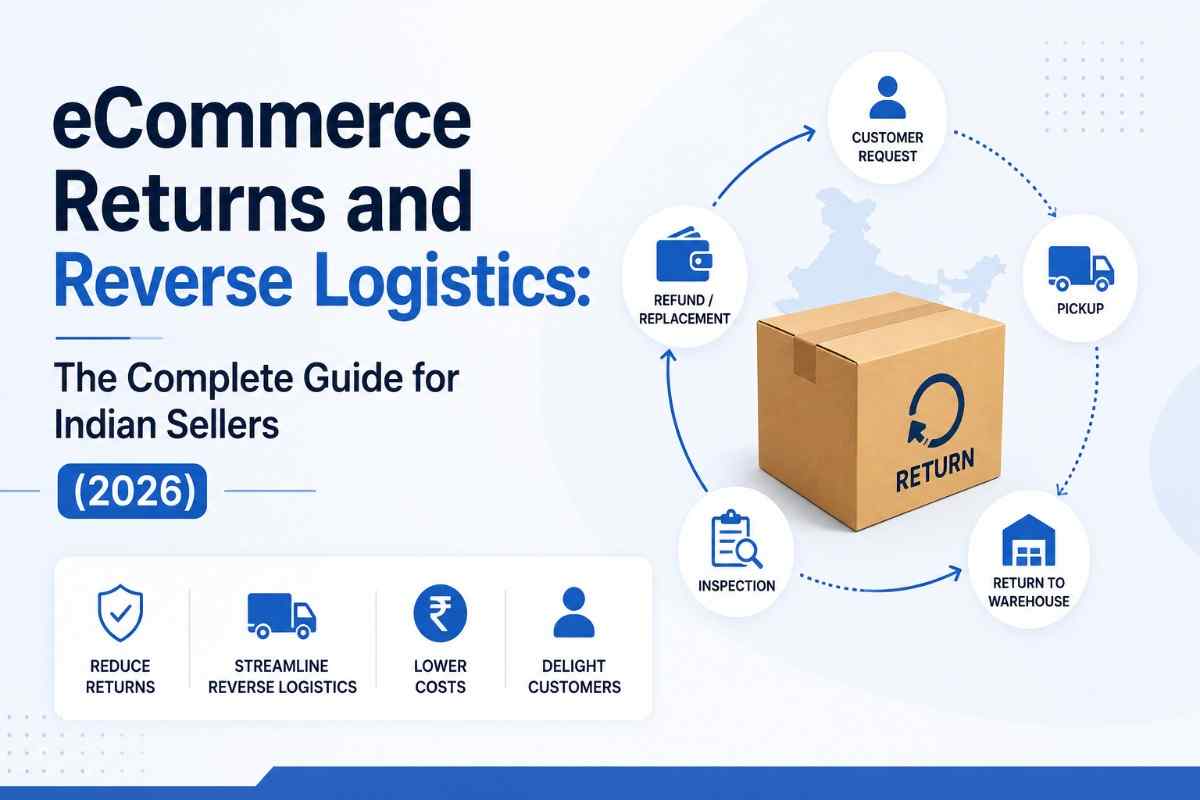
eCommerce returns and reverse logistics are the single most underestimated cost in an Indian seller's business. Most sellers track their forward shipping spend carefully—but the moment a customer clicks "Return," a second logistics operation begins running in reverse, costing 1.5x to 2x the price of the original shipment on a product that may never reach a paying customer again.
In India, this problem is larger than most markets. Return rates range from 15% to 35% depending on the category. COD orders alone generate an RTO rate of 20–40% in high-return segments like fashion and footwear. And with India's eCommerce market projected to reach $345 billion by 2030, every percentage point of unmanaged returns compounds into crores of lost margin at scale.
Returns are not a customer service problem. They are a margin problem, a logistics problem, and an inventory problem—all hitting at the same time. This guide covers everything Indian eCommerce sellers need to manage eCommerce returns and reverse logistics systematically: what it costs, why it happens by category, how RTO differs from customer returns, and the exact strategies that reduce losses and recover revenue from every return that comes back through your door.
Reverse logistics is everything that happens to a shipment after the customer decides not to keep it or after a courier fails to deliver it. It is the full backward journey of a product: from the customer back to the seller through inspection, restocking or disposal, and refund processing.
Customer-initiated returns: The customer received the product and wants to return it—wrong size, not as described, changed their mind, or defective item.
RTO (Return to Origin): The courier could not complete delivery—customer unavailable, refused COD, wrong address, or unserviceable pincode—and the parcel comes back to the seller undelivered.
These two types look similar on the surface but have completely different causes, costs, and solutions.
RTO (Return to Origin) — courier failure, not customer fault. Most expensive per-unit because you pay double freight and receive zero revenue.
Customer Return — Wrong Item Received — Packing or Inventory Error. Seller fault. Full refund + replacement cost.
Customer Return — Defective or Damaged Product — Quality Control or Transit Damage. Full refund + potential brand damage.
Customer Return — Not as Described — product page mismatch. Often a content or photography problem, not a logistics one.
Customer Return — Size or Fit Issues — dominant in fashion. Often a sizing standardization problem.
Customer returns—changed mind/impulse purchase—are especially high for COD orders where buyers face no financial risk at checkout.
Bracketing Returns—The customer orders multiple variants, intending to keep one and return the rest. Growing behavior in fashion and footwear.
.jpeg)
For RTO specifically, steps 1–5 are handled by the courier—the seller's first touchpoint is step 6 onward.
This is a commonly overlooked connection. A tight return policy reduces returns but kills conversion. A loose policy boosts conversion but invites returns. The balance is the insight.
Key data point: 77% of online shoppers check a brand's return policy before buying — meaning your return policy is actually a conversion tool, not just an operational document.
RTO is the most expensive and most preventable return type for Indian sellers.
Address verification before dispatch: Confirm pincode serviceability. Flag incomplete or undeliverable addresses before the label is printed, not after the first delivery attempt fails.
NDR (Non-Delivery Report) management: When a delivery attempt fails, the courier issues an NDR. Active NDR management — calling the customer, rescheduling delivery, updating the address — can reduce avoidable RTO by 8 to 15 percentage points within the first month.
COD risk management: Restrict COD by pincode, order value, or customer history. Offer a small prepaid discount (₹30–₹50) to shift the order mix. Use automated COD risk scoring before shipments go out.
Delivery-day communication: SMS or WhatsApp the customer on the day of delivery so they are prepared to receive it. Reduces missed-delivery RTOs significantly.
Courier routing by pincode performance: Route COD-heavy orders to the courier with the strongest last-mile performance in that specific pincode—not just the cheapest courier overall.
OTP-verified delivery: Eliminates Fake delivery marks that generate false RTOs.
Where RTO is a logistics problem, customer returns are often a product or content problem. Different solutions entirely.
Accurate product descriptions and images: 22% of items are returned because the product looked different from what was shown on the product page. Better photography and honest descriptions directly reduce this return segment.
Sizing guides and fit tools: In fashion, sizing inconsistency is the dominant return driver. Brand-specific size charts, fit guides, and customer review integration reduce size-related returns.
Packaging quality: Damaged-in-transit returns are entirely avoidable with category-appropriate packaging. For fragile goods, the packaging investment almost always costs less than the reverse logistics and refund cost of a damaged return.
Quality control before dispatch: A pre-dispatch QC step — checking items against the order before packing — eliminates wrong-item and defective-item returns that are caused by warehouse errors.
Limit bracketing incentives: Avoid promotions that explicitly encourage ordering multiple sizes or variants. Free returns policies, while conversion-boosting, significantly increase bracketing behavior.
Research shows that 67% of customers avoid future purchases from a brand after a poor return experience—which makes returns management a direct driver of repeat purchase rates, not just a cost center.
The brands winning on returns in India are doing three things differently:
Self-service return initiation: Customers can initiate a return in a few clicks without calling support. Reduces friction and support volume simultaneously.
Proactive communication: Status updates at every stage—return pickup scheduled, item in transit, inspection complete, refund initiated, refund credited. This is the same proactive communication logic that reduces WISMO tickets on forward deliveries.
Fast refund processing: Sellers who process returns within 48 hours recover 15–25% more revenue from returned inventory than those who take 7 or more days — and customers who receive fast refunds are significantly more likely to reorder. Speed is a retention tool.
This is where margin is either recovered or lost. Most sellers focus entirely on the logistics of getting the item back and underinvest in what happens to it afterward.
Grade A—Resaleable as new: The item is unopened, undamaged, and in original packaging. Restock immediately. Every day the item sits uninspected is a day of potential revenue lost.
Grade B — Resaleable with minor issues: The item has been opened or has cosmetic damage but is fully functional. Options: relist at a discount, sell through a clearance channel, or bundle.
Grade C — Refurbishment required: The item is functional but needs cleaning, repackaging, or minor repair before it can be sold. Cost-benefit depends on the category and the item's value.
Grade D—Not Resaleable: Defective, damaged beyond repair, or a hygiene category item that cannot be restocked. Options: liquidate in bulk, recycle, or write off.
Returns management platforms: Automate return request intake, reason capture, courier scheduling, and status communication.
NDR management dashboards: Real-time visibility into failed delivery attempts with automated customer outreach and redelivery scheduling.
Inventory management integration: Ensure that returned stock updates inventory counts in real time so it is immediately available for resale.
Multi-carrier aggregator: Reverse pickups should be bookable through the same platform as forward shipments—not a separate manual process with each carrier.
Analytics and reporting: Return rate by SKU, by courier, by pincode, and by reason code. Without this data, you cannot identify where systemic problems are concentrated.
Each marketplace has different return windows, conditions, and seller protections. Cover:
Amazon India: A-to-Z return policy, SAFE-T claims for seller protection, category-specific return windows (7–30 days), seller-funded vs. Amazon-funded returns.
Flipkart: Seller Protection Fund, return window by category, quality check at the return center, how to dispute false return reasons.
Meesho: Return policy nuances, how RTO is handled, and what evidence sellers need to dispute fraudulent returns.
Your Own D2C Website: Full control over return policy — and full responsibility. Recommended policy elements, how to enforce conditions, and when to make exceptions.
An important topic most sellers underestimate.
Empty box fraud: Customer returns an empty box or a different (lower-value) item and claims a refund for the original product.
Used-item fraud: Customer uses the product and returns it claiming it was defective on arrival.
Wardrobing: Customer purchases a high-value item (clothing or electronics) for a specific occasion, uses it, and returns it within the return window.
How to protect yourself: Pre-dispatch photography, tamper-evident packaging, weight verification at the return center, video evidence of quality inspection, and clear policy language on "used item" returns.
Multi-Carrier Shipping & Reverse Logistics Platforms:
Managing reverse pickups across multiple courier partners can quickly become complex as order volumes grow. Platforms like Shipmozo help sellers centralize both forward and reverse logistics operations through a single dashboard. This enables businesses to schedule reverse pickups, track return shipments, manage NDRs, and monitor return-related performance metrics without coordinating separately with multiple courier providers.
Analytics & Return Intelligence:
Modern shipping platforms provide detailed insights into return trends by SKU, category, courier partner, and pincode. With Shipmozo's shipping intelligence and courier allocation capabilities, sellers can identify high-RTO regions, optimize courier selection, and make data-driven decisions to reduce both return rates and logistics costs over time.
Returns and reverse logistics are not a background operational problem. In Indian eCommerce in 2026, they are one of the primary levers that separates profitable sellers from sellers who are growing their revenue while quietly destroying their margins.
The sellers who build systematic reverse logistics—with clear return policies, active NDR management, fast inspection cycles, and centralized visibility across couriers—do three things better than the rest: they lose less money on each return, they recover more value from returned inventory, and they convert more customers because buyers trust that returns will be handled well.
──────────────────────────────────────────────
A return policy is the customer-facing rules about what can be returned and when. Reverse logistics is the operational system that physically handles the return—pickup, transit, inspection, restocking, and refund processing. One is a policy document. The other is an operational infrastructure.
RTO stands for Return to Origin. It happens when a courier cannot complete delivery and sends the parcel back to the seller. The most common causes in India are customer unavailability at delivery time, COD refusal at the doorstep, incorrect or incomplete delivery address, and courier inability to service the pincode. RTO is not the same as a customer return—the customer never received or accepted the product.
Reverse logistics involves more steps than forward shipping: customer communication, reverse pickup scheduling, transit back to the seller, quality inspection, inventory update, and refund processing. Each step has a cost. Additionally, reverse shipments are less operationally efficient than forward deliveries — they are dispersed pickups from individual customer addresses rather than consolidated dispatches from a warehouse. Industry data shows reverse logistics costs Indian sellers 1.5x to 2x the cost of the original forward shipment.
The most effective interventions are active NDR management (following up on failed delivery attempts immediately), delivery-day WhatsApp/SMS notifications so customers are prepared, restricting COD for high-risk pincodes or order values above a threshold, offering a prepaid discount to shift order mix, and routing COD orders to couriers with the strongest last-mile performance in the relevant pincode.
It depends on the category. For fashion and footwear, 7–15 days is standard across major marketplaces. For electronics, 7–10 days is typical with an open-box check condition. For your own D2C store, a 7-day window with clear condition requirements (unused, original packaging, tags attached) balances customer trust against return abuse. A return window that is too short hurts conversion more than it saves in returns.
On your own D2C website, you have full authority to define your return policy—including making items non-returnable (perishables, personalized products, and hygiene items). However, Indian consumer protection laws (Consumer Protection Act 2019) give customers rights in the case of defective goods or goods not as described—these cannot be waived by your policy. If you sell on marketplaces like Amazon or Flipkart, their return policy overrides yours, and you must comply with their platform rules.
The most effective deterrents are mandatory pre-dispatch photography and weight logging, tamper-evident packaging with unique seals, video recording of quality inspection when the item arrives back, a clear policy requiring original packaging and tags, and weight verification at the return center to catch empty-box fraud. For high-value repeat offenders, most platforms allow sellers to flag accounts for review.
Options include bulk liquidation to secondary market resellers, refurbishment and resale on dedicated refurb channels, donation (for eligible categories), recycling through e-waste or textile recycling programs, and write-off as a tax-deductible loss. The right choice depends on the item's value, category, and condition. The worst option is letting unsaleable returned inventory sit in warehouse space, consuming storage costs with no resolution plan.
Within 48 hours of receipt is the benchmark. Sellers who inspect, grade, and act on returned inventory within 48 hours recover 15–25% more revenue than those who take 7 or more days—because grade A inventory gets back into the sales pipeline faster, and refunds processed quickly drive significantly higher repeat purchase rates.
Yes, directly. 77% of online shoppers check the return policy before completing a purchase. A clear, fair, and easy-to-find return policy reduces the hesitation that prevents first-time buyers from converting. The risk is that a very liberal policy (free returns, 30-day window, no conditions) also increases return rates—particularly bracketing behavior in fashion.


Diveya Mehta is a marketing and content specialist with 3+ years of experience, currently working with Shipmozo. With 1 year of hands-on experience in logistics, she creates practical, insight-driven content focused on shipping, courier performance, and eCommerce growth.





.webp)