

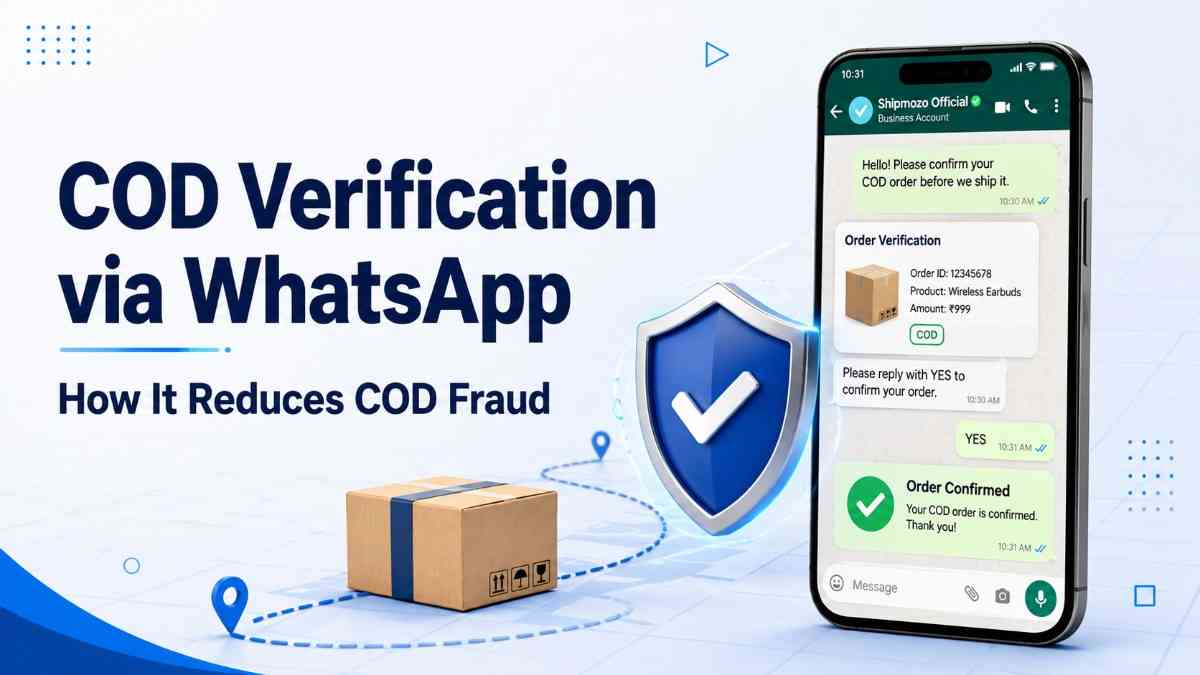
Cash on delivery remains important for ecommerce businesses because many shoppers prefer paying when the parcel arrives. It also creates a clear operational risk: an order can be placed without any payment commitment, then refused, ignored or falsely submitted. This is where cod verification whatsapp workflows can help. A business can send the buyer a WhatsApp message asking them to confirm the order before dispatch.
The objective is not to create friction for every customer. It is to separate genuine COD intent from incomplete, accidental or suspicious orders while the shipment is still at the warehouse. A confirmation message can validate the mobile number, order details, delivery address and willingness to accept the parcel. Orders that remain unconfirmed can be reviewed instead of being released automatically.
For D2C brands, manufacturers selling online and ecommerce sellers handling a high volume of prepaid and COD orders, this small control point can improve order-quality decisions. It can also give customer support teams a documented response when a buyer later claims that an order was placed by mistake.
Verification is not a replacement for address validation, courier selection or delivery follow-up. It works best as one layer in a broader process that includes accurate order data, shipment visibility, NDR handling and sensible COD policies.
For background, businesses can also review this guide to COD fraud in India before designing their own controls.
COD verification via WhatsApp is a pre-dispatch confirmation process in which an ecommerce business contacts a customer on WhatsApp to verify that the cash-on-delivery order is genuine and still required. The message generally includes the order number, product name or summary, payable amount and an action such as “Confirm” or “Cancel.”
A confirmation may be collected through a button, a reply keyword or another structured response. The exact method depends on the business’s technology setup and WhatsApp communication process. The important operational principle is that the response should be recorded against the order, not left only in an agent’s chat history.
This workflow should not be confused with payment collection. The customer is not paying through the confirmation message. They are confirming their intent to accept the package and pay the stated COD amount at delivery.
A WhatsApp confirmation can expose obvious issues such as a buyer denying the order, a wrong phone number, an accidental duplicate or a customer saying that the order was never placed. It cannot prove that the person will definitely be available at delivery, nor can it eliminate every form of fraud. A confirmed order can still result in refusal, an incorrect address or a delivery dispute.
COD fraud affects more than the invoice value of one parcel. When a shipment is refused or repeatedly missed, the seller may lose the forward shipping cost, incur return movement charges, spend staff time on follow-up and put inventory through an avoidable logistics cycle. The effect becomes more visible when margins are narrow or products are bulky, fragile, customised or difficult to resell.
Unverified COD orders also distort operational planning. A warehouse may reserve stock, print a label, pack the item and hand it over to a courier before discovering that the buyer never intended to accept it. This adds work at every stage and can make genuine orders wait longer during busy periods.
The process is particularly useful for businesses that do not want to remove COD entirely. COD is a conversion option for shoppers who are cautious about online payment, but it should be managed with the same discipline as any other fulfilment input.
It also supports a more informed approach to reducing RTO in ecommerce. RTO, or return to origin, occurs when a parcel comes back to the seller after unsuccessful delivery. Verification addresses the order-intent stage, while delivery and NDR processes address problems that appear later.
A confirmation workflow creates value by improving the quality of decisions made before dispatch. It should be measured as an operational control, not promoted as a complete fraud-prevention system. The benefits depend on message delivery, customer response rates, team follow-up and the accuracy of the rules used to hold or cancel orders.
The strongest benefit comes from combining confirmation with accurate customer communication. A vague message that does not show the amount or product may generate confusion. A clear message that gives the customer one simple action is easier to understand and more useful to the operations team.
Before launching the process, define what the business wants to prevent and what decision should follow each customer response. Without these rules, staff may collect confirmations but still dispatch every order automatically. The workflow should connect the customer message to a practical fulfilment action.
A practical message can say: “Your order #12345 for [product] worth ₹[amount] is placed with Cash on Delivery. Please confirm that you want us to dispatch it. Reply CONFIRM to proceed or CANCEL if you did not place this order.” The seller should adapt the wording to its approved communication process and ensure that the customer can identify the order.
Do not describe confirmation as a payment request. Customers should understand that payment is still due to the delivery executive according to the selected COD process. Clear wording reduces the risk of phishing concerns and improves trust.
Verification works when it is designed around customer behaviour and warehouse realities. The goal is to remove doubtful orders without creating unnecessary delays for genuine customers. Start with a controlled segment, review the results and make changes based on operational evidence rather than assumptions.
Track the number of COD orders sent for confirmation, confirmed orders, cancellations, non-responses, manual reviews, dispatched orders, delivered orders and RTOs. Also monitor customer complaints and dispatch delays. A falling RTO rate alone does not prove that the workflow is working if genuine orders are being cancelled or delayed.
For the post-dispatch stage, an integrated shipment tracking process helps support teams see whether a verified order is in transit, out for delivery or facing a delivery exception.
Most problems occur when businesses treat WhatsApp confirmation as a standalone automation instead of part of order governance. The message is only useful if the response changes what happens next and if the data remains available to the people responsible for fulfilment.
A mature workflow also includes a clear escalation policy. Staff should know when to cancel, when to call, when to edit an order and when to return it to the customer for a fresh checkout. Consistency matters because different decisions by different agents make the results difficult to measure.
WhatsApp is one option within a broader confirmation strategy. The right method depends on the customer’s contact details, order value, technology stack and the speed required before dispatch.
Many businesses use a layered model: automated WhatsApp confirmation for selected COD orders, followed by a manual call for unresolved high-risk cases. This balances scale with human judgement and avoids applying the most expensive verification method to every order.
COD verification via WhatsApp can help ecommerce sellers identify cancelled, accidental and suspicious orders before they consume packing and shipping resources. Its value comes from connecting the customer’s response to a defined dispatch decision, retaining a clear order record and continuing to monitor delivery after handover.
Shipmozo supports businesses managing COD Confirmation, B2C Shipping and multi-courier operations, while tools such as NDR Management help teams act when a genuine shipment still faces a delivery exception. These capabilities can be used together to create a more controlled COD process without removing the payment option that many customers prefer.
Review your order rules, start with a practical verification segment and measure both fraud signals and customer experience before expanding the workflow. Talk to an Expert
It is a pre-dispatch process in which an ecommerce business sends a WhatsApp message containing order details and asks the customer to confirm or cancel a COD order. Confirmed orders can proceed, while cancelled, expired or unclear orders can be held for review.
No. It can identify some fake, accidental and unauthorised orders before dispatch, but it cannot guarantee that a confirmed customer will accept the parcel. Address checks, courier monitoring and NDR handling remain necessary.
The message should identify the brand, show the order reference, provide a product summary and state the COD amount. It should give clear confirm and cancel actions and should not request passwords, card details, bank credentials or unnecessary sensitive information.
Not necessarily. A business can verify every order or use risk-based rules for high-value orders, new customers, duplicate patterns, repeat RTO cases and incomplete addresses. Customers without WhatsApp should have a manual or alternate confirmation route.
It can prevent some orders from being dispatched when the buyer denies the order, identifies a duplicate or no longer wants the parcel. It does not resolve every delivery failure, so post-dispatch NDR and shipment tracking processes are still required.
The business should define a response window and then hold, cancel or manually review the order according to its risk policy. A non-response is not automatic proof of fraud because the customer may have missed the message or may not use WhatsApp.


Nisshdeep Kaur is a logistics-focused content specialist with 5+ years of experience in eCommerce shipping and delivery optimization. She shares actionable insights to help businesses improve delivery success rates and scale efficiently with platforms like Shipmozo.





.webp)