

If you're running an eCommerce business in India today, you already know that shipping is not just a backend operation. It's a direct reflection of your brand. A delayed order, a failed delivery, or a confusing return process can cost you a customer — possibly forever.
Yet most growing brands still rely on a single courier partner. And that single decision quietly drains their margins, increases their RTO rate, and limits their ability to scale.
This is exactly why multi-courier shipping aggregators have become a non-negotiable tool for serious eCommerce brands in 2025 and beyond. Platforms like Shipmozo are built to solve this problem — not just theoretically, but at a practical, order-by-order level.
Let's break down everything you need to know.
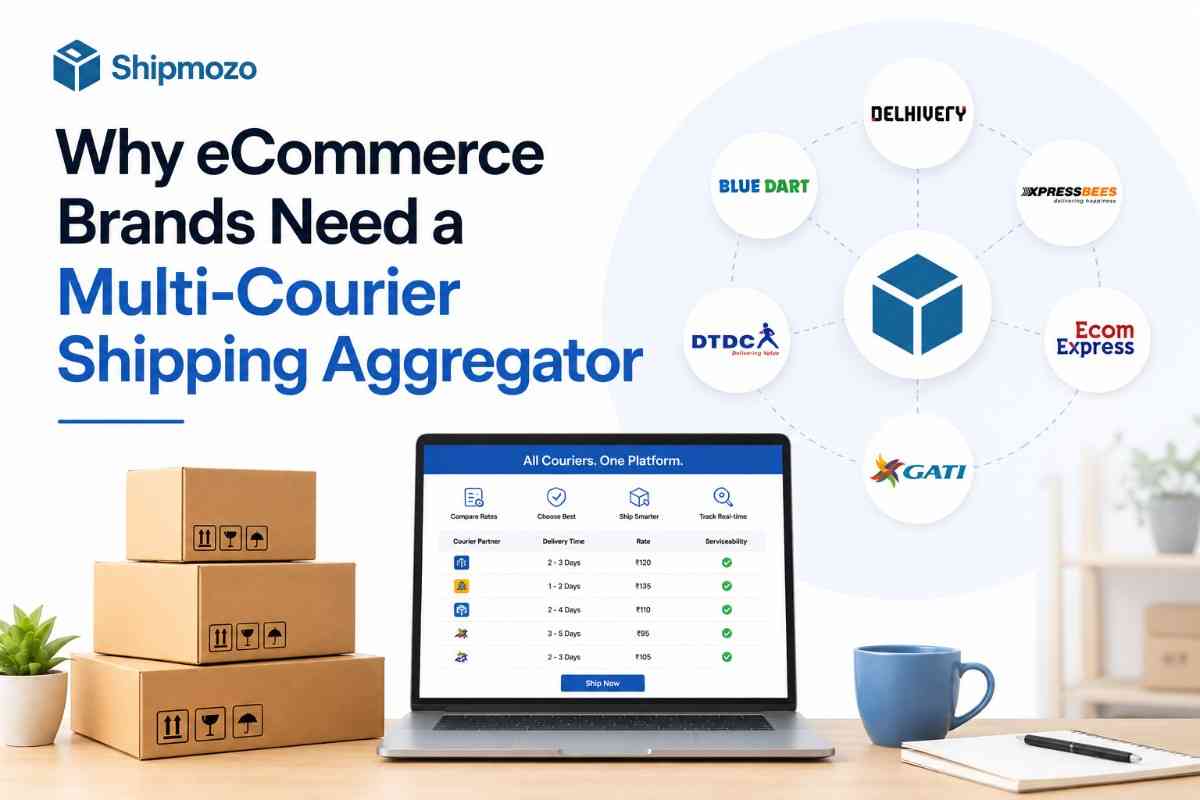
A multi-courier shipping aggregator is a technology platform that connects your eCommerce store to multiple courier partners through a single dashboard. Instead of managing separate accounts, rate cards, and tracking systems for every courier, you get one unified interface to compare, book, track, and manage all your shipments.
Think of it as a control center for your entire logistics operation.
With a platform like Shipmozo, you can compare courier rates in real time, select the best courier for each order based on cost, speed, or delivery performance, generate shipping labels in bulk, track all shipments in one place, manage COD settlements, and handle returns — all without switching between multiple tools or tabs.
Here's what most sellers don't track closely enough:
RTO (Return to Origin) rates in India average between 20–35%. That means for every 10 orders you ship, 2 to 3 come back. And every returned order costs you the forward shipping fee, reverse shipping fee, repackaging time, and often a lost customer.
Beyond RTO, there are other hidden costs to sticking with a single courier:
No price leverage. When you're locked into one courier, you accept their rates without negotiation power. A multi-courier setup means you're always routing to the most cost-efficient option per shipment.
Geographic blind spots. No single courier has equal strength across all pin codes. A courier that delivers excellently in metro cities might consistently fail in Tier 2 or rural areas. Routing every order through one partner means accepting this inconsistency.
Zero fallback. If your courier partner faces operational disruptions — and they do, especially during peak sale seasons — you have no backup. Your orders sit. Your customers complain. Your brand suffers.
Cash flow delays. COD remittance cycles with a single courier can stretch 7–10 days, directly impacting your working capital and ability to reorder inventory.
A multi-courier approach fixes all of the above systematically.
When you can compare rates across multiple courier partners in real time, you stop overpaying. The math computes fast.
Saving ₹15–₹30 per order might sound small. But at 1,000 orders per month, that's ₹15,000–₹30,000 saved every single month—just on shipping costs. That's capital you can reinvest into inventory, marketing, or your team.
Shipmozo lets you compare courier rates per pin code and per weight slab before booking, so every decision is data-backed and cost-conscious.
Not all orders are equal. A prepaid order to a metro city has a different optimal courier than a COD order going to a remote district in UP.
Shipmozo's AI courier allocation engine analyzes cost, serviceability, and historical delivery performance for each order and recommends the most suitable courier automatically. You're not guessing — you're using real data to make the call.
Shipmozo connects you to 27+ courier partners covering 29,000+ serviceable pin codes across India, including remote and rural areas. For brands that sell pan-India, this kind of reach through a single platform is a genuine competitive advantage.
You don't have to tell a customer "we don't deliver to your location." You find a courier that does.
NDR (Non-Delivery Report) management is where most brands lose the most money quietly. When a delivery fails, what happens next determines whether that order converts or comes back as an RTO.
Shipmozo has structured NDR workflows with 3–5 reattempt handling, free NDR calling, and RTO revoke support. The goal is simple: recover as many failed deliveries as possible before they become returns.
Reducing your RTO rate even by 5% at scale translates into tens of thousands of rupees saved monthly.
COD orders are a large portion of revenue for most Indian eCommerce brands. But long remittance cycles create cash flow uncertainty.
Shipmozo offers faster COD remittance (D+1/D+2 where applicable) and a transparent COD dashboard that shows you exactly what's coming in, when, and with what deductions. No more manual reconciliation. No more guessing when your money arrives.
Every shipment is a customer touchpoint. Shipmozo gives you a branded tracking page so customers follow their order under your brand identity — not a generic courier interface. Automated WhatsApp, SMS, and email notifications keep customers updated proactively, which directly reduces WISMO ("Where Is My Order?") queries to your support team.
Fewer support tickets. Happier customers. Stronger brand perception.
Whether you're on Shopify, WooCommerce, Magento, or another major eCommerce platform, Shipmozo integrates directly. Your orders sync automatically, eliminating manual data entry and the errors that come with it.
Bulk label generation, invoice customization, and pickup scheduling all happen from the same dashboard.
One of the most practical advantages of Shipmozo is its pricing model. You pay for shipping — not for using the dashboard. No subscription fees, no hidden charges for accessing features. For brands watching their unit economics closely, this matters
The short answer: any eCommerce brand that ships more than 50 orders a day and wants to scale without logistics becoming a bottleneck.
More specifically, a shipping aggregator like Shipmozo is the right move if you're a D2C brand growing faster than your current logistics setup can handle, a marketplace seller managing orders from multiple channels, a business with a mix of B2C and B2B shipments that need different handling, or a brand with COD orders where cash flow management is a regular challenge.
If you're just starting out at very low volumes, a single courier may be manageable. But the moment logistics starts costing you customers or eating your margins, it's time to upgrade your infrastructure.
Shipmozo is not just a rate comparison tool. It's a full-stack shipping operations platform built specifically for the realities of Indian eCommerce logistics.
Here's what makes it different from simply signing up with multiple couriers separately:
Everything is in one place. Booking, tracking, NDR management, COD reconciliation, returns, analytics — one dashboard, one login, one workflow.
You get a dedicated personal account manager for faster issue resolution. Escalations, courier coordination, and NDR follow-ups happen through a real person who knows your account.
The analytics dashboard shows you delivery success rates, delay trends, and RTO patterns by courier and lane. You can make data-backed decisions about which couriers to use for which regions—and adjust as performance changes.
For international shipping, Shipmozo supports 195+ countries with automated export documentation and multi-carrier tracking. For B2B and heavy dispatch, there's a dedicated LTL workflow with ePOD support and structured weight management to avoid billing disputes.
To put it plainly:
These aren't hypothetical numbers. They reflect the real cost structure of running eCommerce logistics in India — and the real opportunity that a smarter shipping setup creates.
A multi-courier shipping aggregator is a platform that connects eCommerce businesses to multiple courier partners from a single dashboard. Instead of managing separate accounts and rate cards with each courier, you compare, book, track, and manage all shipments from one place. Shipmozo is one such platform, giving you access to 27+ courier partners across 29,000+ pin codes in India.
Working with a single courier limits your flexibility, negotiating power, and geographic reach. No single courier performs equally well across all pin codes or order types. When that courier faces delays or operational issues—which happens regularly during festive season peaks—you have no backup. A multi-courier aggregator like Shipmozo lets you route each order to the best available courier at that moment.
RTO reduction happens through smarter courier selection upfront and proactive NDR management after a failed delivery attempt. Shipmozo's AI allocation engine selects couriers based on past delivery performance for specific pin codes, reducing first-attempt failures. When a delivery does fail, structured reattempt workflows, NDR calling, and RTO revoke support help recover the order before it becomes a return.
Yes, though the impact is most significant once you're shipping 50+ orders per day. At smaller volumes, the cost savings and operational efficiency gains are still real, but they compound more powerfully at scale. Shipmozo has no platform fee, so even early-stage sellers can start using it without adding overhead costs.
Shipmozo offers faster COD remittance cycles (D+1/D+2, where applicable) compared to the 7–10 day cycles typical of single courier arrangements. The COD dashboard gives you full visibility into settlement timelines, deductions, and payout status—so you can plan your cash flow with accuracy rather than uncertainty.
Yes. Shipmozo integrates directly with major platforms, including Shopify, WooCommerce, and Magento. Your orders sync automatically, labels are generated in bulk, and shipment data flows back into your store without manual entry. This eliminates a significant source of errors in high-volume operations.
Shipmozo provides priority support for escalations, including lost shipments, severe delays, and courier coordination issues. You get a dedicated personal account manager who handles these cases directly rather than routing you through generic support queues.
Yes. Shipmozo supports shipping to 195+ countries with automated export documentation (invoice, packing list, and airway bill); duty-free DDP options where available; and multi-carrier tracking—all from the same dashboard you use for domestic orders.
Shipmozo's AI allocation engine evaluates each order against multiple variables—destination pin code, weight, COD vs. prepaid, courier serviceability, and historical delivery performance on that lane—and recommends the optimal courier automatically. You can override the recommendation, but for most sellers, letting the system optimize allocation consistently reduces costs and improves delivery rates over time.
No. Shipmozo follows a zero-platform-fee model. You pay for the shipping itself — the actual courier charges — and nothing extra for accessing the dashboard, features, or support. This makes it straightforward to evaluate ROI without any fixed cost overhead.
Shipping is where your brand promise either holds up or falls apart. Customers don't see your warehouse operations, your sourcing effort, or your marketing strategy. They see whether their order arrived on time, in good condition, with clear communication along the way.
A multi-courier shipping aggregator like Shipmozo gives you the infrastructure to deliver on that promise consistently — at lower cost, with better visibility, and with the flexibility to scale without logistics becoming the constraint.
If you're still managing shipping through a single courier or a manual setup, the cost of that approach is already showing up in your RTO rate, your support ticket volume, and your margins. The question isn't whether to switch—it's how soon.


Ankit Debnath is a sales and marketing professional with 4+ years of experience in the logistics industry, specializing in managing B2B and B2C key accounts. At Shipmozo, he focuses on driving growth through client acquisition, lead generation, and strategic relationship management. Passionate about building strong client relationships and delivering results, he brings a practical, growth-oriented approach to logistics and business expansion.





.webp)