

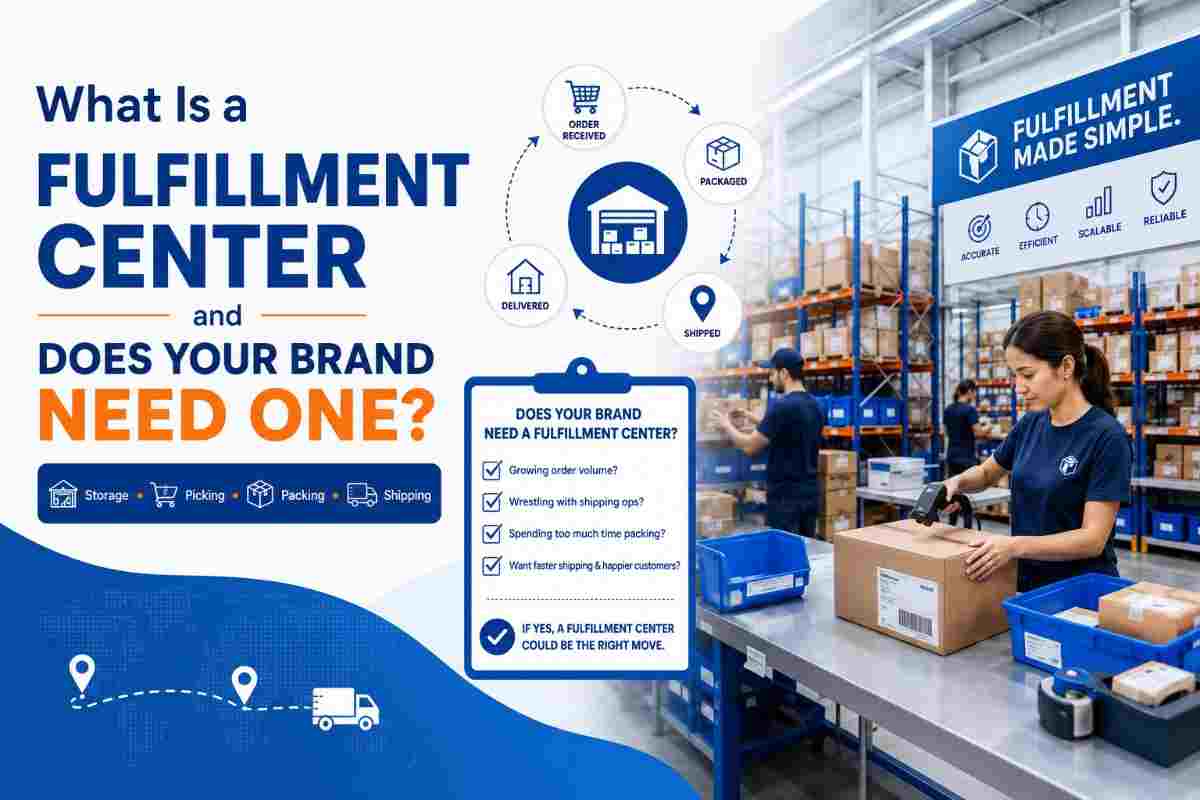
What is a fulfillment center? It is a facility that stores inventory and manages the operational steps between receiving an order and delivering it to the customer. These steps usually include inventory storage, picking products, packing parcels, generating shipping labels and handing shipments to courier or transport partners.
For a small brand, these activities may begin in a home, office, shop or rented room. As order volumes increase, self-fulfillment can create avoidable pressure. Teams spend more time locating stock, correcting packing errors, coordinating pickups and responding to delivery queries. Storage also becomes harder when the business sells through multiple channels or carries many stock-keeping units.
A fulfillment center can take over some or all of this work. The right arrangement depends on your order volume, product type, delivery geography, inventory accuracy and desired level of control. It is not automatically the best choice for every seller. This guide explains the operating model, its benefits and limitations, and the practical signals that show when a growing brand should consider one.
A fulfillment center is a logistics facility designed to process orders on behalf of a business. Unlike a basic warehouse that may focus mainly on storage, it is organised around the complete order cycle. Inventory enters the facility, is recorded and put away, then is retrieved when an order is received. The item is packed, labelled, handed to a delivery partner and tracked until the shipment reaches the buyer.
The facility may be operated by the brand itself or by a third-party logistics provider, commonly called a 3PL. A 3PL provides outsourced logistics services such as storage, order processing, transportation coordination and returns handling. You can learn more about the model in this guide to third-party logistics.
The facility does not replace the carrier. It prepares and dispatches the order, while the carrier performs transportation and delivery. A shipping platform can connect the fulfillment operation with multiple delivery partners, order channels and tracking workflows.
Order fulfillment is often treated as a back-office task until it starts affecting customer experience. A product can be excellent, but incorrect items, late dispatches, damaged packaging or inaccurate inventory can still lead to complaints, cancellations and returns. The operational challenge becomes more visible when sales grow faster than the team, space and processes supporting them.
Self-fulfillment can work well when the catalogue is small, demand is predictable and orders are manageable. It gives the seller direct control and avoids the complexity of moving inventory to an external operator. However, the model can become inefficient when packing consumes productive hours or when the brand needs to ship from several locations.
Inventory placement also influences delivery performance. A facility closer to major demand zones may reduce the distance a parcel travels, but this needs to be balanced against storage charges, transfer costs and stock fragmentation. Splitting inventory across locations without reliable forecasting can create stockouts in one facility while excess stock sits in another.
Brands handling growing operational complexity may benefit from reviewing this guide on multi-channel order fulfillment before choosing an operating model.
Outsourcing fulfillment can provide capacity and process discipline, but the results depend on provider capability, service terms and the quality of your inventory data. A facility is useful when it solves a specific operational constraint rather than being selected only because the business is growing.
External facilities are built for organised inventory storage. They generally use defined locations, receiving procedures and stock movement records. This can be more practical than adding shelves, rent and labour to a retail outlet or office. Storage requirements should still be reviewed carefully for oversized, fragile, regulated or seasonal goods.
Fulfillment teams focus on receiving, picking and packing throughout the day. Standard operating procedures can make dispatch more consistent than an improvised setup where employees switch between sales, customer service and shipping tasks.
A capable operator may have the labour and space to handle promotional campaigns or seasonal demand. You should confirm how peak capacity is allocated, what cutoff times apply and how exceptions are managed before committing inventory.
Regular cycle counts, scan-based movements and system integrations can make stock positions easier to monitor. Accurate inventory is important because overselling creates cancellations, while excess stock ties up working capital.
A fulfillment operation can be connected with surface, air, B2B, B2C, domestic and international shipping workflows. Using multiple carriers or modes can help match the service to the parcel, destination and customer promise. Shipmozo’s multi-courier shipping resources explain this model in greater detail.
When routine dispatch work is delegated, the internal team can focus on product development, merchandising, customer retention and demand generation. This does not remove accountability; the brand still needs to monitor inventory, service levels, claims and customer communications.
The exact workflow varies by provider and product category, but most facilities follow a repeatable sequence. Before transferring stock, document each stage and decide who owns the information, cost and resolution when an exception occurs.
A connected workflow is especially important when order data moves between a store, warehouse and delivery network. Shipmozo’s shipping integration guide covers the systems and workflows involved.
The provider’s warehouse location is only one part of the decision. A good evaluation examines process quality, data controls, commercial terms and the operator’s ability to handle your specific products. Ask for a practical walkthrough instead of relying only on a sales presentation.
Calculate the full cost of self-fulfillment, including rent allocation, wages, packaging, equipment, software, dispatch labour, error handling and returns. Then compare it with storage, receiving, pick-and-pack, packaging, transport and additional service charges from an external provider.
Document receiving timelines, order cutoffs, dispatch windows, inventory accuracy expectations, return processing timelines and escalation contacts. Avoid vague commitments such as “fast processing.” Specify how performance will be measured and reported.
Every SKU should have a clear code, description, dimensions, weight, product image if required, handling instruction and packaging requirement. Incorrect weight or dimensions can lead to billing disputes and unsuitable carrier allocation.
Use sales history and demand forecasts to determine which products should be stored where. Avoid placing all stock in multiple facilities before you understand transfer costs, replenishment lead times and regional demand.
Compare system inventory with physical counts on a planned schedule. Investigate adjustments caused by picking errors, damages, samples, cancellations, returns and unrecorded transfers. A warehouse management process should make every movement explainable; Shipmozo’s overview of warehouse management provides useful operational context.
Decide whether returned items are restocked, quarantined, repaired, exchanged or written off. Define inspection criteria and customer communication. Reverse logistics is not simply the forward process in reverse, because product condition and resale eligibility must be assessed.
Track order accuracy, inventory variance, dispatch timeliness, damage incidents, NDR volume, return turnaround time and shipping exceptions. Review these metrics by SKU, channel, location and carrier where possible. Operational data helps identify whether the issue is storage, packing, transport or customer information.
Many fulfillment problems begin before the first parcel is picked. Brands can reduce disruption by documenting assumptions and testing the process with a limited stock transfer or pilot batch. The following mistakes are common when businesses move too quickly.
The lowest storage rate may not produce the lowest total cost. Receiving fees, pick charges, packaging, minimum monthly commitments, account management, return processing, relabelling and special handling can materially change the economics. Compare the complete cost per shipped order.
Cosmetics, food, apparel, electronics, fragile goods and bulky products have different storage and packaging needs. Confirm whether the operator has appropriate space, materials, security controls and trained staff for your catalogue.
If opening stock is wrong, every downstream report becomes unreliable. Count cartons and units, reconcile discrepancies and agree on the format for receiving reports before the inventory leaves your premises.
A provider may dispatch forward orders well but lack a robust returns process. Confirm who receives return requests, how labels are generated, how inspections are recorded and when usable stock becomes available again. Shipmozo’s guide to reverse logistics explains why this flow needs separate attention.
A fulfillment center controls preparation and handover, not every movement after pickup. Delivery depends on destination, carrier network, weather, public disruptions, serviceability and customer availability. Communicate realistic dispatch and delivery expectations rather than presenting an internal cutoff as a delivery guarantee.
Keep documented backup procedures for system downtime, carrier pickup failures, stock discrepancies and urgent orders. Establish escalation contacts and decide which orders receive priority when capacity is temporarily constrained.
Integrations can move information quickly, but they cannot correct inconsistent SKU codes, poor packaging standards or incomplete addresses on their own. Technology should support a tested operating process, not substitute for one.
These terms are related but not identical. Understanding the difference helps a brand compare providers accurately and avoid paying for services it does not need.
A fulfillment center can be operated by a 3PL, but not every 3PL offers the same depth of fulfillment services. Some specialise in pallet storage and B2B distribution, while others are designed for individual ecommerce parcels. Match the operating model to your order profile, not just the label used by the provider.
What is a fulfillment center worth to your business depends on the operational problem it solves. Consider one when your team is spending a significant amount of time packing orders, your current space is limiting stock, errors are becoming more frequent or you need to support several sales channels without adding a large operations team.
It may be premature when order volume is low, products are highly customised, demand is irregular or the cost and control trade-off does not work. In those cases, improving SKU organisation, packaging standards, shipping software and carrier selection may be a better first step. Brands can review their readiness using these scaling logistics signals.
For a growing brand, the decision should be based on total fulfillment cost, customer service requirements, inventory complexity and expected growth. Start with a measurable pilot if possible. Compare dispatch accuracy, turnaround, damage rates, returns handling and total cost against your existing process before expanding the arrangement.
What is a fulfillment center? It is a specialised operation that stores products and manages the path from order receipt to dispatch, often including returns. It can help a growing brand improve process consistency and free internal teams from repetitive logistics work, but it should be selected after reviewing costs, control requirements, inventory readiness and product needs.
Shipmozo supports the delivery side of this operating model with B2C Shipping, B2B Logistics, Surface Shipping and Air Shipping services. These options can help businesses manage different shipment profiles after orders are ready for dispatch. Start Shipping Today
A fulfillment center is a logistics facility that stores inventory and processes customer orders. Its activities commonly include receiving stock, picking products, packing parcels, generating labels, dispatching shipments and processing returns.
Not exactly. A warehouse mainly provides storage, while a fulfillment center is organised around the complete order cycle, including picking, packing and dispatch. A 3PL may operate a fulfillment center and provide additional logistics services.
A brand should consider one when self-fulfillment is consuming too much time, storage is becoming difficult, order errors are increasing or the business needs to support multiple sales channels and larger demand without building a larger internal operations team.
The facility prepares and hands orders to a courier or freight partner. The delivery partner transports the parcel and completes last-mile delivery. A shipping platform can help coordinate carriers, modes and shipment tracking.
Many facilities handle standard ecommerce products, but requirements vary. Brands should confirm suitability for fragile, bulky, liquid, perishable, regulated, high-value or temperature-sensitive products before moving inventory.
Costs vary by storage space, inventory volume, receiving, picking, packing, packaging, shipping, returns, special handling and contractual minimums. Compare the complete cost per order with the cost of your current in-house process.


Kuldeep Karki is a Digital Marketing Manager at Shipmozo, specializing in performance marketing, SEO, and growth strategy. With over 6+ years of experience in digital marketing, he has worked extensively on scaling B2B and eCommerce brands through data-driven campaigns across Meta Ads and Google Ads.





.webp)