

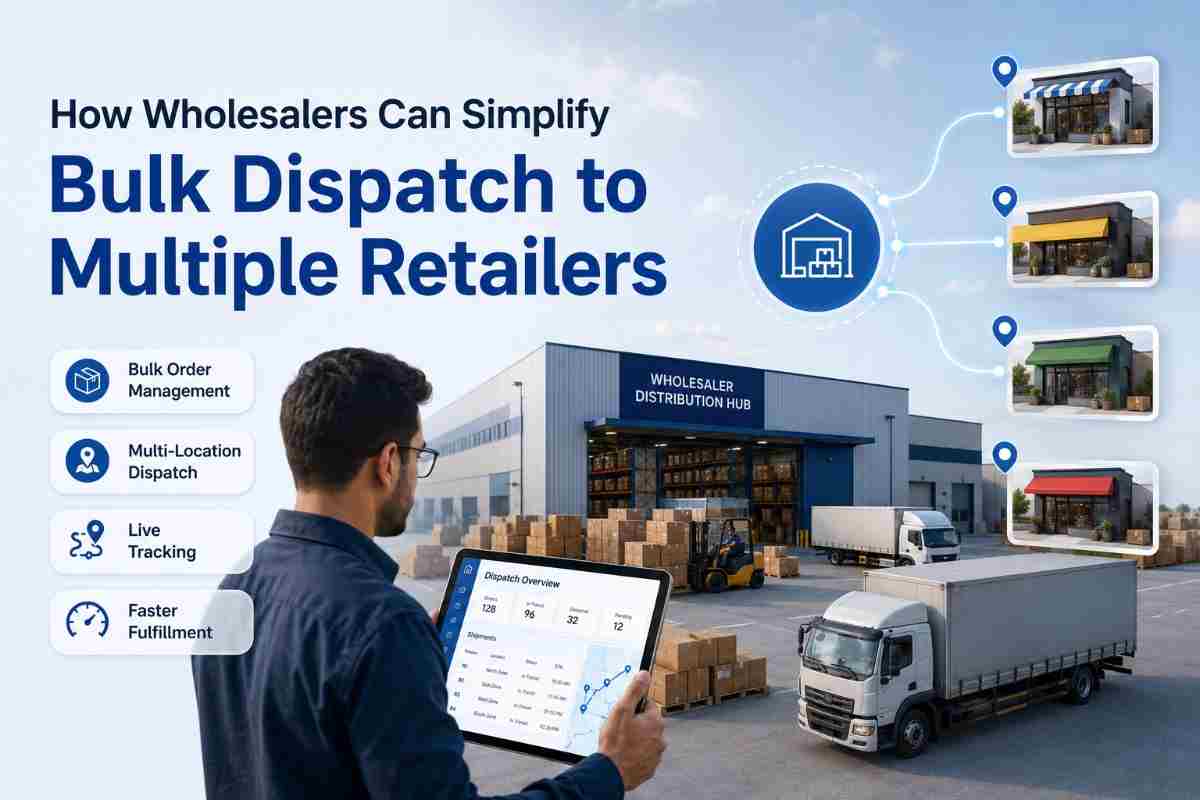
For a wholesaler, fulfilling one large order is usually simpler than sending smaller consignments to 20, 50 or 100 retailers across different locations. Each buyer may have a different delivery address, order quantity, payment condition, unloading requirement and preferred delivery window. When these details are managed through spreadsheets, phone calls and separate courier portals, dispatch teams lose time and errors become difficult to trace.
A structured bulk dispatch wholesale shipping process helps distributors convert multiple retailer orders into a controlled movement plan. The goal is not merely to send more packages. It is to group orders correctly, select a suitable transport mode, generate accurate documentation, monitor movement and close the delivery cycle with proper records.
This guide explains how wholesalers can manage dispatches more reliably while balancing cost, speed, shipment size and retailer expectations. It is especially useful for businesses shipping cartons, cases, pallets or mixed consignments from one or more warehouses to retailers in different cities.
The right process begins before packing. It connects order verification, inventory allocation, packaging, carrier selection, loading, tracking, proof of delivery and reconciliation into one operating workflow.
Bulk dispatch wholesale shipping refers to the planned movement of multiple wholesale orders or large quantities of goods from a supplier or distributor to several business customers. Unlike a single retail parcel, these consignments may involve different package sizes, delivery destinations, transport modes and receiving procedures.
A wholesaler may dispatch full cartons to one retailer, a few cases to another and palletised stock to a third buyer on the same day. These orders can move through surface transport, part truckload, less than truckload, full truckload, rail or air, depending on urgency, weight, distance and available serviceability.
The process generally includes the following activities:
The operational difference between ordinary parcel shipping and distributor dispatch is accountability. A wholesaler must know which products went to which retailer, how many packages were handed over, which transport service carried them and whether the receiving team accepted the delivery.
Businesses handling several carriers can use a bulk shipping workflow to bring larger dispatch volumes into a more organised operating structure.
Wholesale distribution is often judged by product availability and commercial relationships, but delivery execution directly affects both. Retailers plan shelf replenishment, promotions and customer commitments around expected stock arrivals. A shipment that is late, incomplete or delivered without usable documentation creates work for the buyer and the supplier.
Multi-retailer dispatches are also more complex because shipment volume does not always mean uniformity. Ten orders may contain different SKUs, packaging formats and delivery constraints. Sending everything through the same service can create unnecessary costs or operational failures. For example, urgent cartons may need air transport, while heavier non-urgent stock may be more suitable for surface movement or PTL.
A repeatable process helps the dispatch team answer important questions before loading:
Good planning also improves internal coordination. Sales teams can receive realistic dispatch updates, warehouse staff can prepare route-wise loads, accounts teams can match freight charges to orders and customer service can respond with shipment-level information instead of calling the transporter for every query.
For distributors expanding beyond their local market, B2B shipping is not only about transport. It also involves repeatability, commercial documentation, retailer communication and control over exceptions.
When orders are grouped by destination and shipment characteristics, wholesalers can decide whether to use a dedicated vehicle, a shared load or individual parcel movements. This prevents a small order from occupying disproportionate capacity and avoids splitting a large route across unplanned services.
Route-wise and retailer-wise sorting gives warehouse teams a clear dispatch sequence. Each carton can be checked against the order before loading, reducing the risk of short shipments, wrong SKUs or packages being sent to the wrong buyer.
A documented process makes the cost and service trade-off visible. Heavy, low-urgency shipments may suit surface or rail, while time-sensitive replenishment may require air. The best choice depends on the shipment profile rather than habit or a single transporter relationship.
Retailers need practical information: what was shipped, how many packages are moving, which carrier is handling the load and when they should prepare to receive it. Clear updates reduce follow-up calls and make delays easier to manage.
Wholesale dispatch is not complete when goods leave the warehouse. The team should reconcile the dispatched quantity, delivered quantity, shortages, damages, freight charges and receiving confirmation. This creates a reliable record for accounts and customer service.
A manual process may work for a few retailer orders but becomes fragile as destinations and product lines increase. Standard operating steps, consistent data fields and defined exception ownership help the team handle higher volumes without adding the same amount of administrative work.
Wholesalers that need a broader view of carrier operations can also review multiple courier management practices before finalising their dispatch model.
This sequence creates a clear chain from order confirmation to retailer receipt. It also gives managers measurable checkpoints for identifying where delays and errors originate.
A shared, structured order record is safer than information spread across chats, email threads and handwritten notes. At minimum, maintain fields for retailer, order number, destination, SKU, quantity, package count, weight, dimensions, transport mode, carrier reference and delivery status. Changes should be recorded with ownership and time rather than silently overwriting the original instruction.
Review upcoming retailer orders at a fixed time each day or week, depending on dispatch frequency. Identify route clusters, urgent replenishment and capacity requirements before the loading deadline. Last-minute decisions should be reserved for genuine exceptions, not used as the normal operating method.
Some buyers require carton-wise invoices, barcode labels, pallet rules or delivery appointments. Maintain these requirements in the retailer master record and confirm them during order release. A general warehouse checklist is useful, but it should not replace customer-specific instructions.
The lowest quoted rate may not be the lowest operational cost if it leads to repeated delays, reattempts, damage or manual follow-up. Review delivery success, transit exceptions, weight disputes, claims, return movements and retailer complaints alongside freight charges.
Define who handles a delayed pickup, address correction, shortage, damaged carton, non-delivery report or rejected load. The warehouse may own packing issues, customer service may coordinate retailer confirmation and the logistics team may manage carrier escalation. Clear ownership prevents every problem from returning to the business head.
Incorrect measurements can create billing disputes and unexpected freight adjustments. Weigh representative packaging formats, record dimensions consistently and investigate major differences between declared and carrier-assessed values. This is particularly important for cartons that are lightweight but large.
Retailer returns, rejected deliveries and damaged stock require a defined reverse process. Decide how return authorisation, inspection, pickup, inventory adjustment and credit approval will work. A forward dispatch operation without reverse controls can leave stock and financial records unresolved.
Wholesalers can strengthen post-dispatch control by learning how proof of delivery supports receiving confirmation, billing and dispute resolution.
No single mode is suitable for every retailer order. The following comparison provides a practical starting point; actual suitability depends on destination, package profile, serviceability, urgency and carrier terms.
The comparison should be applied at shipment level rather than company level. A wholesaler may use surface transport for standard replenishment, air for an urgent retailer order and FTL for a planned regional movement during the same week.
Wholesalers can simplify bulk dispatch wholesale shipping by treating it as a controlled process rather than a series of individual bookings. Verify orders, allocate inventory, group compatible destinations, select the right mode, protect retailer-level identification and close every movement with delivery evidence.
Shipmozo supports businesses with B2B Logistics, Surface, Air, Rail, PTL, LTL and FTL shipping options. These capabilities can help wholesalers evaluate dispatch requirements across different shipment sizes, routes and urgency levels instead of forcing every order into the same delivery model.
For distributors managing several retailer orders, a disciplined workflow combined with the right logistics mix can make dispatches easier to plan, monitor and reconcile. Review your current order-to-delivery process and identify the first manual handoff that should be standardised.
Talk to an Expert
Bulk dispatch wholesale shipping is the planned movement of multiple wholesale orders or large quantities of goods from a supplier or distributor to several retailers. It includes order consolidation, inventory allocation, shipment planning, documentation, transport selection, tracking and delivery reconciliation.
There is no single best mode for every dispatch. Surface is often suitable for routine or heavier shipments, air for urgent replenishment, rail for suitable long-distance cargo, PTL or LTL for loads that do not fill a truck and FTL for large dedicated movements. The decision depends on weight, dimensions, destination, urgency and serviceability.
Keep every order identifiable through retailer-specific packing lists, carton numbers, labels and dispatch records. Even when multiple orders share a vehicle or consolidated load, each retailer’s cartons and documents should remain distinguishable for receiving and reconciliation.
Weight and dimensions influence capacity planning and the chargeable amount for transport. Lightweight but bulky cartons may occupy more space than their dead weight suggests. Recording both measurements helps wholesalers plan loads and investigate unexpected billing differences.
A shipment is complete after the retailer receives the goods and the wholesaler reconciles the delivered quantity, package count, damage or shortage details and proof of delivery. Pickup confirms warehouse handover, but it does not confirm correct receipt.


Nisshdeep Kaur is a logistics-focused content specialist with 5+ years of experience in eCommerce shipping and delivery optimization. She shares actionable insights to help businesses improve delivery success rates and scale efficiently with platforms like Shipmozo.





.webp)