

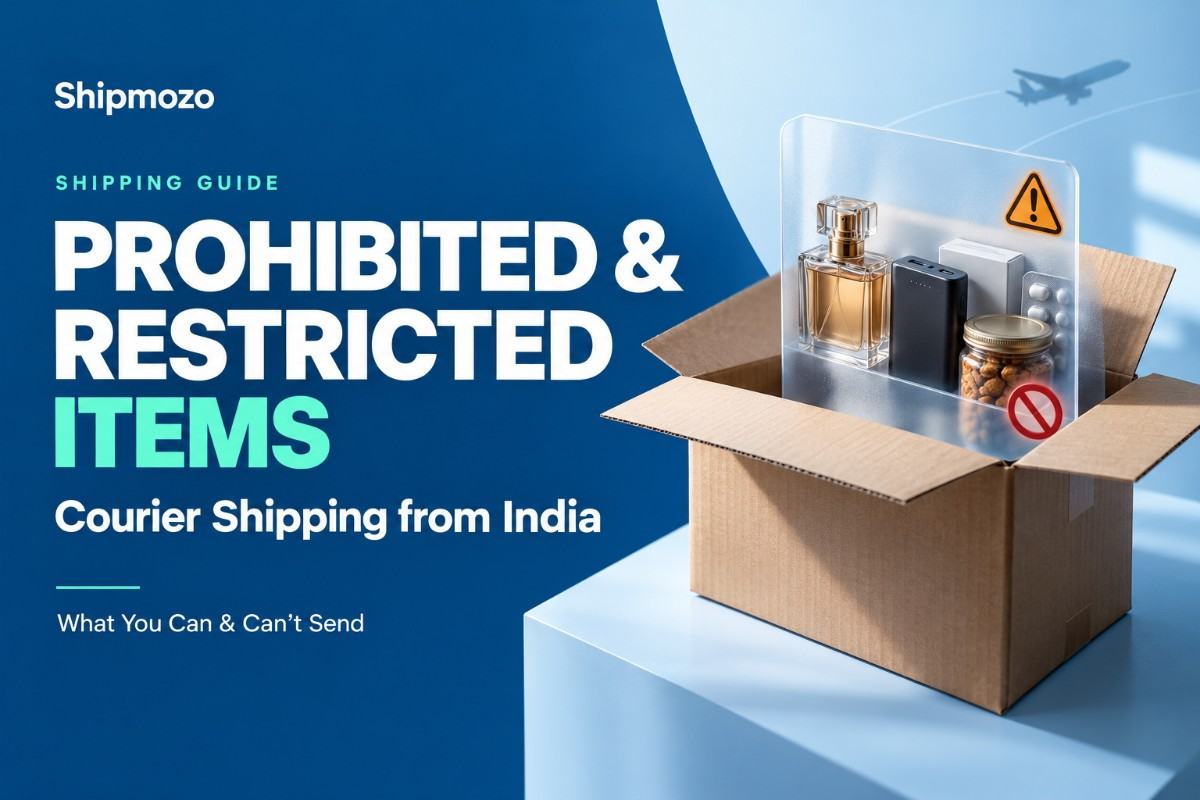
The difficulty is that there is no single universal list for every shipment. Courier companies apply their own operating policies, while destination countries impose additional import restrictions. The rules can also change based on the service used, such as domestic surface transport, air shipping or international delivery.
This guide separates items that are generally forbidden from products that may be accepted only with documentation, special packaging, quantity limits or prior approval. It also addresses common questions such as can I ship perfume, medicines or ghee by courier?
Use the information as a screening guide, not as a substitute for confirmation. Always check the selected courier's latest terms, the destination country's import rules and the product's classification before booking.
Prohibited items are goods that a courier, transport operator, customs authority or law generally does not permit in its network. These products are rejected because they may create safety, legal, security or handling risks. Examples include explosives, illegal drugs, counterfeit currency and many weapons.
Restricted items are not automatically forbidden in every situation. They may move only through approved services or after the shipper meets specific conditions. Those conditions can include an invoice, licence, prescription, material safety information, packaging standard, quantity limit or destination approval.
For example, a lithium battery installed inside permitted electronic equipment may receive different treatment from a loose or damaged battery. Similarly, a medicine shipment may be considered for carriage when it is legally prescribed and properly documented, while a commercial consignment without the required approvals may be rejected.
Courier acceptance depends on several details, not only the product name. The formulation, volume, concentration, declared value, packaging, mode of transport, origin pincode and destination country can all affect eligibility.
For international consignments, review international shipping requirements before creating the label. Customs declarations must be accurate and specific.
Restrictions are not merely administrative details. They protect handlers, vehicles, aircraft, warehouses, recipients and the wider transport network. An undeclared hazardous item can react with other cargo, leak during movement or create a serious safety incident. Even an ordinary consumer product can become problematic if it is packed incorrectly or shipped through an unsuitable service.
For sellers, an item rejected after pickup creates more than a delivery delay. The order may require repacking, rerouting or return-to-origin handling. A customer waiting for a product may receive no clear explanation, and the seller may have to absorb additional logistics costs. Repeated violations can also affect account access or courier allocation.
Businesses should build a product-screening step into order processing rather than relying on a pickup agent's informal confirmation. A courier aggregator can help teams compare suitable service options, but it does not remove the shipper's responsibility to declare goods correctly.
It is also useful to understand how to choose a courier based on product type, destination and service conditions. The cheapest visible rate is not necessarily the right option for a controlled or sensitive product.
The following categories cover the items most commonly questioned by Indian businesses and individual senders. The list is intentionally practical, but it is not exhaustive. Courier policies and government rules can be more detailed for specific products, chemicals, technologies and destinations.
A repeatable screening process reduces avoidable rejection. It is particularly important for manufacturers, distributors, D2C brands and ecommerce sellers whose catalogues contain liquids, supplements, electronics, food or regulated products.
Businesses shipping regularly can maintain a product eligibility register. Include the SKU, accepted couriers, approved service modes, packaging method, documents and last review date. This turns a one-time check into a practical operating control.
Good compliance begins before the order reaches the packing table. Product teams, warehouse staff, customer support and logistics managers should use the same rules so that an item is not promised to a customer before its transport option is confirmed.
Customs and carrier teams need a clear description such as “100 ml cosmetic fragrance,” “herbal tablets,” or “clarified butter food product,” rather than a vague term like “personal goods.” The description should not exaggerate, conceal or incorrectly simplify the contents.
Liquids should have secure closures, leak-resistant primary containers and absorbent protection where appropriate. Fragile electronics need cushioning and battery details. Food should be sealed, shelf-stable where possible and shipped only through a service that accepts it. Packaging cannot make a legally prohibited item acceptable, but poor packaging can make an otherwise eligible item unsafe.
Check the origin and destination pincode serviceability before confirming the order. Remote locations, border areas and international routes may have fewer options. If a product cannot move through the requested channel, inform the customer early and offer a lawful alternative instead of silently dispatching it.
For larger shipping operations, multi-courier shipping can help teams evaluate available partners and service modes. The decision should still be based on each courier's written acceptance rules, not only on price or delivery speed.
Most problems arise from assumptions. A product may be legal to own, commonly sold in shops or accepted by one delivery company, yet still be unsuitable for a particular courier route. These mistakes are common among first-time exporters and fast-growing ecommerce businesses.
If a parcel is stopped, do not attempt to relabel it deceptively or send it through another carrier without clarification. Ask for the reason, document the status and follow the courier or authority's instructions.
The broad categories overlap, but domestic and international shipments are not governed by the same process. Domestic movement generally focuses on courier policy, transport safety and Indian laws. International movement adds export controls, customs declarations, destination-country import rules and possible inspection by multiple authorities.
For a specific shipment, the table is only a starting point. A courier may accept one product formulation but reject another, and a destination may impose rules that are stricter than the origin requirements.
Checking prohibited items courier india requirements before pickup protects the sender, recipient and delivery network. The safest approach is to identify the product accurately, confirm the courier and destination rules, select the right mode, prepare documentation and use compliant packaging. Treat perfume, medicines, ghee, batteries, liquids and food as products requiring verification rather than automatic acceptance.
Shipmozo supports businesses with relevant options including B2C Shipping, International Shipping, Air and Surface services. These options can help sellers evaluate the appropriate logistics route, but the final responsibility for lawful declaration and product eligibility remains with the shipper.
For a product-specific decision, confirm the latest courier terms before creating the shipment. Start Shipping Today
Perfume is often restricted because it may contain alcohol and be flammable. Acceptance depends on the formulation, quantity, packaging, transport mode, courier and destination. Confirm approval in writing before dispatch, especially for international or air shipments.
Medicines may require a prescription, invoice, licence, ingredient details or other documents. International shipments can face additional import controls and quantity limits. Check both the selected courier's rules and the destination country's regulations before booking.
Ghee may be accepted for some domestic shipments when it is properly sealed, leak-proof and within the courier's food-product policy. International delivery can be restricted because of dairy, food labelling, customs and destination-country rules. Verify shelf life, packaging and route acceptance first.
Commonly prohibited or highly restricted categories include explosives, fireworks, ammunition, illegal drugs, weapons, radioactive materials, infectious substances, toxic chemicals, counterfeit goods, cash and certain flammable liquids. The exact list varies by courier, service and destination.
Some batteries may be accepted when installed in approved equipment and packed according to carrier requirements. Loose, damaged, recalled or high-capacity batteries can be prohibited or subject to strict conditions. Confirm the battery type, rating, packaging and transport mode before shipping.
Packages may undergo later screening at a hub, airport or customs facility. A pickup agent's acceptance does not override the courier's formal restrictions, security checks or destination-country rules. The parcel may be held, returned, repacked or disposed of according to the applicable procedure.


Diveya Mehta is a marketing and content specialist with 3+ years of experience, currently working with Shipmozo. With 1 year of hands-on experience in logistics, she creates practical, insight-driven content focused on shipping, courier performance, and eCommerce growth.





.webp)