

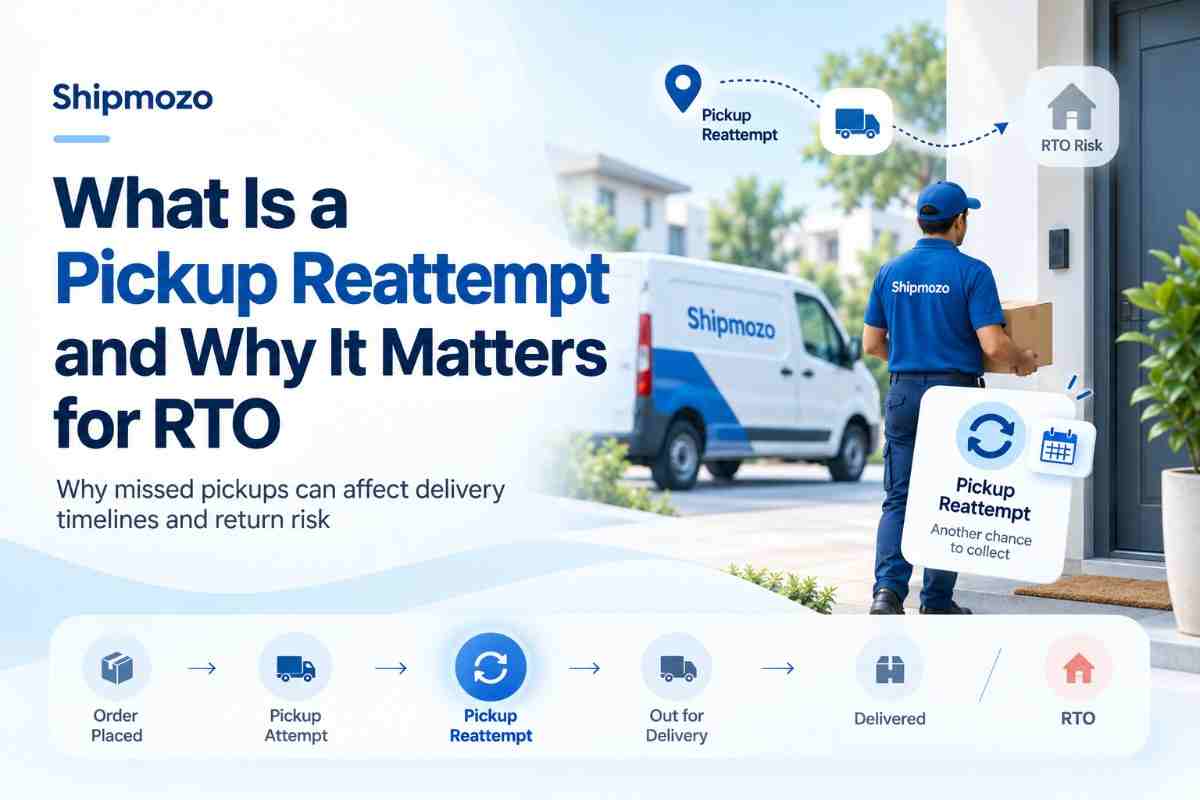
For an ecommerce seller, a missed pickup can look like a minor operational delay. In practice, it can hold up dispatch, affect the promised delivery window, create extra coordination work, and increase the chance of order cancellation. The pickup reattempt meaning is simple: a courier tries to collect a shipment again after the first scheduled pickup was unsuccessful.
This status applies before the parcel enters the courier network. It is different from a delivery reattempt, which happens after a shipment has reached the destination city and the delivery could not be completed. Understanding that distinction helps sellers respond to the correct operational problem instead of treating every failed attempt as an NDR or RTO case.
Pickup failures can happen because the shipment was not packed, the pickup address was unavailable, the parcel was not ready when the rider arrived, or the courier could not reach the location. A controlled response is important, particularly for small and growing brands that have limited inventory and support capacity.
This guide explains how the status works, why it matters for RTO, what teams should do after a failed collection, and which process controls can reduce repeat failures.
A pickup reattempt is a second or subsequent courier collection attempt for an order that was not handed over during the original pickup window. The courier may record the first attempt as failed, missed, unavailable, or not ready, depending on its tracking terminology. The next attempt is then scheduled according to the courier's operating process.
The status can apply to a single parcel or several shipments in a pickup batch. For example, a seller may have ten orders ready, but the courier may collect only eight because two packages were still being packed. Those two parcels could move into a reattempt process while the collected orders continue through transit.
A pickup reattempt concerns the movement of goods from the seller to the courier. A delivery reattempt concerns the movement from the courier's local facility to the consignee. The first is usually a dispatch and handover issue; the second is generally a recipient, address, access, or delivery exception.
This difference matters because the corrective action is not the same. A seller should check packing readiness, pickup timing, and address access for a failed collection. For a failed delivery, the team may need to contact the customer, validate the address, or respond to an NDR status.
The courier normally updates the shipment or pickup record, and another collection attempt may be planned. The exact timing, number of attempts, and escalation rules depend on the courier, service type, location, and reason recorded. Sellers should not assume that every failed pickup will automatically be attempted again without intervention.
If the parcel is repeatedly unavailable, the seller may need to reschedule it, cancel the label, or create a fresh shipment according to the platform and courier process. Keeping the original reason visible is useful for identifying recurring warehouse or courier problems.
A failed pickup does not directly create RTO because the shipment has not yet reached the customer. However, it can contribute to RTO indirectly by reducing the time available for successful delivery. When an order is collected late, every later milestone may also move: line-haul movement, destination processing, out-for-delivery scheduling, and the customer's payment or acceptance window.
The connection is especially important for prepaid and COD orders with time-sensitive demand. A delayed dispatch can lead to customer cancellations, unavailability at the time of delivery, or a missed occasion. For COD shipments, the buyer may lose interest while waiting, refuse the parcel, or become unreachable. The shipment can then move into Return to Origin after unsuccessful delivery attempts.
The practical lesson is to treat pickup performance as an early indicator in the order journey. Monitoring it alongside transit, delivery, and RTO data gives sellers a more complete view of where orders are being delayed.
Managing a failed collection is not only about getting one parcel handed over. A consistent process helps sellers protect dispatch quality and create reliable operational records. The benefits become more visible as order volume grows and manual follow-up becomes difficult.
When a missed pickup is identified quickly, the seller can make the parcel ready for the next collection instead of allowing the order to remain inactive. Faster handover gives the shipment more time to travel through the network and reach the destination before the customer loses interest.
Repeated failures often reveal an internal issue. The warehouse may be completing packing after the pickup cut-off, printing labels too late, or storing ready parcels in different areas. Recording the reason for every failed attempt helps managers separate warehouse delays from courier arrival or access problems.
Pickup records support a fact-based review of courier performance. If parcels are consistently ready but collection attempts are missed, the seller can compare locations, time windows, shipment counts, and exception reasons before discussing the issue with the courier or changing allocation.
A seller can give a better update when the order status is understood. Instead of saying that the shipment is delayed without context, support staff can explain that collection was unsuccessful and that another handover is being arranged. Clear communication does not remove the delay, but it can prevent avoidable confusion.
Pickup control supports RTO prevention by protecting the earliest stage of fulfilment. It works best alongside delivery-focused measures such as address validation, COD confirmation, customer communication, and timely response to NDR events. Sellers can also review delivery success rate by courier and destination to find downstream problems.
A repeatable workflow prevents the team from relying on memory or scattered courier messages. The objective is to confirm what happened, remove the cause, and ensure that the next attempt is visible to the responsible person.
For high-volume sellers, the workflow should be visible to warehouse and support teams through a shared order or shipping dashboard. A manual spreadsheet can work at low volume, but it becomes less reliable when multiple couriers, warehouses, and sales channels are involved.
Most failed collections are preventable when the seller treats pickup as a scheduled warehouse activity rather than an informal courier visit. The following controls are practical for D2C brands, marketplace sellers, distributors, and other ecommerce operators.
Define the latest time by which orders must be packed and labelled for the planned pickup. Orders received after that cut-off should be assigned to the next batch rather than being added to a collection that the warehouse cannot complete.
The checklist should cover parcel count, label readability, packaging condition, invoice or required documents, and the name of the person responsible for handover. It should also include a quick check that the pickup address and contact number are correct.
Use a clearly identified staging area for shipments that are ready for collection. Mixing packed parcels with orders awaiting quality checks or inventory confirmation increases the chance that the wrong shipment will be missed or handed over.
A failed-pickup count tells you that a problem exists, but the reason explains what to fix. Categorise failures as parcel not ready, location closed, address issue, courier did not arrive, access problem, documentation issue, or other verified cause.
A courier may perform differently across warehouses, pin codes, or pickup time windows. Compare the same service across these dimensions before making a broad change to the entire shipping setup.
Access to multiple courier options can help a seller respond to service constraints, but frequent switching without rules creates confusion. Define allocation criteria using serviceability, product type, destination, and historical performance. A carrier allocation process should be clear enough for the team to follow consistently.
Every pending pickup should have an owner and next action. A short daily review of ageing shipments prevents failed collections from remaining unnoticed until the customer contacts support or the order is cancelled.
Pickup issues often become expensive because the initial status is handled casually. Sellers may focus on getting the parcel out eventually while overlooking the process weakness that caused the failure. These mistakes are common across small warehouses and growing operations.
These errors are avoidable when the business assigns ownership. Someone should be responsible for confirming ready parcels, someone should monitor exceptions, and someone should review recurring patterns. Clear ownership matters more than adding another manual message to an already busy workflow.
Several courier statuses can sound similar but describe different points in the fulfilment cycle. Knowing the distinction helps teams choose the right response and prevents inaccurate customer communication.
For a broader view of the final outcome, sellers can review what RTO means in shipping. The key operational principle is to intervene at the earliest stage. A pickup failure may be easier to correct than a customer refusal after several days in transit.
The pickup reattempt meaning describes a renewed attempt to collect a shipment after the original handover did not happen. It is not the same as a delivery reattempt or RTO, but it can affect both by delaying dispatch and reducing the time available for successful delivery.
Sellers should monitor this status, confirm parcel readiness, record the actual cause, and assign a clear next action. Shipmozo's B2C Shipping, Surface, Air, and Rail services can support different shipping requirements as businesses manage their order movement and courier operations. The right setup depends on product characteristics, destination, serviceability, and delivery priorities rather than on one universal shipping method.
Use pickup exception data with NDR and RTO reviews to identify where the fulfilment process is losing time. Start Shipping Today
It means the courier could not collect the parcel during the scheduled pickup and another collection attempt is being arranged or requested. The parcel has not necessarily entered transit yet.
No. A pickup reattempt occurs before the courier collects the shipment. An NDR is recorded after a delivery attempt fails at the customer's location or during the delivery process.
No. It does not directly cause RTO because the shipment has not reached the delivery stage. However, repeated pickup failures can delay dispatch and leave less time to resolve later delivery problems, which may increase RTO exposure.
The seller should check the recorded reason, confirm that the parcel is packed and labelled, verify the pickup location and contact details, prepare the shipment for handover, and reschedule or escalate the collection.
They can set a packing cut-off, stage ready parcels separately, use a handover checklist, track failure reasons, review performance by location and courier, and assign ownership for pending pickup exceptions.


Neha Pant works in business development at Shipmozo, where she focuses on helping eCommerce and D2C brands simplify their logistics and scale operations efficiently. She is passionate about understanding real shipping challenges and connecting businesses with the right solutions.





.webp)