

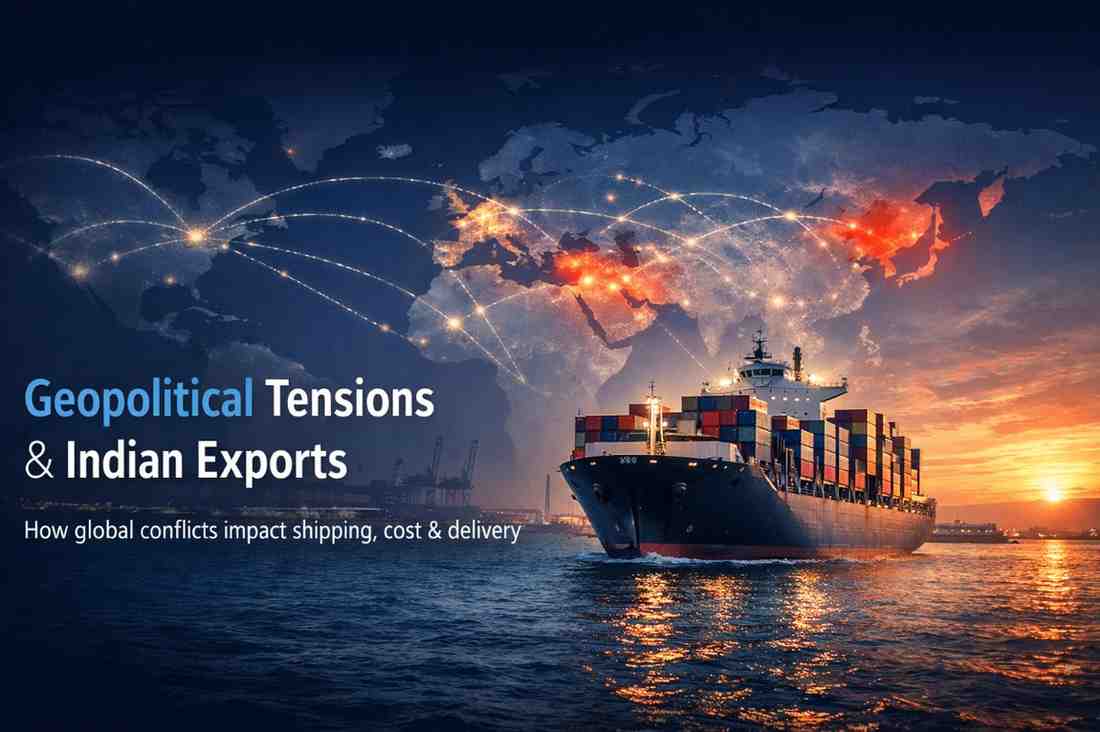
Global trade doesn’t operate in isolation—it’s deeply influenced by geopolitics. From wars and sanctions to trade restrictions and diplomatic conflicts, geopolitical tensions can significantly disrupt supply chains, increase shipping costs, and impact delivery timelines.
For Indian exporters, especially eCommerce sellers and SMEs, these disruptions are not just macro-level news—they directly affect margins, customer satisfaction, and scalability.
In this blog, we’ll break down how geopolitical tensions impact Indian exports and how businesses can stay resilient with smarter logistics strategies.
Geopolitical tensions refer to conflicts or strained relationships between countries that affect trade policies, logistics routes, and economic cooperation.
Geopolitical conflicts often block or restrict key trade routes.
Customer dissatisfaction + higher RTO (Return to Origin) risk
When tensions rise:
Exporters face higher shipping costs per order
For eCommerce sellers, this directly reduces profit margins, especially on low-ticket products.
Countries often tighten import/export rules during geopolitical instability.
Slower deliveries → poor customer experience → refund requests
Geopolitical instability affects global currency markets.
Especially critical for exporters dealing in USD, EUR, or African currencies
Sanctions or political tensions can restrict exports to certain countries.
Businesses lose access to key international markets overnight
Even if you’re exporting from India, your supply chain might depend on:
Geopolitical issues disrupt these dependencies.
Result:
Conflict zones increase risks such as:
This increases:
Instead of reacting late, smart exporters build systems that adapt quickly.
Avoid dependency on a single logistics partner or route.
Keep customers informed to reduce panic and cancellations.
Choose couriers based on:
This is where platforms like Shipmozo become critical.
Shipmozo is not just a shipping tool—it’s a logistics optimization system built for modern exporters.
✔ Multiple Courier Partners (Global Reach)
Access 27+ courier partners and choose the best route dynamically
✔ Smart Courier Recommendation Engine
Automatically selects the most reliable and cost-effective courier
✔ Reduced RTO by Up to 45%
With structured NDR + reattempt workflows
✔ Real-Time Tracking & Visibility
Keep customers informed and reduce WISMO queries
✔ COD & Payment Reconciliation
Stay financially clear even during disruptions
✔ Dedicated Account Manager
Faster resolution during uncertain global conditions
Imagine you’re shipping to the UAE or Africa:
That’s the difference between manual shipping vs intelligent logistics
They increase fuel prices and insurance premiums and reduce carrier availability—leading to higher shipping rates.
eCommerce sellers, SMEs, and businesses dependent on international markets are most vulnerable.
By diversifying couriers, using smart shipping platforms, and maintaining real-time tracking.
Yes, Shipmozo enables shipping to 195+ countries with multiple courier options.
Geopolitical tensions are unpredictable—but your logistics strategy shouldn’t be.
If you want to scale globally without worrying about disruptions, delays, or rising costs, you need a system that adapts in real-time.
That’s where Shipmozo gives you an edge.


Ankit Debnath is a sales and marketing professional with 4+ years of experience in the logistics industry, specializing in managing B2B and B2C key accounts. At Shipmozo, he focuses on driving growth through client acquisition, lead generation, and strategic relationship management. Passionate about building strong client relationships and delivering results, he brings a practical, growth-oriented approach to logistics and business expansion.





.webp)