

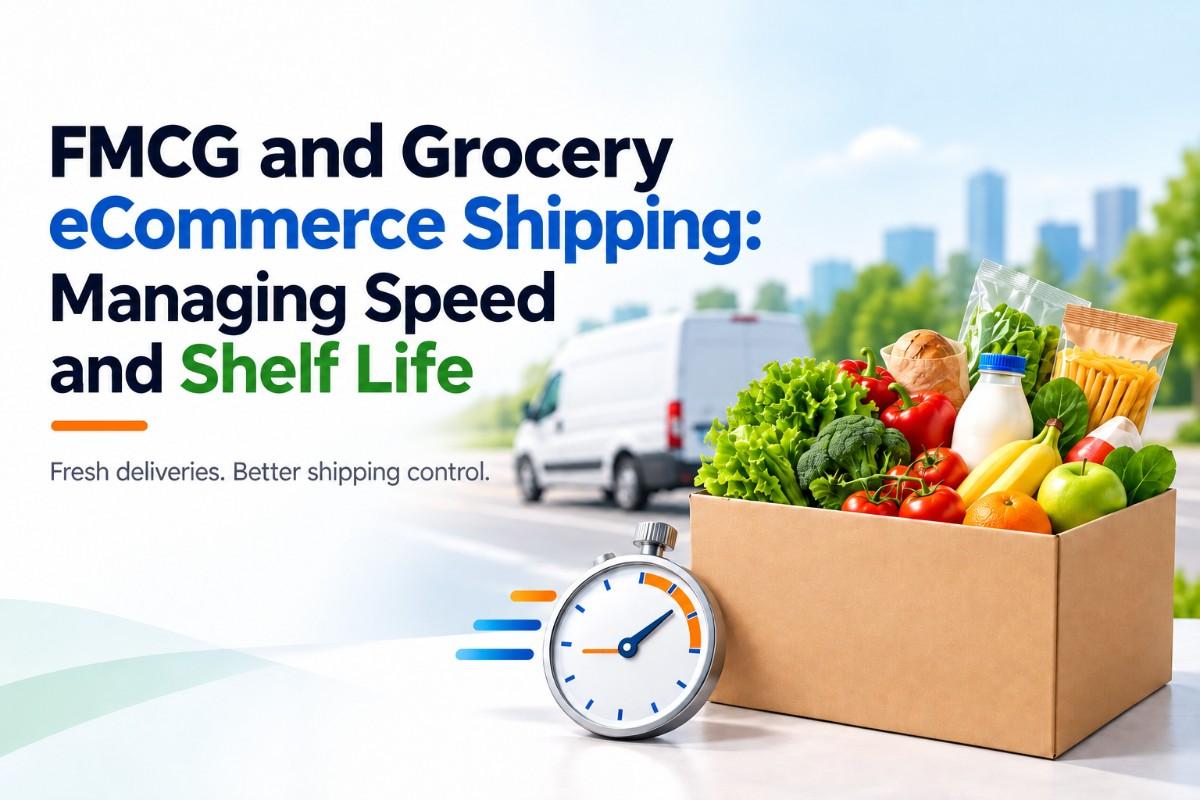
For FMCG brands, fmcg ecommerce shipping india is not simply a matter of moving parcels from a warehouse to a customer. Delivery speed directly affects product freshness, shelf life, customer satisfaction and the likelihood of returns. A packet of snacks, personal care products, packaged food or household essentials may not be temperature-sensitive, but it still loses commercial value when it reaches the customer late, damaged or with inadequate remaining shelf life.
Online FMCG operations also have a demanding order profile. Shipments are usually small, frequent and spread across metros, Tier 2 cities and remote pincodes. Customers expect familiar products to arrive quickly, while brands need to control freight costs, prevent leakage and maintain accurate inventory across multiple stock-keeping units.
The solution is not to choose the fastest service for every order. A reliable shipping plan matches product characteristics, destination, order value, promised delivery window and available inventory with the right transport mode and courier. This article explains how FMCG and grocery sellers can build that process and use logistics data to improve daily execution.
FMCG and grocery eCommerce shipping is the process of fulfilling online orders for fast-moving consumer goods and delivering them to homes, businesses or pickup locations. It covers much more than the final-mile movement. The workflow includes inventory allocation, order processing, packaging, label generation, courier selection, pickup, line-haul movement, delivery attempts, non-delivery management and returns.
These products generally have high order frequency and relatively low individual order value. A customer may purchase several units in one basket, but the shipment can still be price-sensitive because the cost of delivery may represent a significant share of the order value. This makes consolidation, packaging discipline and route selection important.
Shelf life refers to the period during which a product remains suitable for sale or use under specified storage conditions. It is not identical to delivery time. A product can have a long total shelf life but still create complaints if the customer receives a batch with an unexpectedly short balance. Sellers therefore need inventory rotation rules and visibility into the stock dispatched from each fulfilment location.
Delivery performance has a direct commercial impact on consumer goods. Customers may tolerate a delay for a non-urgent purchase, but expectations change when the order contains daily-use products, replenishment items or food. A missed delivery can lead to a cancelled order, a refund request or a purchase from a nearby competitor.
Speed also influences the usable value remaining at delivery. If a product has a limited expiry period, every extra day spent in order processing, sorting or transit reduces the customer’s consumption window. This is particularly important when brands sell clearance batches, promotional packs or products with different expiry dates from the same catalogue.
Operationally, fast delivery must be balanced against cost and feasibility. Air movement may shorten transit on selected lanes but may not be economical for low-value or heavy shipments. Surface transport can work well for planned replenishment and longer-distance movements, but it requires realistic customer promises. The correct decision depends on the shipment, not on a blanket preference for one mode.
Brands that monitor these risks together can make better decisions than those that measure only average delivery time. Delivery success rate, ageing stock, damage rate, first-attempt delivery, return-to-origin and cost per delivered order should be reviewed as a connected operating picture.
A structured fulfilment and delivery process gives FMCG sellers control over the factors that most often damage customer experience. It standardises decisions that are otherwise made manually during busy periods, such as choosing a courier, splitting orders, packing mixed products and escalating delayed shipments.
When inventory is mapped by batch, location and remaining shelf life, the fulfilment team can use a first-expiry-first-out approach where appropriate. This helps the business dispatch stock that should move sooner instead of allowing it to age in storage. Shipping visibility also makes it easier to identify lanes where transit delays are affecting usable shelf life.
Serviceability checks and historical courier performance help brands set delivery expectations based on destination and product requirements. A realistic promise is more valuable than an aggressive one that is frequently missed. For urgent replenishment orders, faster transport can be reserved for lanes where the additional cost is commercially justified.
Standard packaging specifications reduce variation at the packing station. Carton sizes can be assigned by product category, while liquids, glass containers and food products can follow separate packing rules. Accurate weight and dimensions also reduce billing disputes linked to volumetric weight or incorrect shipment declarations.
Shipment tracking gives customers a clear view of order progress after dispatch. Proactive communication is especially useful when an order is delayed or a delivery attempt fails. A branded post-purchase experience can reduce repetitive “where is my order” queries and help the customer understand the next step.
FMCG volume can rise sharply during campaigns, festive periods and promotional events. A multi-carrier process allows the brand to distribute shipments across available delivery networks instead of depending on a single operational channel. This creates flexibility when a courier has a capacity constraint, lane disruption or serviceability limitation.
Brands evaluating this model can also review practical shipping solutions and identify where manual work is causing delays or errors.
Improving delivery outcomes requires a process that warehouse, customer service, inventory and logistics teams can follow consistently. The steps below are designed for businesses selling ambient consumer goods online, with adjustments needed for products requiring temperature control or special regulatory handling.
This type of process is easier to operate when orders and shipment statuses are visible in one place. A multi-courier shipping setup can help teams manage different carriers without maintaining separate manual workflows for every partner.
Operational improvements in this category usually come from small controls applied consistently. The objective is not maximum speed at any cost. It is predictable movement with enough shelf life, acceptable damage risk and a delivery cost that fits the order economics.
Define the minimum remaining shelf life that can be shipped for each product category or channel. This threshold may differ for direct consumers, distributors and promotional bundles. Make the rule visible to picking teams so that unsuitable stock is not selected simply because it is easier to reach.
Food, liquids, cleaning products and fragile items should not be packed together without a clear protective method. Use secondary containment for leak-prone products and maintain a checklist for seals, caps and outer-carton integrity. Packaging trials should include movement and compression checks, not only visual inspection at the packing table.
Use air shipping where speed has a clear business reason and the product is permitted under the relevant carrier conditions. Use surface movement for suitable shipments where cost, weight and planned transit make it more practical. Large replenishment loads may require a different arrangement from individual consumer parcels.
Publish realistic order cut-offs for same-day processing and align them with warehouse staffing and pickup schedules. If a parcel misses the cutoff, the system should update the promised date rather than allowing the customer to assume it will move immediately.
A courier may perform well in one city and poorly in another. Review delivery success, first-attempt performance, average exception time, damage reports and return rates by destination zone. Lane-level analysis is more useful than relying on a single overall courier score.
Give support agents access to the same shipment status that customers see. When an order is delayed, the team should be able to explain whether it is awaiting pickup, moving between hubs, out for delivery or held because of an address issue. A real-time tracking process makes this conversation more precise.
Returned grocery and FMCG products should not automatically return to sellable inventory. Inspect packaging, seals, handling conditions and remaining shelf life before deciding whether to restock, quarantine or dispose of the item. Clear reverse-logistics rules protect customers and prevent unsuitable stock from re-entering the order cycle.
Before a campaign, review expected order volume, popular SKUs, warehouse capacity, packaging availability and courier pickup capacity. Pre-positioning fast-moving products closer to demand can reduce processing pressure, but only if inventory accuracy and batch controls remain strong.
Businesses handling many destinations can review their courier performance metrics regularly instead of waiting for customer complaints to reveal a recurring problem.
Most shipping failures are not caused by one dramatic issue. They develop when inventory, packaging, order data and delivery decisions are managed separately. The following mistakes are common in growing consumer-goods operations.
A courier aggregation approach can be useful when a brand is facing several of these problems at once, particularly when multiple carriers, destinations and service levels need to be managed together.
No single transport mode is suitable for every FMCG shipment. The right choice depends on product value, urgency, weight, destination, shelf-life sensitivity and the customer promise.
Many brands use a combination rather than selecting one option permanently. For example, an ambient bulk order moving between warehouses may use surface transport, while a small urgent consumer order on a distant lane may justify an air service. The operating rule should be documented so warehouse and logistics teams make consistent decisions.
Successful fmcg ecommerce shipping india depends on coordinating shelf-life control, inventory placement, packaging, serviceability, courier selection and post-dispatch monitoring. Speed matters, but a fast shipment that arrives damaged, incomplete or close to expiry does not create a strong customer experience.
Shipmozo supports businesses with a logistics aggregation platform covering B2C Shipping, Surface and Air services. These capabilities can help FMCG brands align transport choices with product urgency, shipment profile and destination requirements while keeping operational workflows more manageable.
Review delivery performance by SKU, lane and courier, then use those findings to improve promises, packing rules and inventory decisions. Start Shipping Today
Brands should track batch-level inventory, apply first-expiry-first-out rules where suitable, define minimum remaining shelf-life thresholds and choose fulfilment locations that support practical delivery times. Packaging and fast action on failed deliveries also help prevent avoidable ageing.
No. Air shipping may suit urgent or time-sensitive orders, but surface shipping can be more practical for suitable ambient products, heavier parcels and planned movements. The decision should consider urgency, weight, destination, product restrictions and order economics.
Packaging should match the product risk. Use cushioning for fragile goods, leak-resistant secondary containment for liquids, suitable seals for personal care products and strong cartons that limit movement. Food, cleaning products and other incompatible categories should be separated appropriately.
Teams should review the non-delivery reason quickly, contact the customer when appropriate, correct address or availability issues and decide on a reattempt or return. Returned consumable products should be inspected before any decision to restock.
Useful measures include end-to-end delivery time, first-attempt success, damage rate, expiry-related complaints, non-delivery reasons, return-to-origin, cost per delivered order and courier performance by destination lane. Reviewing these together gives a more accurate view than measuring dispatch speed alone.







.webp)