
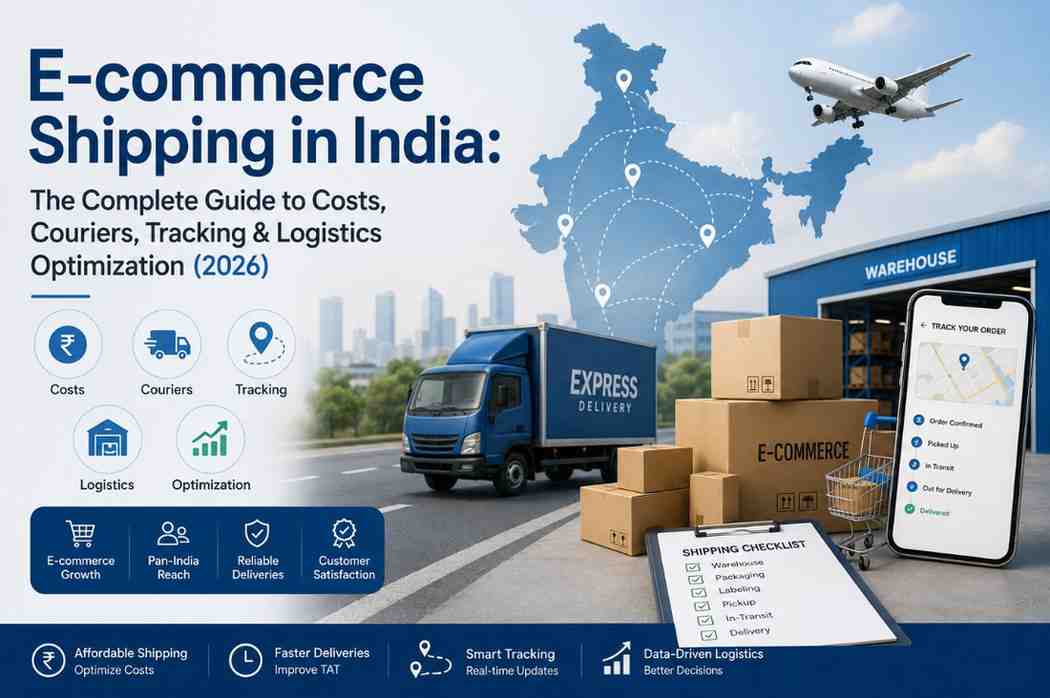
E-commerce Shipping in India: The Complete Guide to Costs, Couriers, Tracking & Logistics Optimization (2026)

Shipping is the part of e-commerce that customers actually experience. A great product page can win the click, but a delayed parcel, a confusing tracking link, or a surprise shipping fee is what loses the customer for good. For Indian sellers shipping into 29,000+ pincodes with wildly different infrastructure, this isn't a minor operational detail—it's one of the biggest levers on conversion rate, RTO, and repeat purchase.

This guide covers everything that "ecommerce shipping" actually involves: how it works end-to-end, the different ecommerce shipping methods and fulfillment models, how shipping costs and volumetric weight are really calculated, COD and RTO management, real-time delivery tracking, courier integration for Shopify/WooCommerce/Amazon sellers, and how to choose between a single courier, a 3PL, or a multi-courier shipping aggregator.

Key Takeaways

  • e-commerce shipping is the full process from order placement to last-mile delivery — not just the courier pickup.
  • Shipping cost is based on whichever is higher: actual weight or volumetric weight (L × W × H ÷ 5000).
  • RTO (Return to Origin) and COD refusals are the biggest hidden cost drains in Indian e-commerce logistics.
  • No single courier performs best across every pincode—a multi-courier aggregator like Shipmozo routes each shipment to the best-performing partner automatically.
  • Real-time order tracking and proactive delivery updates directly reduce WISMO support tickets and improve repeat purchase rates.
At a Glance Detail
Average ecommerce shipping cost in India ₹30–₹150 per shipment, depending on weight, zone, and COD
Standard delivery timeline 3–7 business days (Tier 2/3/rural); 1–3 days (metro express)
Typical COD share of Indian ecommerce orders Still 50%+ in many categories, especially Tier 2/3
Common RTO rate range 10–25% for COD-heavy categories without active RTO management
Couriers typically available via an aggregator 15–30+ partners (Blue Dart, Delhivery, Xpressbees, Ecom Express, DTDC, Ekart, India Post, and more)

What is e-commerce shipping?

E-commerce shipping is the complete process of storing, packing, and delivering a product from a seller to a customer after an online order is placed—covering order processing, courier allocation, transportation, last-mile delivery, and reverse logistics if the order is returned.

It's often confused with just "courier delivery," but e-commerce shipping is broader—it includes everything that happens between checkout and the parcel reaching the customer's doorstep, including the systems that calculate cost, select a courier, and keep the customer informed along the way.

How e-commerce Shipping Works: Step-by-Step

Every e-commerce order moves through the same core stages, regardless of business size:

  1. Order placement—the customer checks out; payment mode (prepaid/COD) and delivery pincode are captured.
  2. Pincode serviceability check—the system confirms whether the destination pincode is deliverable and by which couriers.
  3. Order processing—inventory is allocated, the invoice is generated, and the item is picked and packed.
  4. Courier allocation & label generation — a courier is selected based on destination, cost, COD capability, and past performance; a shipping label with an AWB (Air Waybill) number is generated.
  5. Pickup — the courier scans the parcel, triggering the first tracking update.
  6. In-transit movement — the shipment moves through the courier's hub-and-spoke network.
  7. Last-mile delivery — the local delivery agent attempts delivery at the customer's address.
  8. Delivery confirmation or NDR — if delivered, the order closes and COD is reconciled; if not, it's marked as an NDR (Non-Delivery Report) and may be reattempted or returned.

Where this process breaks down—wrong courier for the pincode, no real-time tracking, or slow NDR follow-up—is usually where RTO and customer complaints spike.

Types of e-commerce Shipping Methods

Choosing a shipping method is a trade-off between speed, cost, and customer expectations. Most sellers offer more than one at checkout.

Shipping Method Typical Delivery Time Cost Best For
Standard Shipping 3–7 business days Low Non-urgent orders, price-sensitive buyers
Express Shipping 1–3 business days Medium–High Time-sensitive orders, metro customers
Same-Day / Next-Day Delivery Hours to 1 day High Quick commerce, hyperlocal, high-AOV urban orders
International Shipping 5–15+ business days Variable (duties/customs apply) Cross-border D2C and export orders

A useful rule of thumb: same-day or next-day delivery improves conversion in metro cities, but in Tier 3/4 and rural pincodes, reliability matters more than raw speed—customers there are often more tolerant of a 5–7 day delivery window than of a missed delivery promise.

E-commerce Fulfillment Models: In-House vs. 3PL vs. Dropshipping vs. Aggregator

A shipping method is about speed; a fulfillment model is about who handles the logistics. These are often confused, but they answer different questions.

Model Who Manages It Control Scalability Typical Use Case
In-House Fulfillment Seller's own warehouse and team High Low–Medium Early-stage brands with low order volume
Third-Party Logistics (3PL) Outsourced fulfillment provider Medium High Brands wanting to scale without owning warehouses
Dropshipping Supplier ships directly to customer Low High Low-capital, low-inventory-risk businesses
Marketplace Fulfillment Amazon FBA, Flipkart Fulfillment, etc. Low High Sellers active on large marketplaces
Multi-Courier Aggregator Seller's own stock, courier selection automated High High D2C/eCommerce sellers shipping their own inventory across India

Most Indian D2C sellers who pack and ship their own inventory fall into the last category — they don't need a 3PL to manage warehousing, but they do need a system that picks the right courier for every order automatically rather than negotiating and managing multiple courier accounts manually.

How e-commerce Shipping Costs Are Calculated

Shipping cost is rarely just "the courier's rate card." It's a combination of several variables:

  • Base freight charge — set by weight slab and delivery zone
  • Volumetric weight vs. dead weight—couriers bill on whichever is higher
  • Zone — local, regional, metro-to-metro, rest-of-India, or special zones (e.g., J&K, Northeast)
  • COD fee — an additional charge for cash-on-delivery orders, usually a flat fee or percentage of order value
  • Fuel surcharge — variable, tied to fuel price fluctuations
  • RTO charge — many couriers charge for the return leg of a failed delivery, not just the forward leg

Volumetric Weight: The Most Commonly Misunderstood Cost Factor

Couriers charge based on whichever is higher: actual (dead) weight or volumetric weight. A large but light product (like a lampshade) can cost more to ship than a small, heavy one (like a phone charger), because courier pricing also accounts for the space the parcel occupies in transport.

The standard formula used by most Indian couriers is:

Volumetric Weight (kg) = (Length × Width × Height in cm) ÷ 5000

If the volumetric weight is higher than the actual weight, the courier bills based on the volumetric figure. Sellers who don't check this before shipping are often the most surprised by invoice discrepancies at month-end.

Cash on Delivery (COD): How It Affects Shipping

COD remains a major part of Indian e-commerce despite the growth of UPI and digital wallets, particularly in Tier 2/3 markets and for new brands without established trust. But it changes the shipping equation significantly.

COD Advantages COD Disadvantages
Higher conversion among first-time/hesitant buyers Significantly higher RTO rates than prepaid
Builds trust where digital payment confidence is low Delayed cash flow due to fixed remittance cycles
Strong demand driver in Tier 2/3/rural markets Additional COD handling fees
Helps new brands without strong recall test demand Higher reverse logistics costs on refused orders

Because COD orders carry meaningfully higher RTO risk, many sellers manage it actively—restricting COD by pincode or order value, offering a small prepaid discount, or using automated risk scoring on COD orders before they're shipped.

RTO (Return to Origin): Causes and How to Reduce It

RTO happens when a shipment can't be delivered and is sent back to the seller. It's one of the costliest problems in Indian e-commerce shipping because it triggers costs twice—once on the forward leg and once on the return.

Common causes of RTO:

  • Incorrect or incomplete delivery address
  • Customer unavailable at the time of delivery
  • Customer refuses COD payment at the doorstep
  • Courier unable to service the pincode reliably
  • Delivery delays causing the customer to lose interest

Practical ways to reduce RTO:

  1. Confirm address and pincode serviceability before dispatch, not after.
  2. Send delivery-day reminders via SMS/WhatsApp so customers are prepared.
  3. Use NDR automation to attempt redelivery quickly instead of defaulting to return.
  4. Route COD-heavy or high-risk pincodes to the courier with the strongest local performance there.
  5. Offer a small prepaid incentive to shift order mix away from COD where possible.

Delivery Tracking and the WISMO Problem

"Where Is My Order?" (WISMO) queries are one of the largest sources of avoidable customer support volume in e-commerce. A clear tracking experience solves this before it becomes a support ticket.

Most courier tracking systems update through the same scan-based milestones:

  • Manifested / label generated
  • Picked up
  • In transit
  • Arrived at destination hub
  • Out for delivery
  • Delivered / undelivered (NDR)

A branded tracking page that shows these milestones — and proactively notifies the customer at each stage — reduces WISMO tickets, builds trust during the wait, and can double as a low-effort upsell surface for related products.
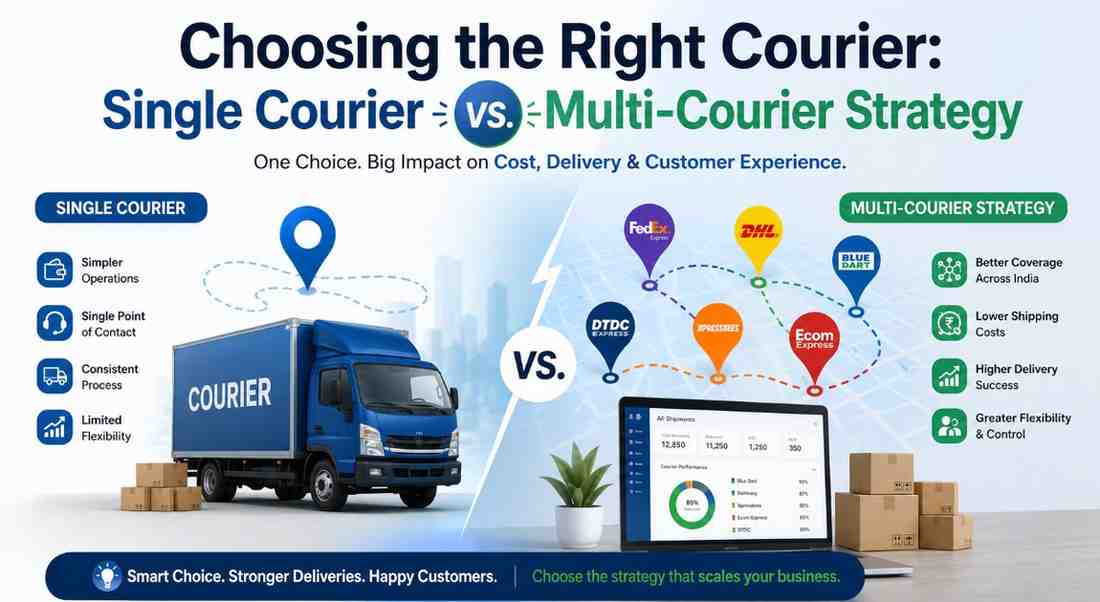
Choosing the Right Courier: Single Courier vs. Multi-Courier Strategy

Choosing the right Courier Aggregator

No single courier is the fastest or most reliable everywhere in India. A courier that performs well in metro Tier 1 cities may have weak coverage in Tier 3/4 pincodes, and vice versa. This is why relying on one courier partner is consistently flagged as a top mistake in e-commerce shipping—a service disruption, capacity issue, or weak regional network with that one courier directly hits every order, not just some of them.

A multi-courier strategy—using several courier partners and routing each order to whichever performs best for that specific pincode—generally outperforms a single-courier setup on delivery success rate and RTO, but managing multiple courier accounts, rate cards, and dashboards manually doesn't scale well past a certain order volume.

This is the specific problem a shipping aggregator platform like Shipmozo is built to solve. Instead of a seller manually choosing between Blue Dart, Delhivery, Xpressbees, or others for each shipment, Shipmozo connects sellers to 27+ courier partners across 29,000+ pincodes from a single dashboard and uses AI-based courier allocation to automatically assign the best-performing courier for each order's specific destination, weight, and COD status.

E-commerce Shipping for Shopify, WooCommerce, Amazon & Marketplace Sellers

Where a seller's store is hosted changes how shipping needs to be set up:

Selling Channel Shipping Consideration
Shopify / WooCommerce (own website) Needs a connected shipping platform for rate calculation, label generation, and tracking at checkout.
Amazon / Flipkart (marketplace) Can use marketplace fulfillment (FBA-style) or self-ship with marketplace-approved couriers.
Meesho / social commerce High COD share typically requires stronger RTO and NDR management.
Multi-channel sellers (own site + marketplaces) Need a single shipping system that syncs orders and tracking across all channels, not separate setups per channel.

For sellers running their own Shopify or WooCommerce store, shipping isn't handled by the platform itself — it has to be connected to a courier or shipping aggregator that can plug into the storefront via API or app integration, pull orders automatically, and generate AWB numbers and tracking links without manual data entry for every order.

Common E-commerce Shipping Mistakes Sellers Make

  • Relying on a single courier for too long, even after performance issues show up in RTO or delay data
  • Ignoring volumetric weight until an unexpectedly high invoice arrives
  • Treating COD as pure demand rather than a risk factor that needs active management
  • Offering free shipping without modeling its cost impact on margins
  • Skipping pincode serviceability checks before dispatch, leading to avoidable NDRs
  • Not tracking courier-level KPIs (RTO%, first-attempt delivery success, average delay), which means problems go unnoticed until they're expensive

How to Optimize e-commerce Shipping: A Practical Checklist

  • Calculate volumetric weight before finalizing packaging dimensions
  • Set COD restrictions by pincode or order value where RTO risk is historically high
  • Track courier-level RTO % and delivery success rate monthly, not just overall averages
  • Automate NDR follow-up (re-attempt scheduling, customer reminders) instead of handling it manually
  • Offer at least two delivery speed options (standard + express) at checkout
  • Use a branded tracking page to reduce WISMO support tickets
  • Route shipments across multiple couriers rather than locking into one, especially as order volume grows across regions
KPI Formula Why It Matters
RTO Rate (RTO Shipments ÷ Total Shipments) × 100 Highest-impact metric for COD-heavy sellers
First-Attempt Delivery Rate (Delivered on 1st Attempt ÷ Total Delivered) × 100 Indicates courier and address-quality efficiency
Average Delivery Time (TAT) Sum of (Delivery Date − Pickup Date) ÷ Total Shipments Tracks real-world speed vs. promised speed
Shipping Cost per Order Total Shipping Spend ÷ Total Orders Shipped Core input for pricing and margin decisions
NDR Resolution Rate (NDRs Converted to Delivery ÷ Total NDRs) × 100 Shows how well failed-delivery follow-up is working

How Shipmozo Helps Simplify e-commerce Shipping

Most of the optimization steps above multi-courier routing, NDR automation, COD risk handling, and real-time tracking—are difficult to do manually past a few hundred orders a month. Shipmozo is built specifically to handle this layer for Indian e-commerce sellers: it connects one dashboard to 27+ courier partners, automatically allocates each shipment using AI-based courier selection, and gives sellers a single view of tracking, COD reconciliation, and RTO data across every courier they use—rather than logging into a separate panel for each one.

For sellers who are currently locked into a single courier relationship or managing multiple courier logins manually, this is usually the fastest way to reduce RTO and improve delivery consistency without rebuilding the entire shipping process from scratch.

Term Meaning
AWB (Air Waybill) Unique tracking number assigned to a shipment by the courier at pickup.
COD (Cash on Delivery) Payment collected by the delivery agent at the time of delivery.
NDR (Non-Delivery Report) Status marking a failed delivery attempt, with the reason logged.
RTO (Return to Origin) A shipment returned to the seller after delivery fails permanently.
3PL (Third-Party Logistics) An outsourced provider handling warehousing, packing, and shipping.
Volumetric Weight Calculated weight based on parcel dimensions, used for billing bulky-light items.
Shipping Zone Geographic distance category (local/regional/national) used to price a shipment.
WISMO "Where Is My Order" — customer queries about shipment status.
Pincode Serviceability Whether a courier can deliver to a specific postal code.
Multi-Courier Aggregator A platform connecting one seller account to several courier partners at once.

Conclusion

E-commerce shipping in India isn't one decision—it's a system made up of courier selection, cost calculation, COD handling, RTO management, and tracking, all working together. Sellers who treat these as separate, ad-hoc problems tend to see rising RTO and shrinking margins as they scale. Sellers who connect them — usually through a multi-courier platform like Shipmozo rather than a single courier relationship — get a shipping process that improves as order volume grows instead of breaking under it.

FAQs

Q1. What is the cheapest shipping method for e-commerce?

Standard shipping is the cheapest option, typically delivering in 3–7 business days, since it doesn't require the premium air or express network used by faster delivery methods.

Q2. How is shipping cost calculated in India?

Shipping cost is based on whichever is higher — actual (dead) weight or volumetric weight (length × width × height ÷ 5000) — combined with the delivery zone, COD fee if applicable, and any fuel surcharge.

Q3. What is volumetric weight in shipping?

Volumetric weight is a calculated weight based on a package's dimensions rather than its actual mass, used by couriers to fairly charge for bulky-but-light items that take up more transport space than their weight suggests.

Q4. Is COD or prepaid better for e-commerce sellers?

Prepaid orders carry significantly lower RTO risk and faster cash flow, but COD typically drives higher conversion among first-time buyers and in markets with lower digital payment trust, so most Indian sellers offer both rather than choosing one.

Q5. Which is the best courier for e-commerce in India?

No single courier is best across all of India—performance varies sharply by pincode, which is why most scaling sellers use a multi-courier aggregator that automatically selects the best-performing courier for each specific delivery destination.

Q6. How long does e-commerce delivery take in India?

Typical delivery timelines range from 1–3 days for express shipping in metro cities to 5–7 days for standard shipping in Tier 2/3 and rural pincodes, depending on courier network strength in that region.

Q7. How do I add shipping to my Shopify or WooCommerce store?

Shopify and WooCommerce don't include courier delivery themselves — sellers connect a shipping aggregator via API or app integration to pull orders automatically, calculate rates, generate AWB numbers, and sync tracking back to the store.

Q8. What is a shipping API in e-commerce?

A shipping API is a connection that lets an online store or order management system automatically send order details to a courier or aggregator platform, removing manual data entry for label generation, rate calculation, and tracking updates.


Seller

Kuldeep Karki is a Digital Marketing Manager at Shipmozo, specializing in performance marketing, SEO, and growth strategy. With over 6+ years of experience in digital marketing, he has worked extensively on scaling B2B and eCommerce brands through data-driven campaigns across Meta Ads and Google Ads.


Linkedin

Kuldeep Karki

Frequently Asked Questions

No items found.
whatsapp