

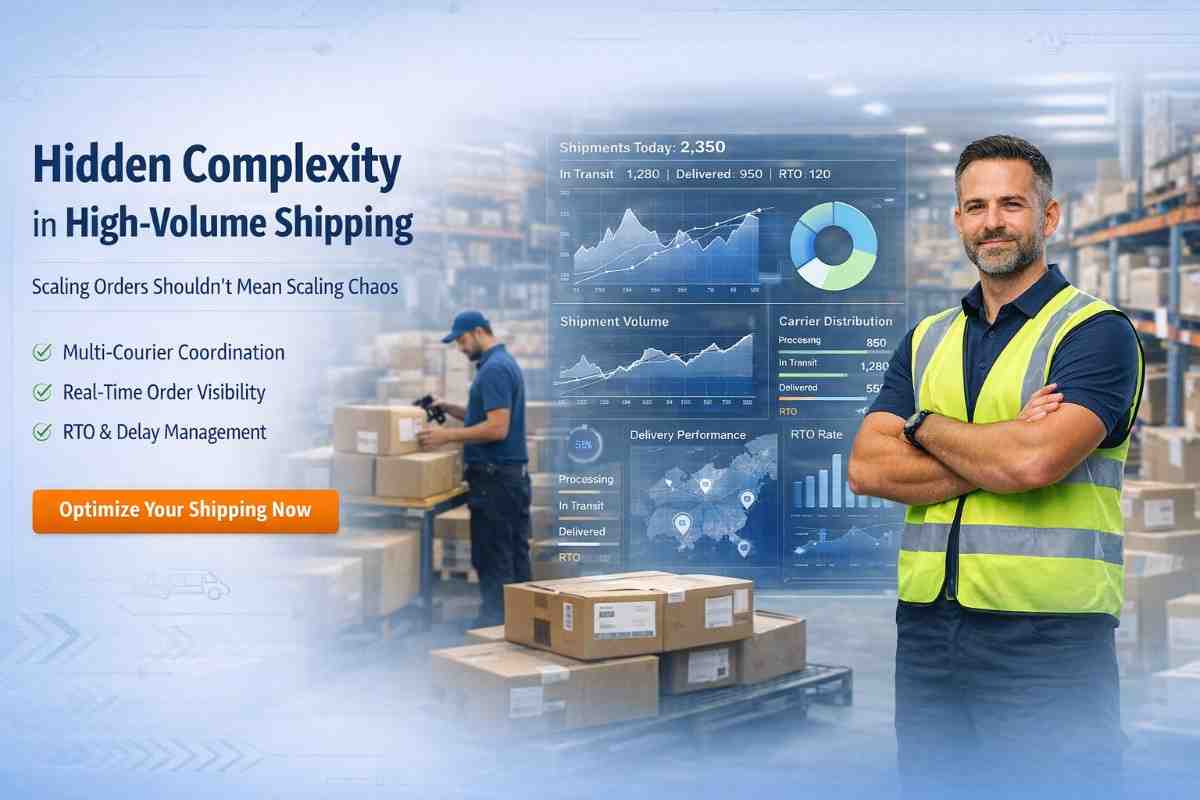
High-volume eCommerce shipping becomes complex due to multi-courier coordination, unpredictable delivery performance, rising RTO rates, operational bottlenecks, and lack of real-time control. Without automation and intelligent logistics systems, scaling shipping leads to inefficiency, delays, and revenue loss.
At low order volumes, shipping feels manageable.
But once you scale to 500–10,000+ orders/day, logistics turns into a data-driven operational challenge.
This is where most sellers lose control.
Requires dynamic courier allocation, not fixed selection
Fact:
Causes:
At scale, teams often:
This leads to:
Modern platforms like Shipmozo help solve these challenges by offering:
Result: More control, lower cost, better delivery success
Because manual processes, single courier dependency, and lack of data-driven decisions lead to inefficiencies and delivery failures.
Use COD confirmation, smart courier selection, and multiple delivery attempts with optimized routing.
Maintaining consistent delivery performance across different regions and pincodes.
Yes, they provide automation, multi-courier options, and data insights that significantly improve performance and reduce costs.
Shipmozo uses intelligent courier allocation, real-time tracking, and RTO reduction strategies to optimize large-scale shipping operations.
High-volume shipping is not just about dispatching orders —
it’s about managing complexity at scale.
The difference between struggling sellers and scaling brands is simple:
Manual logistics vs. intelligent logistics
CTA
Stop losing money due to poor shipping decisions.
Switch to smarter logistics with Shipmozo
Reduce RTO Improve delivery success , and scalewithout chaos


Ankit Debnath is a sales and marketing professional with 4+ years of experience in the logistics industry, specializing in managing B2B and B2C key accounts. At Shipmozo, he focuses on driving growth through client acquisition, lead generation, and strategic relationship management. Passionate about building strong client relationships and delivering results, he brings a practical, growth-oriented approach to logistics and business expansion.





.webp)