

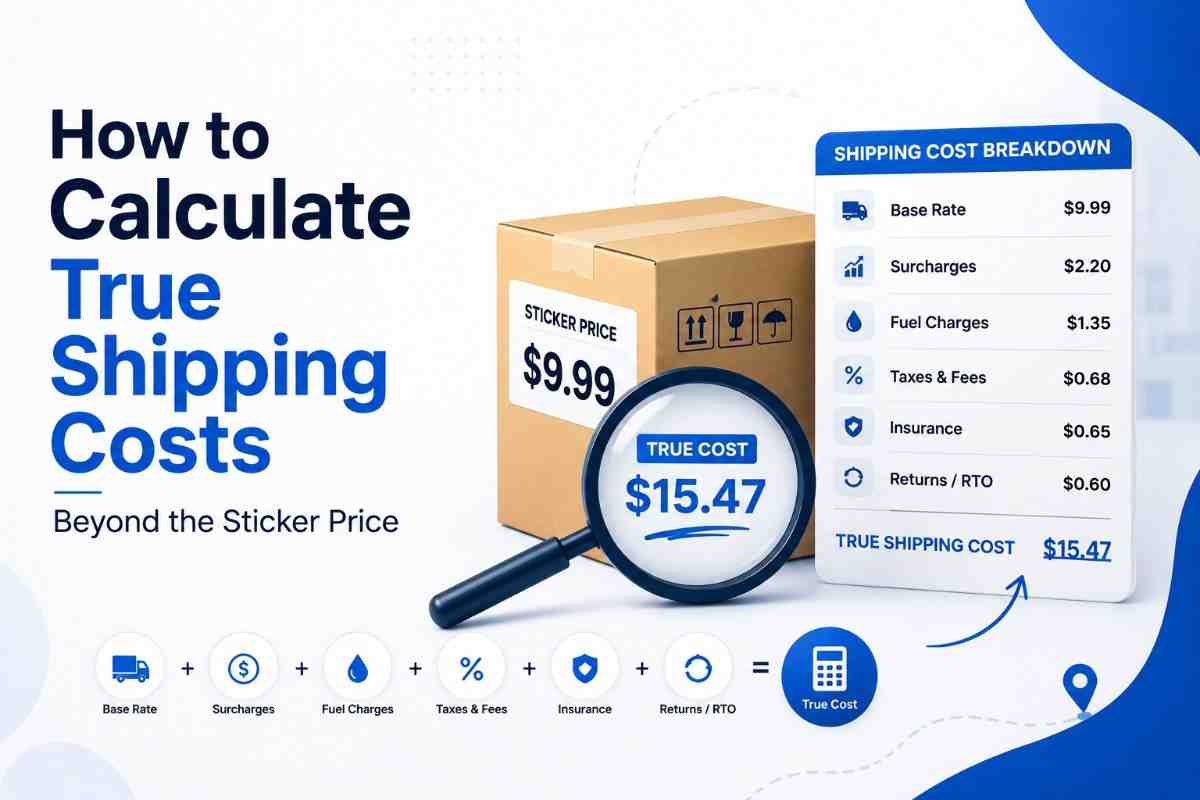
The rate shown on a courier panel is only the starting point. For an online seller, the actual cost of delivering an order may also include packaging, volumetric weight, COD handling, remote-area fees, fuel surcharges, return costs, taxes and billing adjustments. A shipment that appears inexpensive at booking can become significantly costlier after reconciliation.
That is why businesses need more than a basic shipping cost calculator india search result or a single courier quote. They need a repeatable way to estimate the landed logistics cost for each order before selecting a service. This is especially important for brands shipping across different zones, selling products with irregular dimensions, or managing a large COD share.
This guide explains the cost components that affect domestic shipments, shows a practical calculation method, and highlights the operational data an e-commerce business should track. The objective is not to choose the lowest displayed rate every time. It is to understand the final cost and select a service that fits the order, destination and customer promise.
True shipping cost is the complete expense associated with moving an order from the seller’s location to the customer and, when necessary, back to the seller. It combines the billed freight amount with the operational costs created by the shipment lifecycle.
The number is more useful than the initial label rate because it reflects what the business actually pays. For example, a courier may quote a forward shipment at a particular price based on a two-kilogram slab. If the package occupies more space than its physical weight suggests, the courier may bill it using volumetric weight. If the customer does not accept a COD order, the business may incur forward freight, return freight and handling costs.
A practical formula is:
True shipping cost = forward freight + surcharges + packaging + COD cost + expected loss from delivery exceptions + reverse logistics cost − recoveries or reimbursements
Not every component applies to every order. Prepaid parcels may not have COD charges, while a lightweight but oversized package may have a substantial dimensional-weight adjustment. Businesses should therefore calculate the cost by shipment type instead of applying one average figure to every SKU.
The sticker price is generally the rate visible before dispatch. The final billed amount is the amount recorded after the courier validates weight, dimensions, destination and service conditions. Differences can arise from reweighing, address corrections, remote pincode classification, additional delivery attempts or a return-to-origin event.
For a broader view of the operating model, sellers can review this eCommerce shipping complexity guide. It explains why logistics costs extend beyond simply handing a parcel to a courier.
Shipping affects margin, pricing, customer experience and cash flow at the same time. If a seller calculates only the advertised freight rate, product-level profitability can be misleading. A low-value order may generate revenue but lose money after delivery exceptions and returns are included.
Accurate costing is particularly important for businesses serving India’s varied geography. A parcel moving between major urban centres may have a different cost profile from one going to a remote location or a smaller town. Serviceability, transit mode, delivery attempts and return handling can all change the final expense.
Contribution margin shows how much remains after variable costs are deducted from an order’s revenue. When freight, packaging and payment-related delivery costs are understated, the seller may offer free shipping on orders that are not economically viable. A realistic cost model helps the business decide when to charge shipping, set a free-shipping threshold or restrict certain delivery options.
The cheapest base rate is not necessarily the lowest-cost option. A carrier with better performance for a particular zone or product category may create fewer failed deliveries and returns. Comparing total cost by lane, weight slab and payment type supports more informed carrier allocation.
Courier invoices commonly contain adjustments that are difficult to identify when shipment records are incomplete. Recording the booked weight, package dimensions, selected service, destination pincode and final billed amount allows the operations team to investigate discrepancies instead of accepting them as unavoidable.
Businesses that are growing across multiple regions may also benefit from courier performance metrics. Cost and service data should be reviewed together because a low freight bill can hide delivery or return problems.
Before building a calculation sheet or using a rate tool, define which cost elements apply to your business. The following components cover most of the variance seen in domestic e-commerce shipping.
For dimensional billing, see the practical explanation of volumetric weight. For disputes involving billed weight, the guide to weight discrepancy in shipping is also relevant.
A rate-calculation tool becomes useful when the input data mirrors the information used in courier billing. Entering only product price and physical weight will not produce a dependable estimate. The calculation should reflect the parcel, route and order conditions.
The result should be stored by SKU, zone, payment mode and service type. This creates a useful cost history rather than a one-time quote. Businesses managing several carriers can also explore multiple couriers in one dashboard to simplify operational comparison.
A reliable cost model depends more on disciplined data collection than on a complex spreadsheet. Start with the information your fulfilment and finance teams can verify, then improve the model as shipment volume increases.
Product pages often show the item’s dimensions, while courier billing is based on the final packed parcel. Keep a packaging specification for each major SKU, including the outer length, breadth, height and average dead weight. Recheck these values whenever packaging changes.
Do not use one nationwide average if your orders are distributed across regions. Break down costs by local, regional, national and remote movements where the carrier’s rate structure supports those categories. This helps identify products that are profitable in one region but expensive to deliver elsewhere.
Payment mode can change the financial outcome of a shipment. COD may involve handling charges and a higher risk of failed delivery. Track freight, conversion, delivery success, RTO and remittance timing separately for each payment type instead of treating all orders as identical.
Fashion, footwear and products with sizing or fit uncertainty may generate more returns than standard goods. Estimate the forward and reverse cost together when setting prices, selecting packaging or deciding which service levels to offer.
Commercial terms, surcharge rules and serviceability can change. Set a fixed review cycle for rate cards and compare a sample of invoices against booked shipment data. Look for repeated differences rather than investigating only unusually large bills.
Track delivery success, NDR frequency, RTO, transit exceptions and damage alongside freight cost. A service with a slightly higher rate may be operationally preferable if it performs consistently for a particular product and destination group. The right conclusion should come from delivered-order economics, not the booking screen alone.
Packaging is another practical lever. The guide on reducing volumetric weight covers ways to minimise unused space without compromising product protection.
Many businesses underestimate logistics expense because their process captures only the first number shown by the courier. These mistakes are common during early growth and become more expensive as order volume increases.
A structured process for post-pickup shipping charge changes can help the operations team identify whether an adjustment came from weight, dimensions, destination or a contract rule.
Different decisions require different levels of cost detail. A quick rate check is useful for an individual order, while a fully loaded model is more appropriate for pricing and profitability analysis.
For most growing e-commerce businesses, the shipment-cost view should be the minimum operating standard, while the delivered-order view should guide monthly profitability reviews. The strategic view becomes increasingly valuable when multiple carriers or fulfilment locations are involved.
Calculating the real cost of a shipment requires more than checking a courier’s starting rate. Sellers should include chargeable weight, packaging, COD handling, destination surcharges, invoice adjustments, failed deliveries and reverse movement before deciding whether an order is profitable to ship.
A reliable shipping cost calculator india workflow can help businesses compare services using consistent inputs and then validate estimates against actual invoices. Shipmozo supports different operating requirements through B2C Shipping, Surface, Air and other logistics options, helping businesses evaluate the appropriate movement type for each order. Use the data to make informed decisions on pricing, carrier selection and customer shipping policies rather than chasing the lowest visible rate.
Start Shipping Today
The complete cost can include forward freight, chargeable weight, packaging, COD handling, fuel or location surcharges, taxes, invoice adjustments, failed-delivery expenses, RTO and reverse logistics. Not every component applies to every shipment, so businesses should calculate costs by order type.
Volumetric weight accounts for the space a parcel occupies during transport. When it is higher than dead weight, the courier may use the volumetric figure for billing. This is why packed length, breadth and height should be entered into a rate calculation.
Yes. COD orders may carry handling charges and can have a different failed-delivery or RTO profile. Separating the two payment modes gives a clearer view of delivered-order margin and helps businesses set appropriate shipping policies.
Compare the invoice with the booked shipment record, including origin, destination pincode, packed dimensions, dead weight, chargeable weight, service type and payment mode. Investigate repeated differences such as reweighing, remote-area charges or post-pickup adjustments.
No. The lowest base rate may not produce the lowest total cost if the service has more delivery exceptions, RTOs, returns or billing adjustments for a particular lane. Carrier selection should consider freight and operational performance together.


Neha Pant works in business development at Shipmozo, where she focuses on helping eCommerce and D2C brands simplify their logistics and scale operations efficiently. She is passionate about understanding real shipping challenges and connecting businesses with the right solutions.





.webp)