

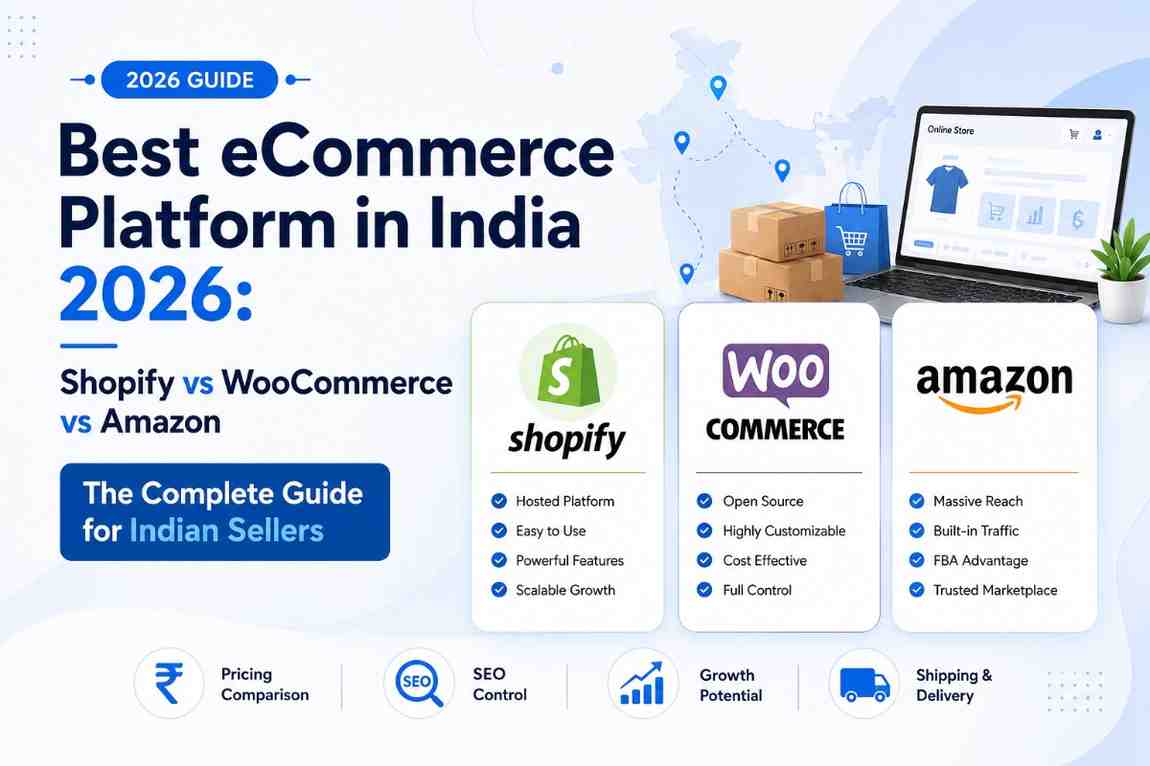
You have decided what to sell. You know your audience. You have sourced your products. Now comes the question every Indian seller faces at some point: Which platform should I use to sell online — Shopify, WooCommerce, or Amazon?
The honest answer is it depends on your business model, your budget, and your growth stage. A D2C fashion brand in Mumbai has very different needs from a first-time seller in Patna testing a product on a ₹10,000 budget. What works brilliantly for one seller can quietly drain margins for another.
Not sure yet? Read on — the details will make this decision clear for your specific situation.
Before comparing, it is important to understand what type of solution each one actually is.
Shopify is a cloud-hosted store builder. You pay a monthly subscription and get a ready-to-run online store—hosting, checkout, inventory, and payment integration included. You do not need a developer to launch. Everything is managed by Shopify.
Best analogy: Renting a fully furnished shop in a well-managed mall. You focus on running your business; the infrastructure is taken care of.
WooCommerce is a free open-source plugin for WordPress. The plugin itself costs nothing, but you need to manage your own hosting, security, updates, and developer support. You own the platform entirely.
Best analogy: Building and owning your own shop. You have full control, but maintenance is your responsibility.
Amazon India is not an eCommerce platform. It is a marketplace — you list your products alongside millions of other sellers on Amazon's platform. You do not have your own store. You pay referral fees and commissions per sale instead of a subscription.
Best analogy: Renting a stall inside a massive busy market. You get walk-in traffic, but you share space with competitors and have limited control over your brand.
This is where most blogs fail Indian sellers—they show USD pricing that means nothing on the ground. Here is what each platform actually costs in India in 2026.
*Transaction fee applies because Shopify Payments is not available in India. Every order via Razorpay, PayU, or Cashfree incurs this fee on top of the payment gateway's own charges.
Hidden costs to budget for:
Real monthly cost example for a store doing ₹5 lakh/month in sales on the basic plan:
Pro tip: Upgrading from the basic to the Shopify plan becomes a net positive at ₹3–4 lakh/month revenue because the 1% drop in transaction fees saves more than the extra subscription cost.
The WooCommerce plugin is free. But running it is not free.
Real monthly cost for same ₹5 lakh/month store:
WooCommerce has zero platform transaction fee, which is a meaningful saving at scale. On ₹5 lakh/month, you save ~₹10,000/month vs Shopify Basic — which is ₹1.2 lakh annually.
Amazon does not charge a monthly fee for most sellers. You pay per sale.
Average total deduction per order: 15%–40% of selling price
Real example for a ₹500 product (apparel):
Amazon's commission model works fine at low volumes. But at scale, 15%–40% per order makes it difficult to build healthy margins — which is why most sellers who grow on Amazon eventually start their own Shopify or WooCommerce store.
This is the section most global comparison blogs miss entirely. India has unique eCommerce dynamics that heavily influence which platform is right for you.
COD accounts for 40%–60% of orders in Tier-2 and Tier-3 cities in India. If you are targeting these markets, COD support is non-negotiable.
Amazon wins on COD simplicity — it is already set up and working. Shopify and WooCommerce both support COD but require configuration and testing, especially for rejection and confirmation workflows.
Every Indian eCommerce business must comply with GST. This includes GST-compliant invoices with HSN codes, CGST/SGST/IGST splits, and seller GSTIN on every order.
Important: If you are GST-registered, you can claim Input Tax Credit (ITC) on Shopify subscription fees and gateway fees, which reduces your effective cost.
India processed over 27.1 billion UPI transactions in January 2026 alone. Your platform must support UPI natively.
All three platforms support UPI. Shopify's main gap is that Shopify Payments is not available in India — so you always pay a third-party gateway fee.
RTO is India's biggest shipping problem. On average, 15%–30% of eCommerce orders in India are returned before delivery, costing sellers 2x the shipping fee plus lost revenue on each order.
How each platform affects your RTO rate:
Amazon India: Amazon's own delivery network (Easy Ship/FBA) has relatively strong delivery rates. However, you have limited visibility and control over NDR management when something goes wrong.
Shopify: You control your courier partners through a shipping aggregator. With the right aggregator, you get real-time NDR alerts, automated buyer outreach, and reattempt workflows that directly reduce RTO.
WooCommerce: Same as Shopify — you manage your own shipping and can use a shipping aggregator for multi-courier selection and NDR management.
Shipmozo integration: Both Shopify and WooCommerce integrate directly with Shipmozo. You get access to 27+ courier partners, AI-based courier selection, COD management, and automated NDR handling — which helps reduce RTO across both platforms.
India's eCommerce growth is now primarily driven by Tier-2 and Tier-3 cities. Pin code coverage, COD availability, and regional language support matter here more than anywhere else.
For Tier-2/3 reach, pairing Shopify or WooCommerce with Shipmozo gives you access to 29,000+ serviceable pin codes through multiple courier partners — comparable to or better than Amazon's network.
Best for: D2C brands, fashion, beauty, lifestyle, and sellers who want to scale fast and own their customer relationships.
Strengths for Indian sellers:
Limitations for Indian sellers:
When to choose Shopify: You are building a brand. You care about owning your customer data, building repeat buyers, and running your own promotions—not sharing a platform with 500 competitors in your category.
Best for: Budget-conscious sellers, businesses with in-house developer resources, content-heavy stores, regional sellers who want full Hindi/regional language support.
Strengths for Indian sellers:
Limitations for Indian sellers:
When to choose WooCommerce: YouYou have a developer, or you are one. You want maximum control, zero platform fees, and a content-driven store (blog + shop) that ranks well on Google over time.
Best for: first-time sellers, sellers testing new products, businesses that want instant traffic without marketing spend, and sellers in categories like electronics, books, and FMCG, where Amazon dominates.
Strengths for Indian sellers:
Limitations for Indian sellers:
When to choose Amazon: You are testing a product and want sales data fast. Or your category is one where Amazon already dominates and buyers search there first (electronics, books, and kitchen appliances).
Many of India's fastest-growing D2C brands in 2026 use all three together:
This is called an omnichannel approach, and it is the model that allows brands to capture market share quickly (via Amazon) while building a long-term business (via their own store).
The platform you choose affects your shipping operations significantly.
On Amazon India: Amazon manages shipping via Easy Ship (they pick up from you) or FBA (you send stock to their warehouse). RTO is handled by Amazon's policy. You have limited ability to choose courier partners or intervene in NDR situations.
On Shopify and WooCommerce: You manage your own shipping. This is actually an advantage—you can use a shipping aggregator like Shipmozo to
For sellers who want control over their delivery experience and RTO rates, Shopify + WooCommerce + a shipping aggregator is the stronger operational model versus relying solely on Amazon's logistics.
Ask yourself these 5 questions:
2. What is your monthly order volume?
3. Do you have a developer or tech support?
4. What percentage of your orders are COD?
5. Do you need GST compliance out of the box?
Amazon India is the fastest way to start getting orders without upfront investment in marketing or store building. Once you have validated your product and are doing 50+ orders/month, migrate to or add Shopify or WooCommerce for better margins and brand ownership.
Yes. Yes. Shopify now bills Indian merchants directly in INR, supports UPI for subscription payment, and integrates with Razorpay, PayU, and Cashfree. Note that Shopify Payments is not available in India, so a 2% transaction fee applies on the Basic plan.
Yes. WooCommerce has a built-in COD payment option that you can enable from the dashboard. For COD confirmation workflows (to reduce RTO), you can integrate with Razorpay COD or use a shipping aggregator that includes COD management.
Shopify does not generate GST-compliant invoices natively in India. You need a third-party app. Tera GST and Sufio are the most commonly used options. Both generate invoices with HSN codes and CGST/SGST/IGST splits automatically per order.
Yes, and many successful Indian D2C brands do exactly this. Amazon drives new customer discovery; your own store builds loyalty and margins. A shipping aggregator like Shipmozo can centralize order management and shipping across both channels.
Amazon Easy Ship has the widest ready-to-use pin code coverage in India. For Shopify and WooCommerce sellers, pairing with a shipping aggregator that covers 29,000+ pin codes (like Shipmozo) gives comparable or better reach with more courier flexibility and NDR control.
RTO depends more on your shipping and NDR management than the platform itself. Sellers on Shopify and WooCommerce who use AI-based courier selection and automated NDR follow-up workflows through a shipping aggregator consistently achieve lower RTO rates than those relying on a single courier or marketplace logistics.
There is no single "best" eCommerce platform for Indian sellers in 2026. The right choice depends on where you are in your business journey.
Start on Amazon if you want to validate your product quickly with zero upfront investment and tap into existing buyer traffic.
Build on Shopify if you are a D2C brand that wants to launch fast, own your customer relationships, and scale without technical overhead.
Choose WooCommerce if you have developer resources, want full control, zero transaction fees, and a platform that grows with your SEO content strategy over time.
And whichever platform you choose, your shipping partner matters as much as the platform itself. Fast, reliable delivery with low RTO is what turns first-time buyers into repeat customers. That is where Shipmozo comes in.
Shipmozo integrates directly with both Shopify and WooCommerce, giving you:


Kuldeep Karki is a Digital Marketing Manager at Shipmozo, specializing in performance marketing, SEO, and growth strategy. With over 6+ years of experience in digital marketing, he has worked extensively on scaling B2B and eCommerce brands through data-driven campaigns across Meta Ads and Google Ads.





.webp)