

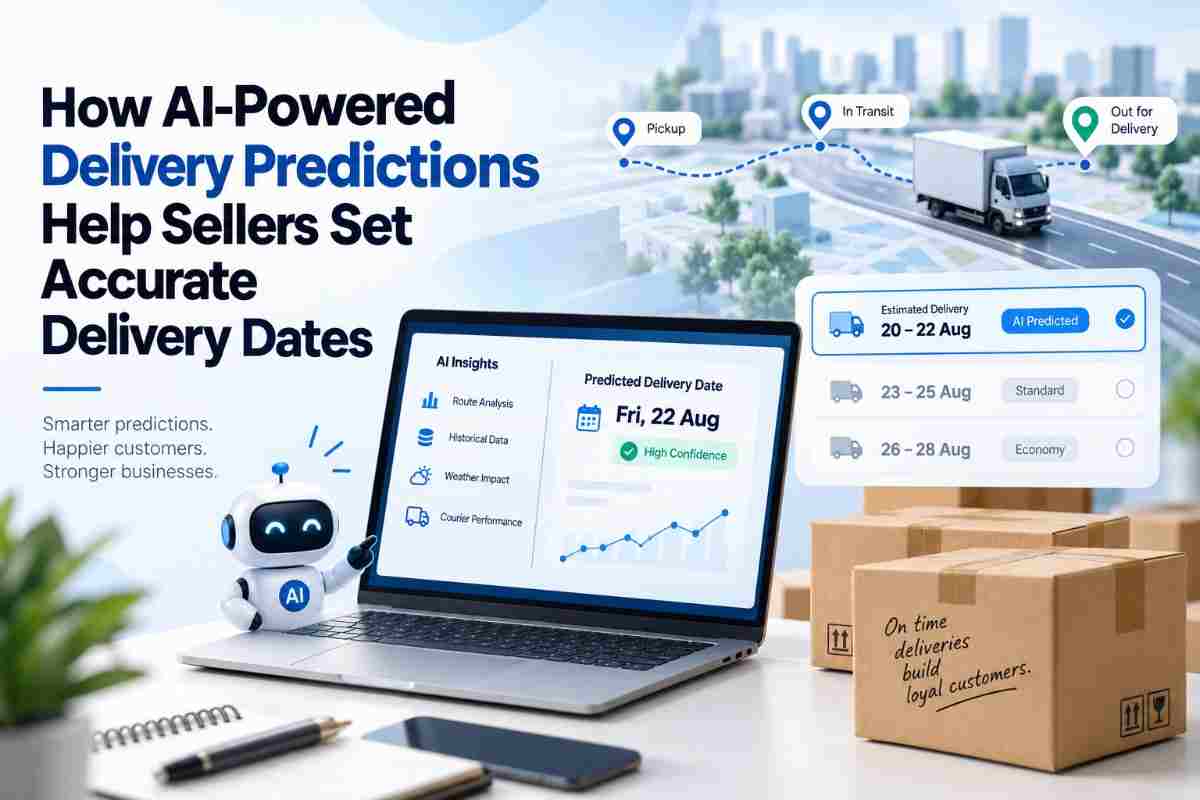
Customers want to know when an order will arrive before they complete payment. For sellers, displaying a delivery date is more complex than adding a fixed number of days to the order date. Transit time can change based on the destination pincode, courier coverage, service type, pickup readiness, route conditions, and the carrier selected for that shipment. This is where ai delivery date prediction ecommerce systems become useful.
An accurate estimated delivery date, or EDD, depends on the quality of the courier allocation decision behind it. If an order is assigned to a carrier that has suitable serviceability and a reliable record for the destination, the displayed estimate is more likely to reflect actual delivery conditions. If the allocation is based only on habit or headline price, the estimate may be less dependable.
For growing eCommerce businesses, delivery prediction is not only a technology concern. It affects checkout confidence, customer support workload, failed delivery handling, repeat purchases, and the way operations teams plan dispatches. This guide explains how AI-supported courier allocation contributes to more practical delivery estimates and how sellers can use the capability responsibly.
AI delivery date prediction is the process of using shipment information, courier performance signals, and destination-level delivery patterns to estimate when an order is likely to reach the customer. The prediction may be shown as a date or a delivery window during checkout, order confirmation, or post-purchase communication.
The important point is that the prediction is connected to the shipping decision. A system cannot produce a useful estimate by looking only at the order timestamp. It needs to consider which courier is likely to handle the shipment, whether that carrier serves the destination, and what delivery performance can reasonably be expected for that route.
In Shipmozo's model, AI Courier Allocation supports this process by helping match shipments with a suitable courier. The selected carrier influences the expected movement of the parcel, so better allocation can provide a stronger basis for EDD accuracy.
A typical workflow starts when an order is created. The shipping system evaluates relevant order and destination details, considers available courier options, and allocates the shipment according to the applicable delivery logic. The resulting carrier choice can then inform the estimated delivery date shown to the buyer.
This does not mean that AI can eliminate uncertainty. Weather, network disruptions, incorrect addresses, customer unavailability, operational backlogs, and other events can still affect delivery. The purpose is to make the estimate more evidence-based than a manually selected or universally applied timeline.
Delivery promises influence the buying decision. A customer comparing two similar products may prefer the seller that clearly communicates when the parcel is expected. A vague or unrealistic timeline creates hesitation before purchase and dissatisfaction after dispatch.
For sellers, the cost of an inaccurate estimate appears across several teams. Customer support receives more “where is my order” requests, operations teams spend time checking shipment updates, and marketing or sales teams may face complaints when a promised date is missed. Accurate expectations do not prevent every delay, but they make communication more credible and easier to manage.
The delivery estimate also affects the customer experience after checkout. If the parcel reaches the buyer within the stated window, the seller appears organised and dependable. If it arrives significantly earlier or later than expected, the customer may judge the brand based on the promise rather than the product alone. A practical prediction therefore needs to balance convenience with operational reality.
Businesses that manage several courier options face an additional challenge: every carrier may perform differently across locations and shipment types. A courier performance review helps sellers understand why allocation quality matters to delivery communication.
AI-supported delivery prediction is most valuable when it improves a connected operational process rather than functioning as an isolated date calculator. The benefit comes from using better courier allocation to create a more relevant estimate for each order.
A single delivery rule for every pincode, product type, and courier can be too broad for a growing seller. Allocation based on shipment and destination conditions allows the estimate to reflect the selected service more closely. This is particularly useful when a business serves a mix of metropolitan, Tier 2, Tier 3, and remote locations.
When the estimate is based on the carrier handling the order, sellers can communicate a more meaningful delivery window. Customers can plan to receive the parcel, arrange payment for COD orders, or contact support before a potential delay becomes a complaint.
Manual courier selection often depends on an operator's experience, habit, or a quick rate comparison. That approach may work at low order volumes, but it becomes harder to apply consistently as the business grows. AI-assisted allocation helps standardise the decision-making process while leaving teams better placed to manage exceptions.
The difference between automated and manual allocation is explained further in this AI versus manual selection comparison.
When courier allocation and EDD logic are connected, a seller can examine whether delays are linked to a destination, service type, or carrier choice. This creates a stronger basis for operational reviews than simply looking at total delivery time across all shipments.
As order volume increases, the number of shipping decisions increases with it. An automated approach can support a larger shipment workflow without requiring an operator to evaluate every order from scratch. Teams can focus on packing readiness, exception handling, customer communication, and performance improvement.
AI-powered delivery predictions produce better results when the seller's shipping workflow is properly configured. The technology can support allocation, but it still depends on clean order information and sensible operational rules.
The process works best when sellers treat the estimate as an operational signal. It should guide customer communication and planning, while teams remain prepared for events that cannot be predicted from historical or current shipment data.
AI does not remove the need for shipping discipline. Sellers can improve the usefulness of predicted dates by controlling the quality of the inputs and setting clear expectations throughout the order journey.
Record actual package weight and dimensions instead of relying on rough estimates. Incorrect data can affect courier selection, billing, serviceability, and the delivery timeline. Sellers should also maintain accurate warehouse addresses and destination details so the system evaluates the correct route.
Customers experience the total time from order placement to delivery. The seller controls part of that timeline through order processing, packing, and handover, while the courier controls the transit portion. Displaying an estimate without accounting for handling time can create an expectation the logistics network cannot meet.
A range can be more honest than a single date for destinations or lanes with variable transit conditions. The width of the window should reflect the seller's operational knowledge and the service being offered. A narrow date range may look attractive, but it can create unnecessary dissatisfaction if it is not supported by actual performance.
Overall delivery performance can hide important differences between locations. Analyse performance by pincode, city, region, and service type. Remote destinations may require different expectations from metropolitan routes, and surface movement may need a different estimate from air movement.
The date shown at checkout should not be the last delivery communication. Order confirmation, dispatch updates, tracking messages, and exception notifications should remain consistent. A branded customer-facing tracking experience can also make status information easier to understand after dispatch.
Set an internal process for orders that are not moving within the expected timeline. Teams should know when to check the last scan, verify customer details, contact the courier, or initiate an appropriate NDR workflow. Prediction is most useful when it leads to timely action.
Sellers looking to streamline the wider workflow can review these eCommerce shipping solutions for practical process improvements.
Most delivery-date problems are not caused by one incorrect prediction. They usually result from a combination of poor data, weak process controls, and promises that do not reflect the operating environment.
These mistakes are avoidable when technology is combined with clear data standards, courier performance reviews, and a practical customer communication policy.
Both methods can be used in eCommerce operations, but they differ in consistency and scalability. Manual estimates may be adequate for a small catalogue with predictable routes. As shipment volume and destination coverage increase, automated allocation provides a more repeatable way to evaluate available courier options.
The comparison does not mean that automation should operate without oversight. Teams still need to validate data, monitor delayed shipments, and decide how to communicate unusual events. The practical advantage is that routine allocation can be handled systematically while human attention is reserved for exceptions and process improvement.
Reliable delivery dates begin with reliable shipping decisions. For eCommerce sellers, ai delivery date prediction ecommerce is most effective when it connects order data, destination serviceability, courier allocation, and shipment monitoring instead of treating the EDD as a standalone checkout message.
Shipmozo's AI Courier Allocation helps support the carrier-selection process that feeds EDD accuracy. Combined with multi-courier B2C Shipping and shipment visibility through tracking, it gives sellers a more structured way to manage delivery expectations as order volume grows. Estimates should still be presented responsibly because external disruptions and customer-side issues can affect the final outcome.
Start with accurate shipment details, review actual delivery performance, and use automated allocation to make each estimate more relevant to the order being placed. Start Shipping Today
AI improves estimated delivery dates by connecting the prediction with courier allocation. It can help evaluate shipment, destination, serviceability, and courier-performance signals so the displayed estimate is more relevant than a fixed timeline applied to every order.
No. An AI-generated date is an estimate, not a guarantee. Weather, network disruptions, incorrect addresses, customer unavailability, warehouse delays, and other operational events can change the final delivery outcome.
Useful inputs include the delivery pincode, package weight and dimensions, warehouse location, payment details, order timestamp, service type, and accurate customer information. Complete data helps the system assess courier suitability and delivery expectations.
Different courier options may have different serviceability and performance across destinations and shipment types. The selected carrier influences how the parcel is likely to move, so allocation is an important input for calculating a relevant delivery estimate.
Sellers can display a single date when their operational data supports that level of precision. For routes with more variability, a delivery window is often more responsible because it communicates an expectation without overstating certainty.
The seller should review tracking events, verify the address and customer details, check the courier movement, and communicate the updated status. An internal exception process helps the team decide when to contact the courier or begin the appropriate delivery-support workflow.


Nisshdeep Kaur is a logistics-focused content specialist with 5+ years of experience in eCommerce shipping and delivery optimization. She shares actionable insights to help businesses improve delivery success rates and scale efficiently with platforms like Shipmozo.





.webp)