

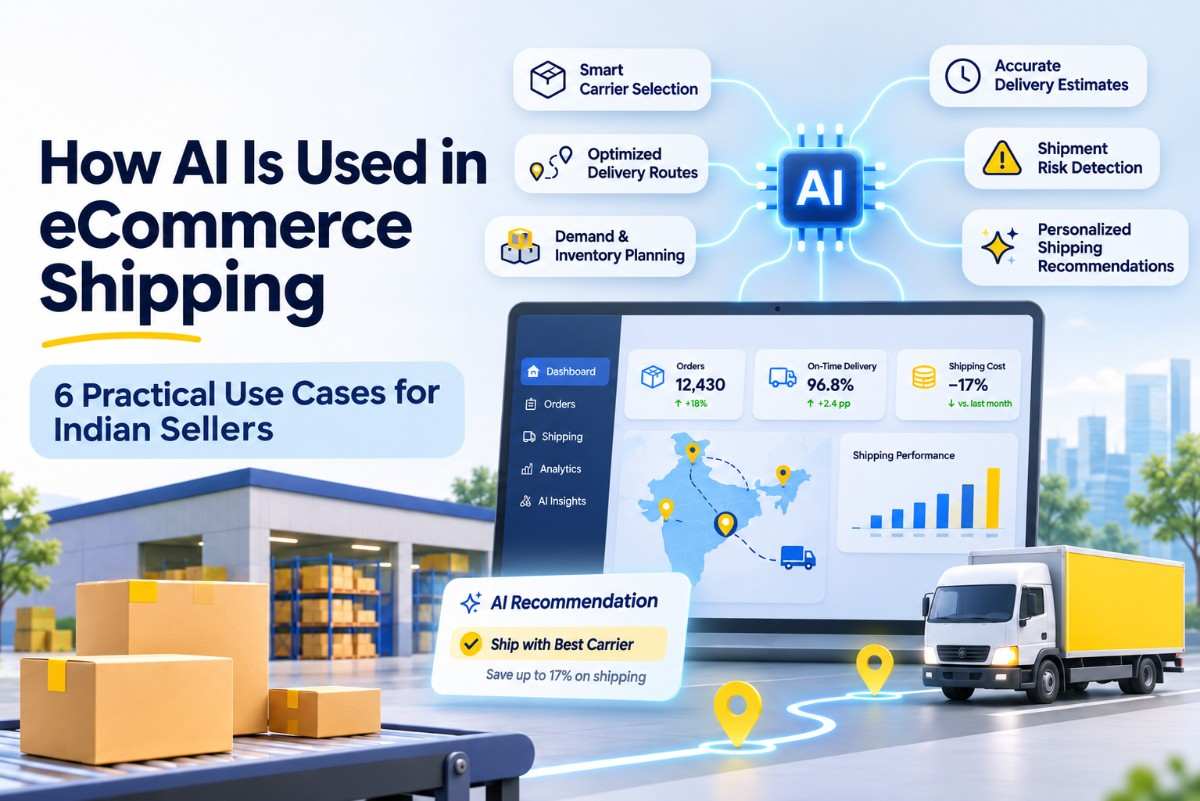
For an online seller, shipping decisions affect more than freight cost. Courier selection, delivery promises, failed attempts, COD orders, customer queries and returns all influence the final buying experience. As order volumes grow, reviewing every shipment manually becomes difficult. This is where AI in eCommerce shipping becomes useful.
Artificial intelligence does not replace logistics teams or courier partners. It helps them process more information and make faster operational decisions. An AI system can examine shipment attributes, past delivery performance, destination patterns and customer behaviour to recommend an appropriate action.
For Indian sellers, this matters because the delivery environment varies significantly between metros, Tier 2 and Tier 3 cities, remote pincodes, high-density urban areas and locations affected by weather or local disruptions. A courier that performs well in Bengaluru may not be the right choice for every shipment to Assam, Rajasthan or a remote island location.
This guide explains six practical use cases: courier selection, delivery prediction, shipment exception management, customer support, demand planning and returns or RTO management. The objective is not to present AI as a magic solution, but to show where it can support everyday shipping decisions.
Sellers can also review the broader eCommerce shipping issues that technology can help address before deciding which processes to automate.
AI in eCommerce shipping uses technologies such as machine learning, predictive analytics and natural-language processing to support decisions about courier selection, delivery estimates, shipment exceptions and customer support. AI models can identify patterns in historical data and, where appropriate, current tracking events. Rule-based automation is different: it executes predefined instructions without necessarily learning from past outcomes. The two approaches can work together in a shipping workflow.
In simple terms, traditional shipping software follows fixed rules. For example, a seller may instruct the system to select Courier A for all prepaid orders under 2 kg. An AI-assisted system can consider more variables, such as recent delivery performance in the destination area, serviceability, shipment type, historical delays and the probability of a successful delivery.
Predictions depend on the quality and relevance of available data. Incomplete addresses, inaccurate weights, missing scan events and inconsistent courier records can reduce model reliability, particularly for destinations with limited shipment history.
AI is therefore best understood as a decision-support layer around shipping operations. It can improve speed and consistency, but sellers still need clear business rules, human oversight and reliable courier data.
Indian eCommerce shipping involves multiple variables at the same time. A seller may handle prepaid and COD orders, different package sizes, several courier partners, varied delivery zones and customers with different service expectations. The same product may need surface shipping for one destination and air shipping for another because of urgency, network availability or package economics.
Manual decision-making becomes especially challenging during sales campaigns, seasonal peaks and rapid business expansion. Teams may select a courier based on habit instead of current performance. They may also miss early signs of a delay because tracking events are spread across different systems.
The value of AI in logistics in India lies in using operational data at a scale that people cannot easily review shipment by shipment. A model can identify that a particular route has rising delays, that certain pincodes have a higher rate of failed delivery attempts or that a package is likely to miss its expected delivery window.
However, AI should be introduced where it solves a defined problem. A seller does not need automation simply because competitors use the term. The right question is: which decision consumes time, changes frequently and can be improved with historical data?
Businesses exploring this area should first map their current workflow, data sources and measurable problems. That assessment is more useful than adopting an AI label without changing a specific process.
One of the clearest applications is recommending a courier for a particular shipment. The model may consider pickup location, destination pincode, package weight, service type, COD status, delivery history and courier availability. This is more flexible than applying one courier rule to every order.
Effective AI courier selection should consider the seller's priorities. The cheapest available service may not be suitable for a time-sensitive order, while the fastest service may not be commercially sensible for a low-value product. Sellers should define the factors that matter, such as cost, serviceability, delivery success and transit reliability.
Illustrative seller example: A Delhi seller shipping a COD parcel to Jaipur sees Courier A at ₹45 and Courier B at ₹49. If recent, reliable destination-level data suggests Courier B has a better delivery-success probability, the higher-priced option may be commercially preferable. These figures are hypothetical, not Shipmozo rates or performance results.
Shipmozo describes AI Courier Allocation as a shipping feature that considers inputs such as serviceability, delivery history and cost. Actual recommendations depend on the order and available couriers.
AI can estimate when a shipment is likely to arrive by analysing historical transit times, route conditions, scan events, destination patterns and current shipment progress. This can help sellers provide a more realistic delivery window instead of relying only on a generic service-level estimate.
AI delivery prediction is probabilistic, not a promise. Delays caused by weather, network disruptions, incomplete addresses or operational incidents can still change the outcome. Sellers should use predictions to prioritise communication and exceptions rather than advertise an absolute delivery guarantee.
Illustrative seller example: A package initially has a two-day standard transit estimate. After its most recent hub scan shows an unusual delay, a prediction system may revise the expected arrival to three or four days and flag it for proactive communication. A standard transit-time estimate, a predicted ETA and a guaranteed delivery date are different things; predictions are not guarantees.
Not every shipment follows the expected path. An order may show an address issue, customer unavailability, a failed delivery attempt, a damaged package or a hub delay. AI can classify these events, identify recurring patterns and prioritise cases based on the likely business impact.
For example, a system may flag a non-delivery report where a phone number is reachable and a reattempt may be useful. It may separately identify an address-related issue that requires customer confirmation before another attempt. This helps teams avoid treating every exception in the same way.
Illustrative seller example: A COD order receives an NDR marked 'Customer Unavailable'. An AI model might prioritise it for review using historical exception patterns. A separate, rule-based workflow can then request buyer confirmation and, if appropriate, submit a reattempt request through the courier's supported process. The model does not itself establish customer intent or authorise another attempt.
For the operational steps, see Shipmozo's NDR reattempt workflow.
Shipping generates many repetitive questions: where is the order, when will it arrive, why has it been delayed and what happens after a failed attempt? AI-assisted support can use tracking information and shipment status to provide relevant responses instead of sending the customer to a generic tracking page.
Useful communication should be specific and cautious. If an order is in transit, the message can explain the latest scan and expected next step. If there is an exception, the customer should receive a clear action request, such as confirming an address or selecting a suitable reattempt option.
What makes this AI-assisted? A fixed 'Out for Delivery' SMS is conventional automation. An AI assistant connected to trustworthy tracking data can interpret a customer's question, explain the last verified scan in plain language and route an unresolved issue to a human. It must never invent a scan, promise a delivery date without supporting data, or handle a payment dispute without appropriate escalation.
AI can analyse order history, product demand, campaign calendars, seasonality and regional buying patterns to support dispatch planning. The shipping benefit is indirect but important: better preparation can reduce processing delays, split shipments and avoid last-minute courier decisions.
A seller may use these insights to plan packaging materials, allocate stock closer to demand centres or prepare additional pickup capacity before a promotion. The model should be treated as a planning aid because demand can change due to pricing, product availability, competition or an unexpected event.
Illustrative seller example: Before a festival sale, a D2C brand forecasts a temporary increase in apparel orders. The fulfilment team can use that forecast to arrange enough cartons and labels, adjust packing shifts and discuss pickup capacity with courier partners. A forecast guides planning; it does not guarantee demand.
Shipping teams can pair this work with eCommerce analytics to connect order trends with delivery performance and customer outcomes.
Return to Origin (RTO) happens when a parcel is not successfully delivered and moves back to the sender. A customer-initiated return happens after successful delivery when a buyer requests to send the item back. These are different workflows and should be analysed separately.
For RTO, a model may examine COD status, destination, prior attempts, address completeness and courier outcomes to flag shipments that need extra confirmation or monitoring. For customer returns, it may help group return reasons such as fit, damage, product expectations or late arrival. An observed pattern does not, on its own, prove the underlying cause.
Illustrative seller example: An apparel brand notices repeated failed delivery attempts for some COD orders. It tests buyer confirmation before dispatch and measures changes in successfully delivered orders and RTO rate. Separately, the brand reviews size-related returns to improve its product information. Historical risk scores should not automatically block genuine customers.
Reverse-logistics analysis can also highlight reverse-pickup delays, repeat attempts and expensive return routes, helping sellers distinguish delivery failures from post-delivery product issues.
Implementing AI successfully starts with process discipline. A seller should not begin by automating every decision. Start with one workflow where the problem is visible, the data is available and the result can be measured.
Suggested pilot: Test recommendations on one comparable group of shipments while retaining a baseline group using the existing process. Compare delivery success rate, RTO rate, cost per successful delivery, NDR resolution time and customer complaints over a suitable period. Account for courier mix, seasonality and destination differences before attributing any change to the model.
Useful recommendations require consistent operating rules, sufficient data and measurable outcomes.
AI can be less reliable on low-volume routes, during exceptional disruptions or when recent courier performance differs from the training data. Patterns in historical records may also reflect operational failures rather than customer behaviour. Review results by location, payment type and shipment category, and recalibrate models when performance changes.
Introduce changes to a limited shipment group first and evaluate unintended consequences as well as improvements.
Each method has a role in a practical shipping operation:
A sensible hybrid process uses fixed rules for eligibility, AI to rank permitted options, and human review for exceptions.
AI can help Indian eCommerce sellers make better-informed shipping decisions, especially where courier choices, delays and exception cases are too numerous to review manually. The strongest approach is to test one measurable problem, use credible data and combine AI recommendations with clear operating rules.
Of the examples discussed here, Shipmozo's published features include AI Courier Allocation, multi-courier shipping, shipment tracking and NDR-related tools. The other use cases in this guide illustrate wider industry applications; they should not be read as a claim that Shipmozo currently offers each AI capability.
Ready to simplify courier selection and shipment management? Visit the Shipmozo seller panel to get started, or explore Shipmozo's shipping features to find the tools relevant to your business.
AI is used to recommend couriers, estimate delivery windows, identify shipment exceptions, automate customer responses, support demand planning and analyse returns or RTO patterns. It supports decisions but does not eliminate the need for operational oversight.
AI courier selection compares shipment information such as pickup location, destination pincode, weight, COD status, service requirements and historical courier performance. It can recommend a suitable option based on the seller's defined priorities, including cost, serviceability and delivery reliability.
AI can estimate a delivery window using tracking events, historical transit times, route conditions and destination patterns. The estimate is not a guarantee because weather, network disruption, address issues and customer availability can change the actual delivery outcome.
AI can identify patterns associated with failed delivery attempts and RTO, such as COD status, address quality, destination and previous delivery events. Sellers can then use suitable actions such as confirmation, address verification or a better NDR reattempt process.
Small sellers can use it when a specific repetitive problem is consuming time, such as comparing couriers or monitoring delivery exceptions. They should begin with a limited workflow, verify data quality and retain manual review until recommendations are reliable.
No. AI analyses data and recommends or prioritises actions, while courier partners perform transportation and delivery. Shipping teams remain responsible for rules, customer communication, exception handling and reviewing unusual outcomes.


Neha Pant works in business development at Shipmozo, where she focuses on helping eCommerce and D2C brands simplify their logistics and scale operations efficiently. She is passionate about understanding real shipping challenges and connecting businesses with the right solutions.