

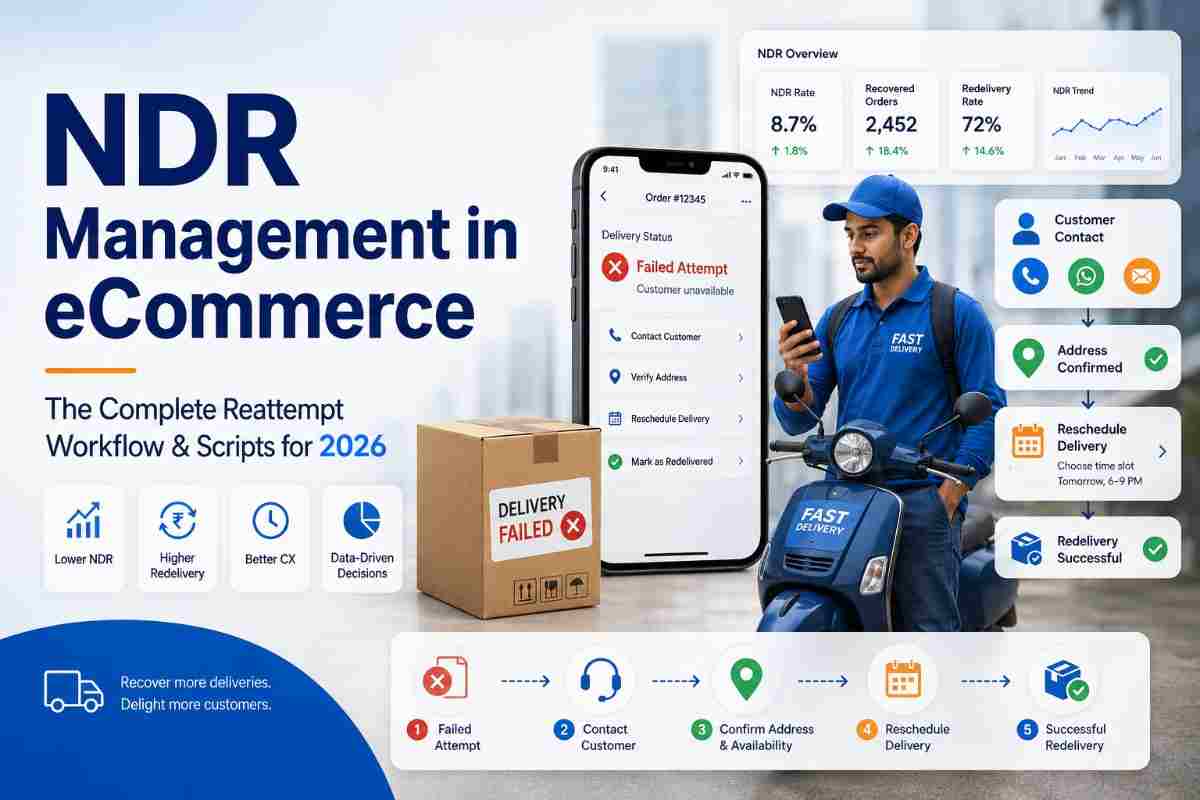
If you run an eCommerce or D2C business in India, you've seen it happen: an order gets packed, dispatched, marked "out for delivery" — and then stalls. The courier couldn't hand it over. This is called an NDR (Non-Delivery Report), and how you handle it in the next few hours decides whether that order becomes a delivered sale or an expensive RTO (Return to Origin).
RTO isn't just a lost sale. It means paying for forward shipping and reverse shipping, blocking working capital on a COD order, and absorbing a customer's frustration that they may never come back from. The businesses that keep their RTO percentage low aren't the ones with the cheapest courier—they're the ones with a disciplined NDR reattempt workflow.
This guide breaks down exactly how to build that workflow in 2026, plus ready-to-use scripts for calls, SMS, and WhatsApp that convert failed deliveries into successful ones.
NDR (Non-Delivery Report) is a status raised by a courier partner when a delivery attempt fails. It comes with a reason code—customer not available, address incorrect, customer refused, and so on. The shipment is still in the courier's hands at this stage, and a reattempt is possible.
This is the single most important distinction in failed delivery management:
Every RTO begins life as an NDR. Not every NDR has to end as an RTO. The 24–48 hour window between the two is where your entire NDR management process either earns its value or doesn't.
Every hour an NDR sits untouched, the odds of a successful delivery reattempt drop. Courier systems move fast toward automatic RTO once attempts run out, so a same-day response — ideally within a couple of hours — is the benchmark for high-performing sellers.
There's a cash-flow angle too, specific to India's COD-heavy market: COD remittance only happens after successful delivery. An order stuck in NDR for days is working capital frozen for days, with no guarantee it converts at all.
Use this structure regardless of which shipping aggregator or courier network you run on.
Pull NDR status from your courier feed as it updates, rather than waiting for a daily export. Minutes matter here.
Different NDR reasons need different fixes. Don't treat them all the same.
WhatsApp and SMS outreach convert faster than email because they're read almost instantly. Save phone calls for high-value orders or cases where an automated message gets no response.
Address problems can usually be fixed directly inside the courier's dashboard—no need to rebook the shipment. Availability problems need a specific, confirmed time slot, not a vague "we'll try again."
NDR resolution rate — the share of NDRs converted into successful deliveries — is the real leading indicator. The RTO rate only tells you what already went wrong; the NDR resolution rate tells you how well your process is working right now.
Break down NDR reasons by pincode, courier, SKU, and marketing channel. A spike in one SKU or ad campaign usually points to an upstream fix—checkout validation or ad targeting—not a delivery-stage fix.
Running this workflow manually across two or three courier dashboards is possible at low volume, but it breaks down fast once you're shipping across multiple couriers and cities. This is where a multi-courier shipping platform like Shipmozo becomes useful — it centralizes NDRs from all your courier partners into a single dashboard, so your team isn't logging into five different panels to catch a failed delivery.
Instead of manually triaging each NDR reason, the reattempt and reason-tagging step happens from one place, which matters most for sellers scaling past a few hundred orders a month.
Copy, adapt to your brand voice, and keep the core structure — short, clear, and built for a fast yes/no reply.
Hi {Name}, We tried delivering your order {OrderID} today but couldn't reach you. Reply with a good time today or tomorrow and we'll reattempt right away. 📦
Hi {Name}, We're having trouble locating the delivery address for order {OrderID}. Could you share a nearby landmark or confirm your full address so we can deliver without delay?
Hi {Name}, Your COD order {OrderID} is scheduled for delivery. Please keep ₹{Amount} ready. Reply YES to confirm, or let us know if you'd rather pay online instead.
Hi {Name}, we noticed order {OrderID} couldn't be delivered. If this was a timing issue, reply "RESCHEDULE," and we'll arrange a new slot at no extra cost.
"Hi, this is {Agent Name} calling from {Brand}. Our courier wasn't able to deliver your order {OrderID} today—do you have two minutes to help us get it to you?"
"No problem—when would work better for you, today or tomorrow? I'll lock that slot in with the courier so it doesn't happen again."
"I understand. Before I mark this as a return, is there a size, color, or small adjustment that would still work for you? If not, I'll process the return on your end—no issue at all."
"Totally understand — want me to send a payment link instead, so there's no cash needed at the door?"
A strong reattempt workflow matters, but the sellers with the lowest RTO percentage invest just as heavily upstream:
Handling failed deliveries well isn't a support-desk chore — it's a direct lever on revenue and customer trust. The gap between a seller with a high RTO rate and one with a low one almost never comes down to which courier they use. It comes down to how fast, and how precisely, they act in the narrow window between a failed delivery attempt and an irreversible return. Build the workflow, keep your scripts ready, and track NDR resolution rate as closely as you track sales.
NDR stands for Non-Delivery Report — a status raised by a courier when a delivery attempt fails. It's an intermediate stage; the shipment is still with the courier and eligible for reattempt.
NDR is a single failed delivery attempt where the parcel is still recoverable. RTO (Return to Origin) happens after all attempts are exhausted, and the parcel begins its return journey to your warehouse, at your cost.
Within 24 hours at the latest, ideally within a few hours. The longer an NDR goes unaddressed, the lower the chance of a successful reattempt before the courier marks it RTO.
Yes, the first outreach (WhatsApp/SMS confirmation and reattempt scheduling) should be automated for speed and scale. Human phone calls are best reserved for high-value orders or NDRs that don't resolve after an automated message.
Customer unavailability and address-related issues are typically the top two causes, followed by COD payment hesitation and unreachable phone numbers. The first two are largely preventable through better checkout validation.
Yes. Fast, structured, multi-channel NDR outreach consistently improves delivery success rates compared to manual or delayed processes — though the exact improvement depends on product category, COD share, and how quickly the team acts within the NDR window.
NDR resolution rate is the percentage of non-delivery reports that convert into successful deliveries rather than returns. Unlike the RTO rate, which only shows the final outcome, the NDR resolution rate shows how well your process is performing in real time while there's still a chance to fix a failing delivery.
No—reserve calls for high-value orders or cases where an automated WhatsApp/SMS message goes unanswered. Automated first-touch outreach handles the majority of NDRs faster and at lower cost.


Diveya Mehta is a marketing and content specialist with 3+ years of experience, currently working with Shipmozo. With 1 year of hands-on experience in logistics, she creates practical, insight-driven content focused on shipping, courier performance, and eCommerce growth.





.webp)