

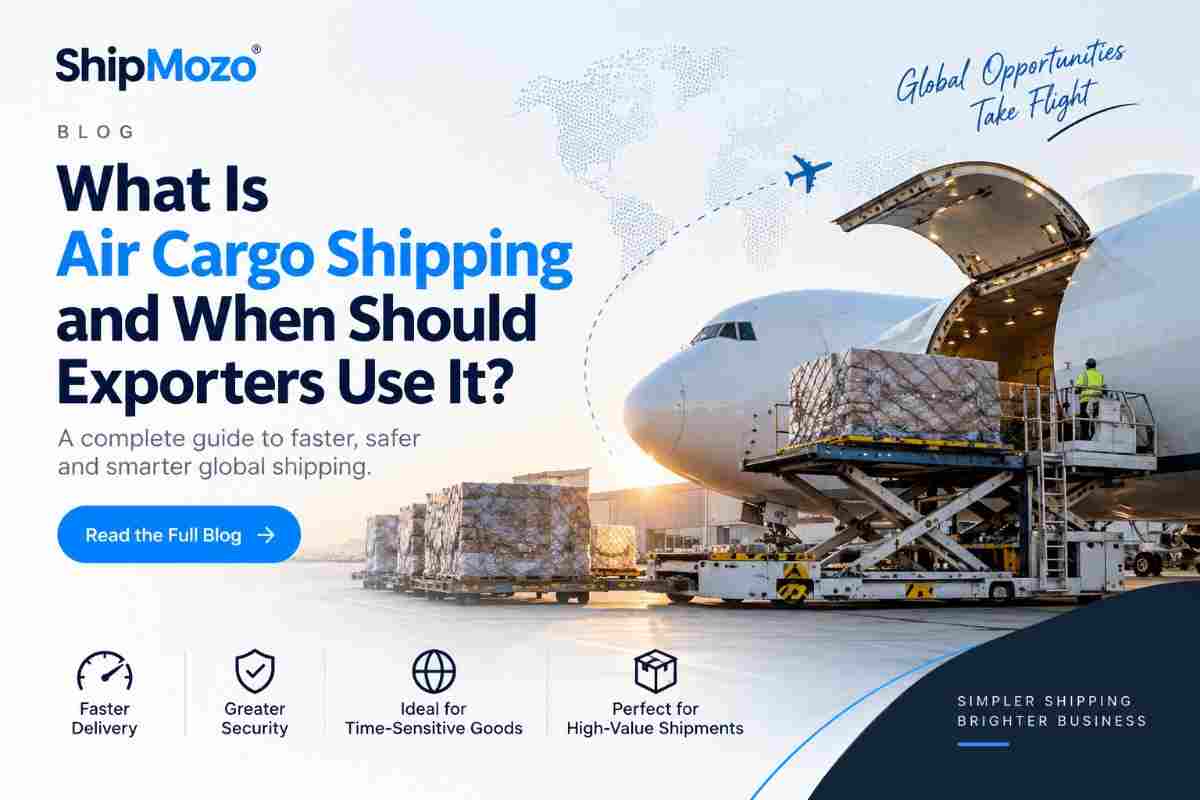
For exporters, choosing the right transport mode affects delivery speed, inventory planning, working capital, and customer commitments. Air freight is often considered when a shipment must move quickly across domestic or international routes, but speed alone does not make it the right option for every consignment. Weight, dimensions, product value, urgency, destination, handling requirements, and budget all need to be evaluated together.
If you are researching what is air cargo shipping, the short answer is that it is the movement of commercial goods by aircraft through a coordinated network of airports, cargo terminals, freight forwarders, airlines, customs authorities, and delivery partners. The process can support both regular export orders and time-sensitive consignments.
This guide explains how the mode works, when exporters should consider it, what affects pricing, and how to prepare cargo before handover. It also covers the operational limitations that can lead to delays, document issues, or unexpected charges. For businesses comparing transport options, the objective is not to select the fastest mode automatically. It is to match the mode with the shipment's commercial priority.
Exporters handling multiple order types can also review Shipmozo's air shipping overview for a concise explanation of the service category.
Air cargo shipping is the transportation of goods using aircraft. Cargo may be carried in dedicated freighter aircraft or in the cargo hold of passenger aircraft, depending on the route, airline network, available capacity, product type, and shipment schedule. The movement typically begins at the seller's warehouse and ends at the buyer's facility or a designated delivery location.
Unlike passenger baggage, commercial cargo requires shipment documentation, packaging suitable for handling, accurate weight and dimensions, and compliance with airline and destination-country rules. International consignments may also require export declarations, commercial invoices, packing lists, certificates, permits, and customs clearance information.
The movement is usually divided into several operational stages:
Air cargo is not limited to small parcels. It can include cartons, pallets, commercial samples, spare parts, machinery components, garments, electronics, medicines, and other approved products. However, acceptance conditions vary by carrier and route. An exporter should confirm serviceability and restrictions before packing the shipment, especially for batteries, chemicals, perishables, oversized pieces, or high-value goods.
Transport decisions influence more than the freight bill. A delayed export order can hold up a production line, cause a stockout at a distributor, disrupt a product launch, or weaken a buyer relationship. Air freight gives exporters an option when the cost of waiting is higher than the premium paid for faster movement.
This is particularly relevant for businesses shipping products with short selling windows. Fashion collections, seasonal merchandise, promotional materials, replacement parts, and urgent samples can lose commercial value if they arrive after the required date. Faster transport may also help an exporter replenish overseas inventory without holding excessive safety stock in every market.
The mode can support several business situations:
Air transport does not remove customs, documentation, or last-mile risks. A flight can arrive on schedule while the shipment remains held because the invoice is incomplete, the consignee information is incorrect, or the product requires an approval. Exporters should therefore evaluate the complete door-to-door process, not only flight duration. A broader international shipping framework helps place air movement within the full cross-border workflow.
The main advantage of this mode is speed, but experienced exporters assess several benefits together. The value comes from how the transport option supports inventory, customer service, and supply-chain responsiveness.
Air routes generally provide faster long-distance movement than surface transport and other slower freight options. Transit time still depends on flight availability, connections, terminal processing, customs, and final-mile delivery. Exporters should communicate a realistic end-to-end timeline rather than treating the flight segment as the delivery promise.
Air networks connect major commercial centres and support cross-border trade where speed is important. This can be useful for exporters serving multiple countries from one production base. The available route may not be direct, so the exporter should check destination serviceability and planned connections before accepting an order.
Faster replenishment can help a business respond to demand without storing large quantities near every customer. This does not mean air freight always reduces total logistics cost. The benefit must be assessed against freight charges, warehousing costs, stockout risk, product value, and the financial impact of delayed sales.
Exporters often need to send product samples, prototypes, replacement units, or limited quantities before a larger order is ready. Air cargo can be practical for these shipments when the commercial value of speed exceeds the savings available through slower transport.
Factory delays, route interruptions, unexpected demand, and missed dispatch windows can require a recovery plan. Air freight provides an additional option for selected shipments. It should be used selectively because repeated emergency movement can increase logistics costs and hide underlying planning problems.
International cargo passes through multiple handling points, making status visibility important. Tracking information can help exporters identify pickup, terminal receipt, departure, arrival, clearance, and delivery events. Accurate status updates also make it easier to coordinate with consignees and customer-service teams.
A reliable air shipment begins before the cargo reaches the airport. The exporter should validate the commercial need, prepare the shipment data, and confirm that the goods can travel on the selected route. The following process provides a practical operating sequence.
For a related explanation of the transport reference used in this process, see Shipmozo's guide to the AWB number.
Air freight performs best when shipment preparation is consistent. Exporters should create a repeatable checklist rather than relying on individual employees to remember route-specific requirements. A standard process reduces preventable exceptions and makes it easier to compare performance across orders.
Define when a shipment should move by air, surface, rail, or another available option. The rule can consider product value, customer priority, required delivery date, stock position, margin, shipment size, and disruption risk. This prevents teams from choosing air freight simply because an order is late.
Compare more than the quoted freight amount. Include pickup, terminal handling, documentation, customs-related charges, duties or taxes where applicable, delivery, packaging, insurance, and possible re-rating. Also consider the cost of delayed inventory or missed sales when deciding between modes.
Product descriptions should be specific enough for handling and customs review. Weight, dimensions, value, country of origin, consignee details, and document references should match across systems. Small data errors can create disproportionate delays once a shipment is already in transit.
Use suitable cartons, internal cushioning, moisture protection, palletisation, and sealing based on the product. Avoid unnecessary empty space because it can increase volumetric weight. At the same time, do not reduce protective material so aggressively that damage risk increases.
Air cargo bookings are tied to acceptance and flight schedules. Cargo that misses a terminal cutoff may move on a later flight, changing the expected arrival date. Build time for pickup, documentation review, warehouse dispatch, and airport handover.
Not every export order needs the same service level. Create categories such as emergency, priority, standard, and economical. This helps teams reserve faster transport for shipments where delay has a measurable commercial consequence.
Track pickup reliability, acceptance delays, flight departures, clearance holds, delivery exceptions, damage, re-rating, and final delivery performance. A lane that looks fast in theory may perform differently because of congestion, connection points, or destination procedures. Shipment records should guide future carrier and mode decisions.
Many air cargo problems are caused by process gaps rather than aircraft capacity. Exporters can reduce avoidable exceptions by identifying the following issues before dispatch.
For shipments where the billed weight differs from the submitted information, exporters should understand the causes of weight discrepancy charges and keep packing records available.
No transport mode is universally best. The right choice depends on the shipment's deadline, cost tolerance, physical characteristics, and destination network. The following comparison provides a practical starting point.
For a smaller shipment with a strict deadline, air may be commercially sensible even when its rate is higher. For a large, low-margin consignment, a slower option may protect the economics. Exporters should also consider whether the shipment can be split: a small urgent quantity may move by air while the balance travels through a lower-cost mode.
Shipmozo supports multiple transport categories, including surface shipping, air, rail, PTL, LTL, and FTL. This broader choice helps businesses evaluate mode selection as an operational decision instead of treating every order as identical.
Understanding what is air cargo shipping helps exporters make better decisions about speed, inventory, documentation, and transport cost. Air freight is most useful when delivery urgency, product value, market timing, or supply-chain disruption justifies paying for a faster movement option. It is less suitable when the cargo is bulky, low-margin, non-urgent, restricted, or better aligned with a planned surface or ocean movement.
Before booking, verify serviceability, product eligibility, actual and volumetric weight, packaging, documents, cutoff times, customs requirements, and the complete door-to-door timeline. Then compare the commercial impact of delay with the additional freight expense.
Shipmozo helps businesses evaluate and manage relevant options through Air Shipping, International Shipping, B2B Logistics, and Multi-Courier Shipping services. These capabilities can support exporters as they coordinate different shipment priorities and transport requirements. Talk to an Expert
Air cargo shipping is the movement of commercial goods by aircraft through cargo terminals, airline networks, customs processes, and delivery partners. It can be used for domestic or international consignments, subject to route, product, documentation, and carrier requirements.
Exporters should consider air freight for urgent replenishment, high-value goods, samples, critical replacement parts, time-bound orders, and products with a short selling window. The decision should compare the cost of delay with the higher transport cost.
Air cargo is generally faster for long-distance movement, but total delivery time also includes pickup, terminal handling, security screening, customs clearance, and last-mile delivery. A flight schedule alone does not determine the final delivery date.
Pricing may depend on actual weight or volumetric weight, with the chargeable basis determined by the carrier's rules. Route, service level, shipment dimensions, product type, handling needs, customs-related services, and delivery scope can also affect the final charge.
No. Batteries, liquids, chemicals, aerosols, perishables, medicines, magnets, and other controlled products may require special packaging, declarations, approvals, or carrier acceptance. Exporters should confirm restrictions before dispatch.
Common documents include a commercial invoice, packing list, accurate exporter and consignee details, product description, declared value, and any export, import, regulatory, or product-specific documents required for the route. Requirements vary by product and destination.


Nisshdeep Kaur is a logistics-focused content specialist with 5+ years of experience in eCommerce shipping and delivery optimization. She shares actionable insights to help businesses improve delivery success rates and scale efficiently with platforms like Shipmozo.





.webp)