

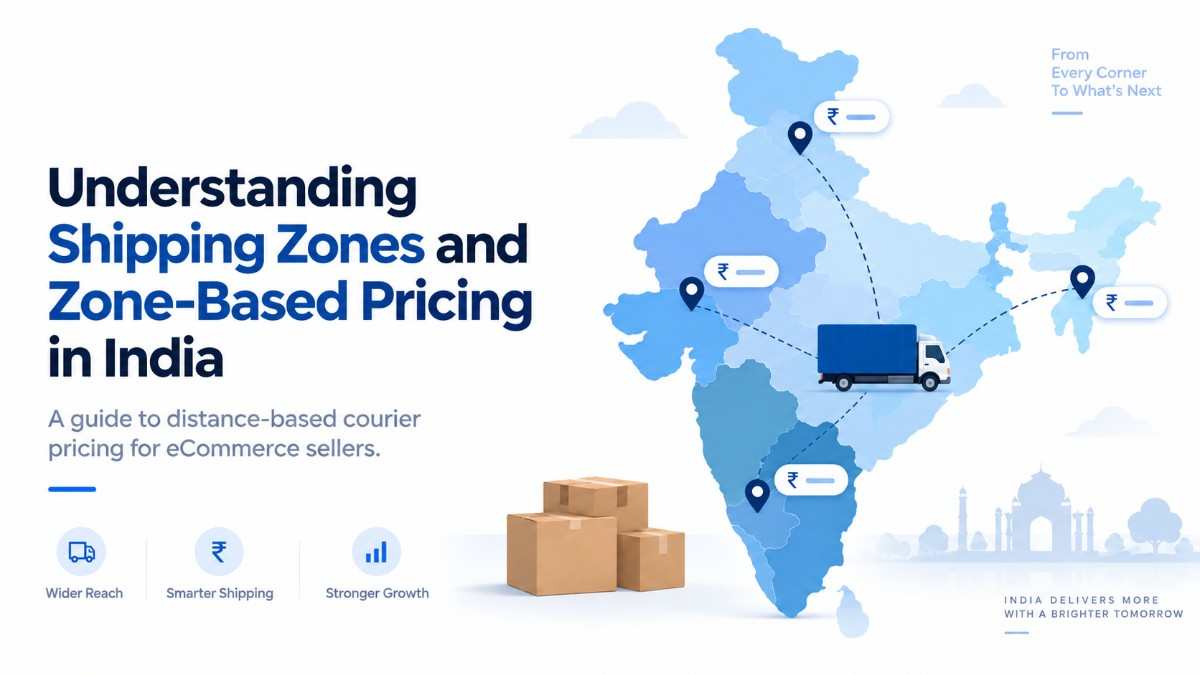
Shipping costs can change significantly depending on where an order is picked up and where it is delivered. For online sellers, understanding shipping zones india pricing is important because the same parcel may attract different charges across local, regional, national, and remote destinations.
Courier companies use zones to group delivery locations according to distance, transport connectivity, handling complexity, and serviceability. These groups help them calculate freight rates without creating a separate price for every individual pincode. A shipment moving within the same city usually costs less than one travelling across the country, while remote or difficult-to-serve locations may attract additional charges.
Zone-based pricing affects product margins, checkout shipping fees, free-shipping thresholds, cash flow, and customer experience. A seller who calculates rates only by product weight may underestimate the actual cost of serving distant customers. The reverse can also happen: charging one high flat rate may discourage buyers in nearby locations.
This guide explains how delivery zones work in India, what charges are included in a courier rate, how to estimate the payable amount, and which operational practices help sellers control location-based shipping costs.
Shipping zones are geographical categories used by courier companies to price and manage parcel movement. Each zone represents a group of origin-destination combinations with broadly similar transport requirements. The exact names and boundaries differ between courier partners, so there is no single national zoning map followed by every logistics provider.
A courier may classify a shipment based on the relationship between the pickup pincode and delivery pincode. A parcel delivered within the same city may be treated as a local movement. A parcel sent to another city in the same region may fall under a regional zone. Shipments travelling between distant parts of India are commonly placed in national or long-distance zones. Locations such as islands, border areas, hilly regions, and difficult-to-reach districts may be treated as remote or special-service destinations.
The zone is not always determined by the physical distance shown on a map. Courier networks rely on hubs, line-haul routes, distribution centres, and delivery stations. Two places that appear close geographically may have different rates if one has limited transport connectivity. Similarly, a longer route between well-connected cities may be priced more competitively.
These categories are useful for planning, but sellers should check each courier’s zone matrix or rate card before quoting a customer. A pincode serviceability check is also important because a location may be technically covered but subject to different handling rules.
For a broader explanation of serviceable delivery locations, see Shipmozo’s guide to pincode serviceability.
Location-based rates directly affect the economics of every order. A product that is profitable when delivered locally may produce a much smaller contribution margin when shipped to a distant state. This is especially relevant for low-value products, bulky items, fragile goods, and cash-on-delivery orders where freight may represent a large share of the order value.
Many sellers focus on the base freight shown by a courier and overlook the way zones influence the final invoice. The payable amount can also change because of the shipment’s chargeable weight, fuel or handling components, remote-area fees, COD charges, taxes, or later weight verification. A reliable pricing process must therefore connect the destination, package measurements, service type, and courier rate.
Sellers generally choose one of three approaches: charge the customer the full delivery amount, subsidise part of the cost, or offer free shipping by building an estimated freight cost into the product price. Each method has consequences. Passing the entire charge to the buyer may reduce conversions in distant regions, while a single national shipping fee can make nearby orders unnecessarily expensive or distant orders unprofitable.
Zones also influence courier selection and fulfilment decisions. A seller may use surface transport for standard national orders and air transport for urgent deliveries, subject to the courier’s service availability. The origin warehouse matters as well. Shipping from a facility closer to a major customer cluster can reduce the number of long-distance shipments and improve delivery planning.
Businesses that manage several courier partners can compare serviceability, delivery performance, and rates by route instead of relying on one default carrier. A multi-courier shipping approach is particularly useful when one partner has stronger coverage in certain zones and another performs better elsewhere.
Knowing how courier zones work gives sellers a more realistic view of fulfilment costs. It does not automatically produce the lowest rate, because rates depend on contracts, shipment profiles, service levels, and carrier policies. However, it helps a business make better decisions before an order is booked and before a courier invoice is received.
Packaging decisions are closely connected to these benefits. A large but lightweight package may be billed by dimensional weight rather than its physical weight. Shipmozo’s explanation of volumetric weight can help sellers understand why carton dimensions matter.
There is no universal rate that can be applied to every shipment. The following process provides a practical way to estimate the charge before booking an order.
For example, a seller in Delhi shipping a compact 1 kg parcel to a nearby customer may receive a local or regional rate. The same parcel sent to a distant southern state may enter a national zone. If its packaging is oversized, the billed weight may increase even though the product itself weighs only 1 kg. The exact charge must come from the courier’s live rate calculation rather than a generic online estimate.
Zone-based cost control works best when it is treated as a recurring operational process rather than a one-time rate check. Rates, coverage, packaging, and order geography can change as the business grows. A monthly or quarterly review is useful for identifying patterns before they become margin problems.
Group historical orders by destination region, pincode cluster, courier, service type, and chargeable-weight slab. This shows where freight is highest and whether the cause is distance, package size, a particular carrier, or a special-service destination. Use actual invoice data where available, not only published base rates.
Product weight alone is not enough for many categories. Apparel, footwear, home goods, cosmetics, and bundled products can occupy more space than their physical weight suggests. Maintain standard packaging dimensions for major SKUs and update them when the packing method changes.
Do not apply the same rate logic to a small parcel and a heavy or fragile shipment. Bulky products may require different partners or transport modes, while high-value products may need insurance and stronger delivery controls. A separate rule can protect margins without penalising every order.
The lowest quoted rate is not necessarily the lowest total cost. Failed attempts, customer contacts, delays, damage, and returns create operational expense. Compare route-level performance with the billed rate before shifting volume to a cheaper carrier.
Check whether the courier applies an additional charge to remote pincodes and whether delivery is available to the customer’s exact address. If a surcharge must be passed to the buyer, show the condition clearly at checkout rather than adding an unexpected amount later.
Keep photographs or packing records for shipments where billed weight frequently differs from declared weight. Reviewing carton selection, weighing equipment, and courier remeasurement patterns can reveal a process issue. Shipmozo’s resource on weight discrepancy charges provides relevant terminology for this review.
Working with multiple courier options can help a seller match routes and shipment profiles more effectively. It also reduces dependence on one network when serviceability changes. However, allocation should consider delivery quality and customer promises, not just the displayed freight amount.
Most pricing errors do not come from the basic idea of zones. They happen when sellers treat a zone label as the entire rate calculation. A zone is only one input among several, and ignoring the other inputs can produce inaccurate checkout prices and unreliable margin reports.
These issues become more difficult to manage as order volume increases. Sellers that need help evaluating their setup can review Shipmozo’s guidance on choosing a shipping aggregator.
The following comparison is illustrative rather than a universal courier rate card. Actual zone names, pincodes, prices, and surcharges depend on the carrier, origin, destination, package, and service selected.
In practice, the most useful comparison is not simply “near versus far.” Sellers should compare the total billed amount for the same packed shipment across carriers and modes, then add the operational outcomes associated with each route.
Understanding shipping zones india pricing helps online sellers set realistic shipping charges, protect margins, and avoid surprises during courier billing. The key is to evaluate the complete pricing chain: pickup and delivery pincodes, courier zone, packed dimensions, chargeable weight, service mode, additional fees, and return exposure.
Shipmozo can support this process through courier aggregation, B2C Shipping, Surface Shipping, and Air Shipping. These options help businesses assess different delivery requirements instead of treating every order as the same shipment. For an accurate decision, review actual routes, packed shipment data, carrier serviceability, and invoice performance together.
Talk to an Expert
Shipping zones are geographical categories used by courier companies to price parcel movement. Common categories include local, regional, national, and remote or special-service zones. The exact pincode mapping differs between courier partners.
A zone reflects the transport distance and network effort between the pickup and delivery locations. A local parcel generally costs less than a long-distance national shipment, while remote destinations may attract additional charges. The final amount also depends on chargeable weight, service type, COD, taxes, and other applicable fees.
No. Courier companies can classify the same origin-destination route differently because their hubs, service areas, contracts, and network structures vary. Sellers should check the selected courier’s own rate card or live calculation.
It depends on the courier’s billing rules. Where dimensional billing applies, the carrier compares dead weight with volumetric weight and generally uses the higher value, subject to minimum billable weight and slab rules. Sellers should measure the packed parcel, not just the product.
Sellers can use right-sized packaging, review destination costs, compare multiple courier partners, choose an appropriate surface or air service, check remote-area rules, and reconcile billed weight with booked weight. Warehouse placement and clear shipping thresholds can also improve cost control.
Not always, but a remote or special-service pincode may have a higher charge, restricted coverage, or different delivery conditions. The seller should verify the exact pincode with the selected courier before quoting a customer.


Diveya Mehta is a marketing and content specialist with 3+ years of experience, currently working with Shipmozo. With 1 year of hands-on experience in logistics, she creates practical, insight-driven content focused on shipping, courier performance, and eCommerce growth.





.webp)