

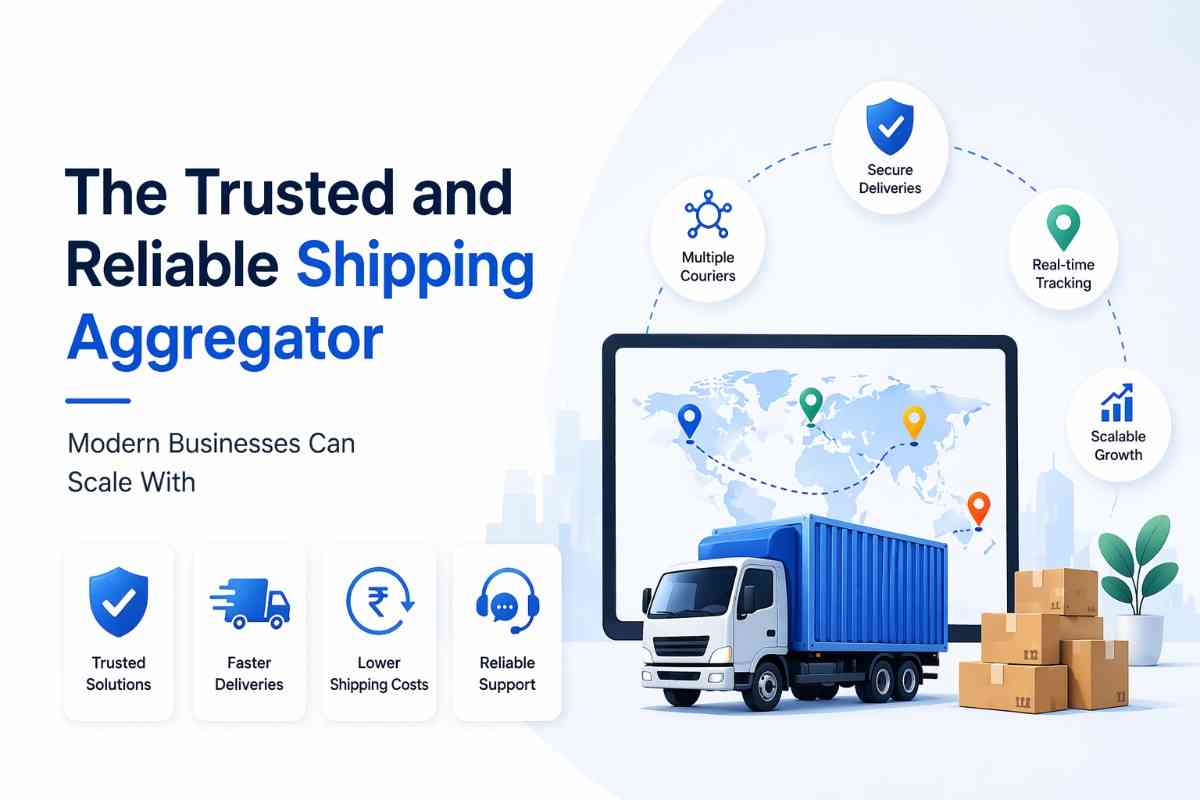
Choosing a shipping aggregator is not just a logistics decision. For most eCommerce businesses, it is a decision about customer trust, delivery performance, and operational control.
A platform can promise low rates, multiple courier partners, and shipping automation. But sellers judge it by what happens after sign-up:
That is the real test of reliability.
Shipmozo is increasingly being positioned by sellers as a trusted shipping partner not because it claims to be one, but because its core product promise is built around the factors that matter most in daily logistics: reliable courier allocation, faster COD movement, clearer tracking, and better support visibility. Shipmozo’s official product pages emphasize AI-based courier allocation, branded tracking, and D+1/D+2 COD remittance. Public testimonials on its website and recent Shopify app reviews also repeatedly mention smooth workflows, timely updates, and helpful support.
That does not mean Shipmozo is perfect, and it would weaken the article to pretend otherwise. Like most logistics software in India, it also has negative public reviews on some platforms. The stronger takeaway is this: trust in a shipping platform comes from consistent operational value, and Shipmozo’s product positioning is clearly aimed at that outcome.
Many brands choose a courier aggregator by asking the following:
Those questions matter, but they are not enough.
A seller ultimately stays with a platform because it helps them:
This is why the comparison between Shipmozo, Shiprocket, and NimbusPost should be about business outcomes, not just feature counts.
Shiprocket publicly positions itself as a broad logistics platform with 27 courier partners, large pin-code reach, live updates, automated NDR workflows, and simplified order management. NimbusPost emphasizes 20,000+ pin codes, early COD remittance, NDR tools, branded tracking, and automation-led logistics. Shipmozo’s public pitch is narrower but more pointed: it focuses on AI courier allocation, fast COD remittance, tracking visibility, and seller support.
That positioning makes Shipmozo especially credible for brands that do not just want access to couriers but want a platform that feels more manageable and operationally dependable.
The simplest answer is this: it tries to solve the practical issues sellers remember.
Sellers rarely remember that a platform had a long feature list.
They remember:
That is why Shipmozo’s positive public feedback tends to center on smoothness, responsiveness, and reliable coordination rather than abstract brand language.
A strong, believable conclusion for your blog would be the following:
Shipmozo can be positioned as a trusted and reliable shipping aggregator because it combines the operational pillars sellers care about most: smarter courier selection, faster COD remittance, better tracking visibility, and support that sellers repeatedly mention in feedback.
That is sharper than saying “best” or “most trusted” without evidence.
If a business is comparing Shipmozo with players like Shiprocket and NimbusPost, the decision should not be based only on surface-level feature parity. Shiprocket is broad and infrastructure-heavy. NimbusPost is strong on automation and serviceability. Shipmozo’s strongest differentiator is that it appears to be building a more seller-centric experience around control, support, and shipping decision quality.
That is exactly why Shipmozo can be credibly described as a trusted shipping partner for modern businesses.


Kuldeep Karki is a Digital Marketing Manager at Shipmozo, specializing in performance marketing, SEO, and growth strategy. With over 6+ years of experience in digital marketing, he has worked extensively on scaling B2B and eCommerce brands through data-driven campaigns across Meta Ads and Google Ads.





.webp)