

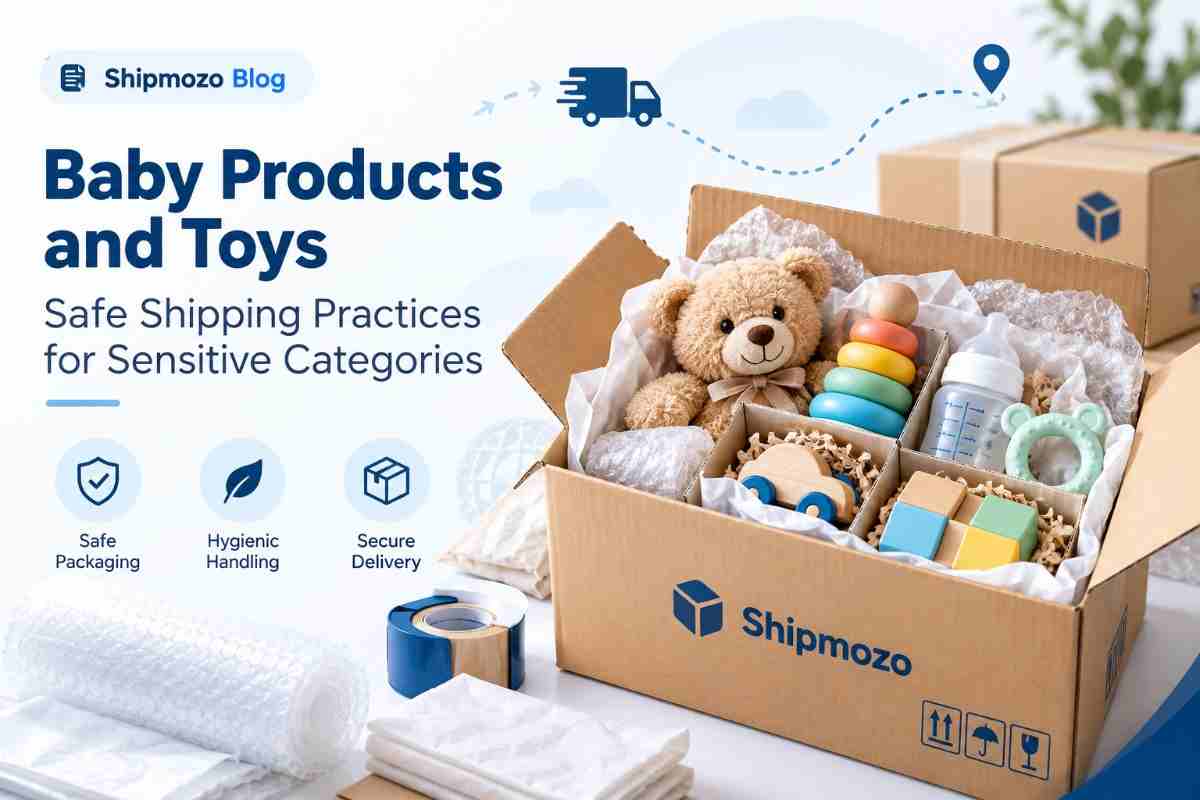
For a baby products brand, the delivery experience is part of product safety. Parents expect feeding accessories, soft toys, nursery products, and children’s items to arrive clean, intact, and ready to use. A crushed carton, broken component, exposed fabric item, or delayed delivery can create more than a normal customer-service issue.
That is why shipping baby products toys safely requires a process that covers packaging, handling, courier selection, tracking, and returns. The correct approach depends on the product’s material, dimensions, fragility, hygiene requirements, and destination. A lightweight rattle needs different protection from a wooden activity table, while a plush toy needs different handling from a sealed feeding product.
This guide explains the operational controls that baby and toy brands can use before handing parcels to a courier. It also covers common risks such as moisture exposure, loose parts, incorrect volumetric weight, failed delivery attempts, and unsuitable return handling.
The objective is not simply to move more parcels. It is to protect the product condition, provide accurate delivery visibility, and create a repeatable shipping workflow as the catalogue and order volume grow.
Safe shipping means matching the product, packaging, service level, and delivery process to the risks involved in transportation. It starts with identifying what can go wrong during storage, sorting, line-haul movement, last-mile delivery, and a possible return.
Baby products and toys are not one uniform category. The shipment profile can vary significantly:
The process should therefore include product-level packaging instructions, accurate parcel measurements, serviceability checks, a suitable delivery mode, shipment visibility, and a documented return inspection. For definitions of terms such as carrier selection and routing, brands can refer to carrier allocation in logistics.
Shipping protection does not replace product compliance. The seller remains responsible for ensuring that the item is legally permitted for sale and transport, carries the required warnings or instructions, and is packed according to the product’s characteristics. Batteries, liquids, magnets, electronic components, and products with age restrictions may require additional courier or transport checks.
Before dispatch, confirm the item description, declared value, dimensions, weight, and destination details. These records support accurate billing, customer communication, and claim investigation if the parcel is damaged or lost.
Customers buying for infants and children judge a parcel differently from an ordinary household purchase. They are more likely to inspect the outer box, seals, product surface, accessories, and safety instructions before allowing a child to use the item. A product that arrives dirty, dented, incomplete, or visibly tampered with may be rejected even when its core function still works.
Damage also creates operational cost at several points. The brand may need to arrange a replacement, pay forward and reverse shipping charges, inspect returned inventory, write off unsellable stock, and respond to a customer complaint. When the order is placed during a birthday, festival, or newborn purchase occasion, a missed delivery can further reduce customer trust.
Delivery performance matters as well. If the address is incomplete or the customer misses a delivery attempt, a parcel can move into an NDR process and eventually be returned to origin. Brands should monitor these events rather than waiting for the customer to report a problem. A clear NDR workflow can help the operations team verify the address, contact the buyer, and decide whether a reattempt is appropriate.
A documented process gives a baby products business more control than handling every order according to individual staff judgement. It creates repeatable decisions for packing, shipping, exception management, and returns. This is particularly useful when a brand sells through its own website, marketplaces, social channels, and wholesale accounts.
Product-specific packaging reduces the chance that a toy or baby item will move inside its carton. It also helps warehouse staff use the correct inserts, seals, cushioning, and outer box without making decisions from memory. Consistent packing is especially important when temporary staff or multiple fulfilment locations handle the same SKU.
Recording actual weight and outer dimensions before dispatch helps prevent avoidable billing disputes. This is important for toys and nursery products because a large carton can be charged using dimensional or volumetric weight. The volumetric weight calculation should be considered while designing packaging, not only after a charge appears.
Tracking information allows the support team and customer to see whether a parcel is booked, picked up, in transit, out for delivery, delayed, or returned. For high-consideration purchases such as baby gear, timely updates reduce uncertainty and give the buyer an opportunity to coordinate receipt.
A defined return process separates unopened, unused, opened, damaged, and incomplete products. This protects customers while helping the warehouse decide whether an item can be restocked, repacked, repaired, quarantined, or disposed of. Reverse movements should be treated as an inventory process, not simply as another delivery.
Different courier networks can perform differently by pincode, parcel size, service type, and delivery lane. Reviewing delivery attempts, transit exceptions, damage reports, and return rates helps a brand make practical routing decisions rather than choosing a carrier based only on the lowest displayed rate.
The following workflow can be used for individual orders and adapted for bulk dispatches. The controls should be recorded in the warehouse SOP so that the result does not depend on one experienced operator.
Packaging alone cannot solve every shipping problem. The strongest results come from connecting warehouse controls with order data, courier performance, and customer communication. The following practices are useful for brands managing a growing catalogue.
Maintain a simple packing matrix for each product family. It should specify the inner protection, outer carton size, sealing method, label requirements, and any special handling note. Review the matrix when a product, supplier box, or packaging material changes.
Products intended for infants should remain protected from dust and moisture throughout handling. Avoid reusing visibly damaged cartons or unclean protective material. For opened returns, define whether the product needs repackaging, a quality inspection, or removal from sale.
Empty space allows contents to move and can increase the billed size. Measure the packed parcel, not only the product, and test whether a smaller carton provides adequate protection. Do not reduce cushioning simply to lower dimensions; protection comes first.
Warehouse storage and picking locations should make it clear which products require extra care. Avoid placing heavy cartons on top of fragile toy boxes or using one generic packing station for products with incompatible requirements.
Show realistic dispatch and delivery information at checkout. Mention that delivery dates can vary by destination, weather, operational disruptions, or remote-area handling. Send tracking updates and provide a support route for customers who need to change delivery instructions.
Review damage rate, missing-component complaints, delivery success rate, NDR rate, RTO rate, average delivery attempts, return condition, and shipping charge adjustments. Break the data down by SKU, pincode, courier, packaging type, and service mode to identify patterns.
Before a sale or seasonal peak, test packaging inventory, label-printing capacity, pickup schedules, and customer-support escalation. Baby and toy orders can be time-sensitive, so a backlog at packing or pickup can affect the customer experience before the parcel even enters transit.
Brands that are adding channels or couriers may benefit from reviewing an eCommerce shipping integration approach that connects order data, courier booking, tracking, and COD workflows.
Many shipping failures in this category come from small process gaps rather than a single major error. The following mistakes are common when brands scale quickly or use generic packaging for a wide product range.
There is no single transport or packaging method for the entire baby and toy catalogue. A practical decision should start with the product’s physical risk and the customer’s delivery requirement.
This comparison is a starting point, not a substitute for testing. Brands should review actual damage, delay, and return data by product family and destination before changing their packaging or courier rules.
Safe fulfilment for baby products and toys depends on disciplined execution at every handoff. Classify each SKU, protect the product from impact and moisture, record the packed dimensions, validate the destination, and monitor the shipment after pickup. Returns also need a separate inspection process because an opened baby-use product may no longer be suitable for resale.
For brands focused on shipping baby products toys safely, Shipmozo can support the operational workflow through relevant services such as B2C Shipping, Surface Shipping, Air Shipping, and International Shipping. These options can help businesses align shipment movement with product type, destination, urgency, and fulfilment requirements, subject to service availability and courier terms.
Use shipment data to refine packaging, courier allocation, exception handling, and customer communication over time. A safer process is built through measurable controls, not assumptions.
Talk to an Expert
Inspect the product first, protect it from moisture and abrasion, stabilise it with suitable cushioning, and place it in a strong outer carton. Small accessories should be sealed separately, while the final parcel should be measured and weighed before booking.
Many durable, non-urgent toys can move by surface shipping when the packaging protects them from impact, compression, and moisture. Fragile, electronic, bulky, or time-sensitive items require a separate review of packaging and service suitability.
Count the components during picking, place loose pieces in a sealed inner pouch or compartment, secure the main product, and remove empty space inside the carton. A final packing check helps confirm that the order is complete before dispatch.
Not automatically. The returned parcel should be inspected for seal condition, use, contamination, damage, and missing parts. Products that cannot be confidently verified as unused and suitable for resale should be quarantined or handled according to the brand’s quality policy.
Couriers may calculate charges using volumetric weight when a parcel occupies more space than its actual weight suggests. Accurate outer dimensions and right-sized protective packaging help the seller understand and manage the billable shipment profile.
The operations team should review the reason, verify the address and phone number, contact the customer promptly, and request a reattempt when appropriate. If the issue is not resolved, the parcel may move towards return to origin and should be tracked as a reverse shipment.







.webp)