

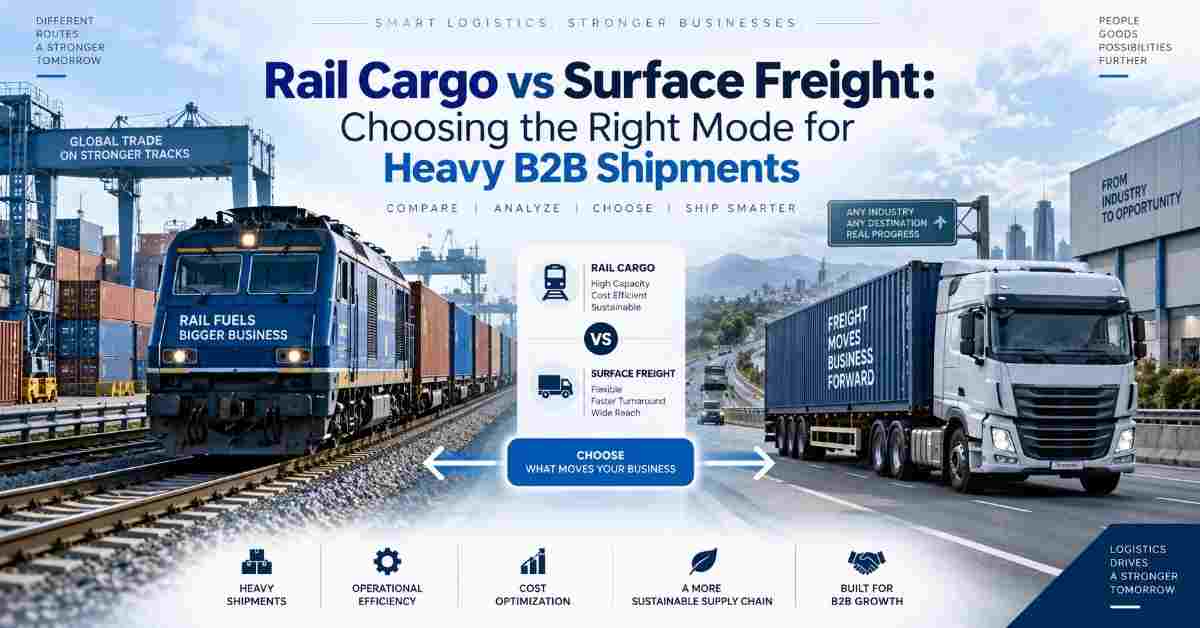
Choosing between rail and road transport can affect the landed cost, delivery schedule and handling risk of a heavy business shipment. For manufacturers, distributors and wholesalers, the decision is rarely about selecting the fastest option. It is about matching the transport mode to the cargo, route, service commitment and receiving process.
Understanding rail cargo vs surface freight helps logistics teams make better decisions for palletised goods, machinery, raw materials, industrial components and large commercial consignments. Rail can be useful for high-volume movement across long distances when schedules and terminal access are workable. Surface freight can offer broader reach, flexible pickup and delivery, and better access to locations that are not directly connected to rail terminals.
This guide explains how both modes work, where each performs well, what costs and operational details to review, and how to build a practical mode-selection process for heavy B2B shipments in India.
For a broader understanding of commercial movement, see this guide to B2B shipping and use it as a foundation for evaluating freight requirements.
Rail cargo is the movement of goods through the railway network, usually between freight terminals, inland container depots or other designated loading points. It is commonly considered for long-distance shipments, dense freight corridors and consignments that can be consolidated into containers, wagons or scheduled cargo services. The shipment normally requires coordination between pickup, terminal handling, rail movement and final delivery.
Surface freight refers to the movement of goods by road. Depending on shipment size and planning, a consignment may move as a full truckload, a partial truckload or through another road-based freight service. Road transport can support door-to-door movement because trucks can collect cargo from a plant or warehouse and deliver it directly to a business location, subject to road access and vehicle restrictions.
Neither mode is automatically better. The right choice depends on the complete logistics chain rather than the middle-mile rate alone. A low line-haul price may not be economical if terminal transfers, local drayage, loading delays or additional handling increase the total cost.
Heavy commercial shipments create different planning challenges from parcels. A delayed machine part can interrupt production, while a poorly secured pallet can arrive damaged even when the transport leg itself was completed on time. Mode selection therefore affects more than freight charges. It influences inventory planning, customer commitments, warehouse labour and the number of times cargo changes hands.
Distance is one of the first considerations. Rail can become attractive when the route is long, the shipment is substantial and the business can plan around a fixed schedule. Surface freight can be more practical for shorter or irregular routes, especially when the origin or destination is far from a suitable rail terminal.
Shipment density also matters. Dense goods such as metal components, packaged raw materials and industrial equipment use vehicle or container capacity efficiently. Bulky goods with relatively low weight may be priced according to dimensions, vehicle space or handling requirements. Teams should review both actual and dimensional characteristics before comparing quotes. Shipmozo’s reference on volumetric weight explains why package dimensions can influence transport calculations.
For this reason, logistics managers should compare the complete door-to-door process. A reliable mode decision includes pickup, terminal movement, main haul, destination handling, final-mile delivery and exception management.
Each transport mode offers operational advantages. The strongest choice is usually the one that fits the shipment’s physical characteristics and the organisation’s ability to plan around the mode’s limitations.
These benefits should be assessed against the actual shipment plan. Rail may lose its advantage when a consignment requires several short transfers. Road freight may become inefficient when repeated heavy loads travel long distances without adequate vehicle utilisation.
A repeatable decision process prevents teams from choosing transport based only on a headline quote. Use the following steps for each lane or shipment category.
This process also helps businesses create mode rules. For example, a company may reserve rail for planned high-volume trunk movement and use surface freight for urgent replenishment, terminal drayage and destinations outside the rail network.
Heavy freight performs better when the shipment is prepared as an operational project rather than treated as an oversized parcel. Small gaps in data or packaging can create delays at pickup, loading and delivery.
Do not apply one national rule to every destination. Document the preferred mode by origin-destination pair, shipment weight band, dispatch frequency and delivery requirement. Revisit these rules when volumes, customer locations or terminal access changes.
Weigh the packed shipment, not just the product. Record pallet dimensions, total height, centre of gravity and lifting points where relevant. Clear data reduces disputes over weight, capacity and vehicle suitability. Shipmozo’s guide to net weight and gross weight is useful when different teams use inconsistent measurement terms.
Confirm dock height, vehicle access, forklift availability, unloading labour, appointment requirements and site restrictions before dispatch. A truck or rail-linked movement can arrive at the destination and still face delay if the consignee cannot safely unload the cargo.
Use packaging suited to vibration, stacking, weather and repeated handling. Photograph the packed load, seal numbers and visible condition at dispatch. For machinery or fragile components, include handling instructions and inspection steps at receipt.
A status such as dispatched or in transit does not explain why a shipment is late. Monitor missed cut-offs, terminal holds, vehicle delays, address problems, unloading failures and damage reports. Categorising these exceptions helps teams improve lanes rather than reacting to individual incidents.
Ensure the invoice, packing list, e-way bill details, shipment weight, consignee information and transport documents match. Inconsistent information can lead to hold-ups, rework or disputes during handover.
Many freight problems occur because the mode decision is made before the shipment and receiving process are understood. The following mistakes are common in heavy B2B movement.
These mistakes are avoidable when procurement, warehouse, sales and finance teams agree on the service requirement before the shipment is booked.
The following comparison is a starting point, not a substitute for a lane-specific quote. Actual performance depends on route, season, cargo, service availability, terminal capacity and the quality of first-mile and last-mile execution.
Businesses often use both modes instead of treating the decision as permanent. A hybrid plan can place the long trunk movement on rail while using road transport for pickup, terminal transfer and final delivery. The practical objective is to design the most suitable movement chain for each lane.
The right answer in rail cargo vs surface freight depends on shipment density, distance, urgency, terminal access, delivery requirements and total door-to-door cost. Rail can suit planned heavy movement across established corridors, while surface freight offers reach and flexibility for varied origins, destinations and delivery schedules.
Shipmozo supports businesses with B2B Logistics, Surface, Rail and PTL, LTL and FTL options, helping logistics teams align freight movement with shipment requirements instead of relying on one mode for every order. Review your major lanes, test the complete cost and monitor actual service performance before standardising the approach.
Talk to an Expert
Rail is worth evaluating when the shipment is substantial, the route connects practical rail terminals, the cargo can be planned in advance and the delivery schedule can accommodate fixed service timings. Include the cost and time of first-mile and final-mile road transport before making the decision.
Surface freight is generally more suitable when the origin or destination is not close to a practical rail terminal, when delivery must be door-to-door, when dispatch quantities change frequently or when the consignee requires flexible scheduling. It can support both full-load and partial-load requirements.
No. Rail may offer an attractive long-haul option for the right shipment profile, but terminal handling, local transfers, storage and additional road legs can change the total cost. Compare complete door-to-door charges rather than only the central transport rate.
Yes. A hybrid movement can use road transport for pickup and final delivery while rail handles part of the long-distance route. This approach is useful when the cargo benefits from rail capacity but the origin and destination require road access.
Collect the packed weight, dimensions, pallet count, commodity details, origin, destination, delivery urgency, loading and unloading constraints, terminal proximity, packaging requirements and documentation needs. These details allow a more accurate comparison of cost, service and handling risk.
Track total landed cost, transit-time variability, missed cut-offs, handling exceptions, damage, delivery appointment performance, documentation accuracy and proof of delivery completion. Review results by lane and shipment type instead of relying only on a national average.


Ankit Debnath is a sales and marketing professional with 4+ years of experience in the logistics industry, specializing in managing B2B and B2C key accounts. At Shipmozo, he focuses on driving growth through client acquisition, lead generation, and strategic relationship management. Passionate about building strong client relationships and delivering results, he brings a practical, growth-oriented approach to logistics and business expansion.





.webp)