

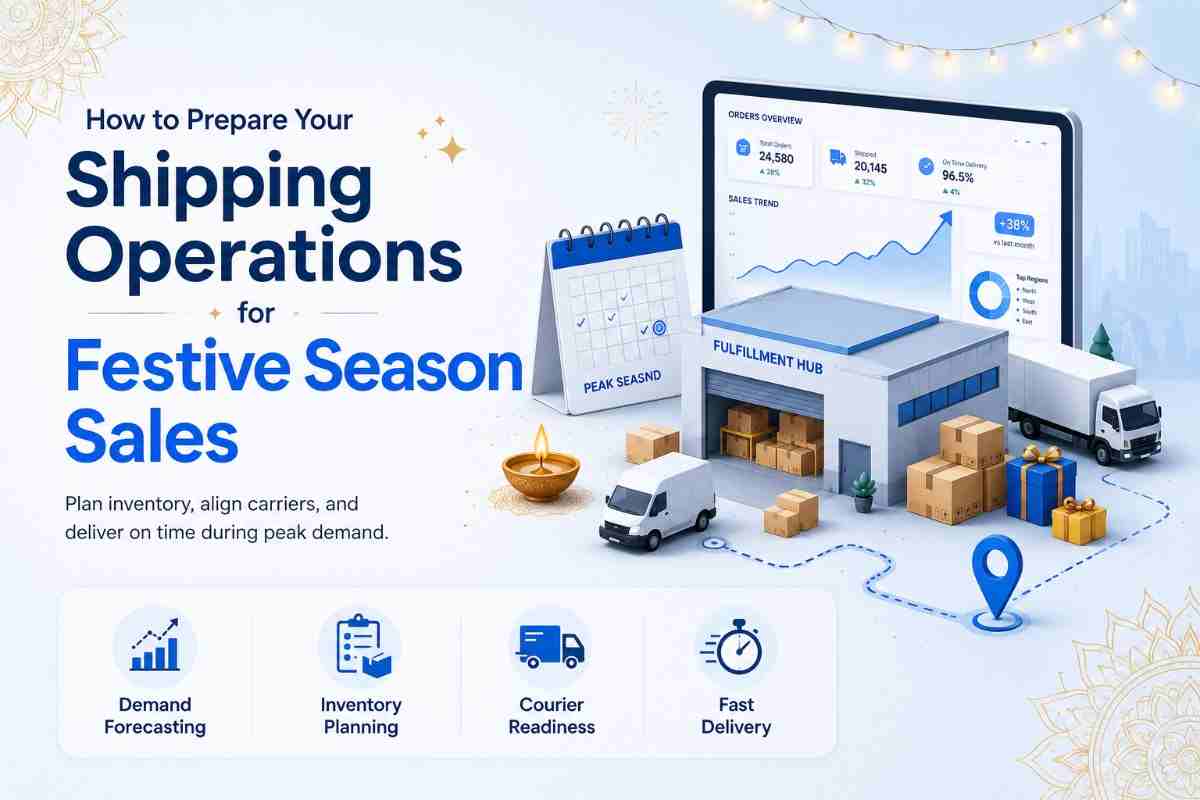
Festive sales can compress weeks of normal order volume into a few high-intent shopping days. For eCommerce brands, festive season shipping preparation is not limited to booking more pickups. It involves checking inventory, packaging capacity, courier coverage, payment workflows, customer communication and returns before the sale begins.
Diwali campaigns, marketplace events and Big Billion Days can create sharp demand across cities, pincodes and product categories. A process that works at regular volume may become difficult to manage when order queues increase, pickup slots fill quickly and customers expect frequent updates. Small gaps in address data, stock visibility or dispatch handovers can then create delays, cancellations and avoidable return-to-origin shipments.
The right approach is to convert a seasonal sales forecast into an operating plan. Start with expected order volume, identify the points most likely to fail and assign an owner to each activity. A multi-courier platform can also help businesses manage carrier capacity, serviceability and shipment visibility from one operating layer.
This guide explains how to prepare a reliable festive dispatch system without assuming that every order needs the fastest or most expensive service. The objective is controlled scale: accurate order processing, suitable courier selection, clear customer communication and a practical recovery plan when exceptions occur.
Festive season shipping preparation is the structured planning of people, inventory, packaging, technology, courier capacity and customer support for a temporary rise in shipments. It begins before promotional campaigns go live and continues until the final festive returns and undelivered orders are resolved.
The process covers both forward and reverse movement. Forward logistics includes order confirmation, pick-and-pack, label generation, pickup scheduling, transit and last-mile delivery. Reverse logistics includes return requests, quality checks, reverse pickups, replacement shipments and inventory updates.
Businesses can use shipping integration to connect order sources, courier workflows and tracking updates. This reduces the need to copy order data between separate systems during the busiest period.
Customers judge a festive purchase by the complete experience, not only by the discount. If an order is confirmed but not dispatched, or tracking remains unchanged for several days, support tickets rise and customer confidence falls. Delivery problems can also affect reviews, repeat purchases and the brand’s ability to fulfil future campaigns.
Peak-season logistics has a different risk profile from regular shipping. Courier networks may experience higher intake, warehouses may operate with temporary staff and customers may be less flexible because products are intended for a festival, event or gifting deadline. A delivery arriving after the occasion may have little value even if the parcel eventually reaches the buyer.
A structured operating plan gives managers early visibility into these risks. It also makes it easier to compare courier performance by lane, identify bottlenecks and move suitable shipments to another service when conditions change. For brands evaluating their current setup, this courier performance metrics guide can help define the right review points.
Preparation does not remove every delay or exception. It helps the business respond consistently instead of making decisions order by order. The strongest benefits come from connecting commercial plans with warehouse and logistics capacity.
When orders are segmented by weight, destination, payment mode and promised delivery window, teams can select a suitable service rather than defaulting to one option. This supports cost control while preserving faster services for urgent or time-sensitive shipments.
Different carriers may perform differently across local, regional and remote pincodes. A multi-carrier setup allows the business to distribute volume based on serviceability and operational fit. It also reduces dependence on a single network during a period when capacity is uncertain. A multi-courier platform can centralise these workflows.
Integrated order import, label generation, shipment creation and tracking reduce repetitive data entry. This matters during peak periods because manual errors multiply as the number of orders increases. Teams can spend more time on packing accuracy and exception resolution.
Proactive tracking updates reduce “where is my order” queries and give customers a clearer view of dispatch, transit and delivery attempts. A branded tracking experience can keep customers informed while reinforcing the seller’s identity after checkout.
Centralised shipment statuses help support and operations teams identify stuck, delayed or undelivered parcels. A documented NDR workflow makes it possible to contact the customer, confirm availability and request the right next action before the shipment moves to return.
COD order confirmation, remittance checks and return tracking become easier to monitor when responsibilities and records are clearly defined. This reduces confusion between finance, customer support, warehouse and logistics teams.
The following sequence can be adapted for a D2C store, marketplace seller or multi-channel eCommerce business. Complete the planning work early enough to test the process with real orders before the main campaign starts.
For a broader view of the order-to-delivery workflow, review this guide to order management workflows before finalising roles and escalation paths.
Peak-season execution depends on disciplined routines. The following practices help teams maintain control when order queues, customer messages and carrier updates arrive at the same time.
Track orders received, orders packed, orders awaiting pickup, shipments in transit, delivery attempts, NDRs, RTOs and returns. Review the numbers by warehouse and courier. A total volume figure can hide a serious issue in one region or one product category.
Define the latest time an order can be received for same-day processing, packing and courier handover. Share different cut-offs for standard and express services if the workflows differ. Internal cut-offs should allow time for verification, packing and manifest closure.
Pre-approve alternatives for important lanes and product types. A backup is useful only if the team knows the serviceability, rate logic, pickup process and escalation contact in advance. Switching carriers during a crisis without these checks can create new errors.
Use SKU-level pick lists, barcode checks or a second verification step for high-value orders. Festive bundles and promotional combinations are easy to pack incorrectly when temporary staff work quickly. The cost of a wrong item includes the return movement, replacement shipment and customer dissatisfaction.
Do not review only the number of NDRs or delayed shipments. Track how long each case has remained unresolved. A parcel with no action for several days is more likely to become a customer complaint or RTO than one addressed promptly.
Warehouse teams should own packing and handover accuracy, logistics teams should own courier coordination, support should own customer contact and finance should own COD reconciliation. Shared visibility is valuable, but unclear ownership slows decisions.
Run short daily reviews and adjust allocation when a lane, service or warehouse begins to underperform. After the campaign, compare the forecast with actual demand and document what should change for the next seasonal event.
Many peak-season failures are caused by decisions made too late. The following mistakes are common among growing sellers that have strong demand but have not yet formalised their logistics processes.
Brands that recognise several of these issues may benefit from reviewing the signs that their business needs a courier aggregator before the next major sale.
The choice is not simply between doing everything manually and automating every decision. The practical difference is how easily the operation can manage volume, visibility and exceptions.
A platform is most useful when it connects the stages that create operational friction: order import, courier selection, label generation, tracking, COD workflows and exception management. Businesses should assess integration quality, serviceability, reporting, support and the ability to handle their shipment types before making a decision.
Festive season shipping preparation should begin with a clear view of demand, available stock, packing capacity and courier coverage. From there, the focus should move to accurate order data, realistic delivery communication, COD controls, proactive NDR handling and a planned reverse flow.
Shipmozo helps Indian manufacturers, distributors, wholesalers, D2C brands and eCommerce sellers manage seasonal logistics across B2B shipping, B2C shipping, surface, air, rail, PTL, LTL, FTL and international shipping requirements. Relevant capabilities include multi-courier shipping, AI courier allocation, channel integration and branded tracking.
Review your process before the sale, test it with sample shipments and monitor performance daily once orders begin. A prepared operation gives your team more control when demand rises and customer expectations become time-sensitive. Use Shipmozo to support your festive season shipping preparation and Start Shipping Today
It is the structured planning of inventory, warehouse capacity, packaging, courier allocation, tracking, COD, customer communication, NDR handling and returns before a seasonal demand spike.
Preparation should begin before promotional campaigns go live. The business needs enough time to forecast demand, arrange packaging, test integrations, confirm courier coverage and process sample orders before the main sale.
Different couriers can perform differently by destination, weight, payment mode and product type. Using multiple carriers gives the business more flexibility and reduces dependence on one network when capacity is constrained.
Sellers can use COD confirmation for suitable high-risk or high-value orders, define how unconfirmed orders are handled and reconcile collected cash and remittance records through clearly assigned finance workflows.
Review non-delivery reports daily, contact the customer promptly, capture the reason and request a reattempt where feasible. Cases that cannot be recovered should be moved into a controlled return-to-origin and inventory process.
It should continue tracking delayed shipments, NDRs, RTOs, returns, replacements, COD remittances and inventory updates. The post-sale workload can continue after the campaign ends and requires its own review.


Diveya Mehta is a marketing and content specialist with 3+ years of experience, currently working with Shipmozo. With 1 year of hands-on experience in logistics, she creates practical, insight-driven content focused on shipping, courier performance, and eCommerce growth.





.webp)