

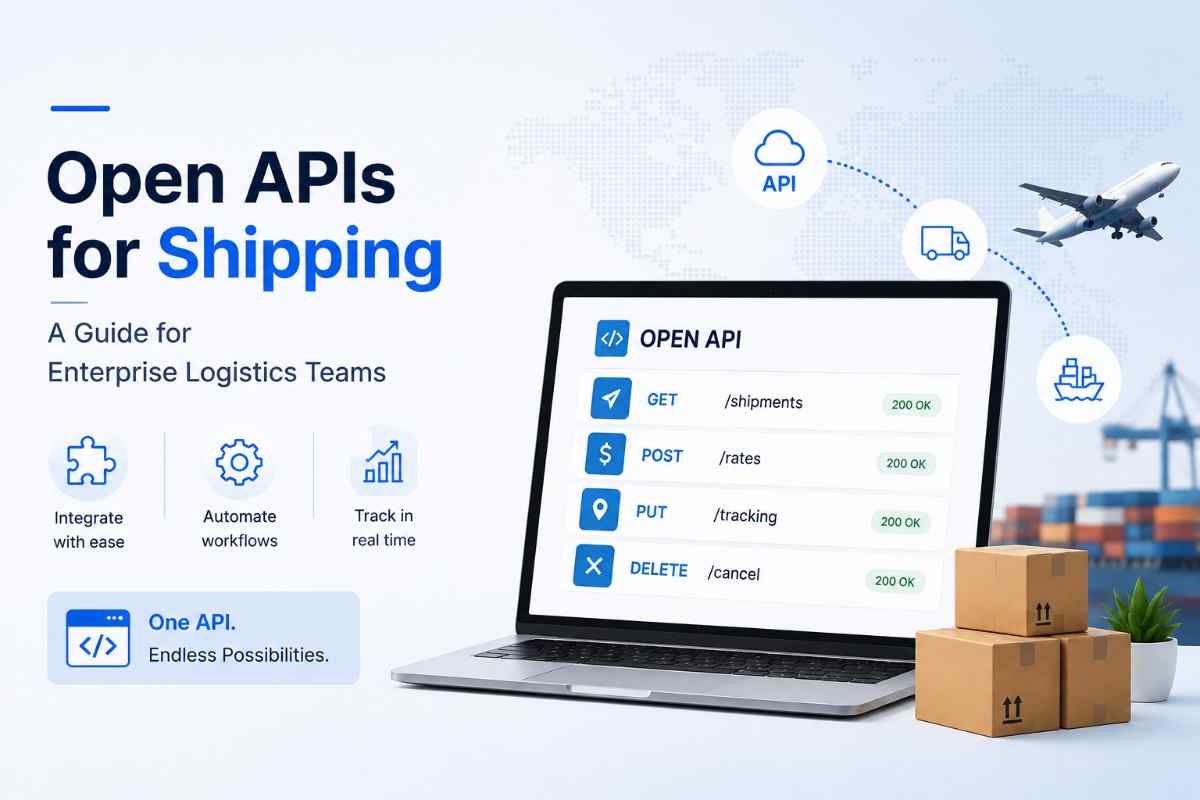
Enterprise logistics rarely operates from a single storefront or one carrier account. Orders may originate from marketplaces, brand websites, distributor portals, sales teams, warehouses, and enterprise resource planning systems. Each channel creates shipment data, while different carriers return their own labels, tracking events, service codes, and exception statuses. A well-designed shipping api integration connects these systems so logistics teams can coordinate execution without moving data manually between platforms.
Open APIs are not simply a developer convenience. They are an operating layer between commercial systems and physical fulfilment. They can help an enterprise create shipments, allocate carriers, generate labels, receive tracking events, manage delivery exceptions, and reconcile shipment information through software workflows. The value depends on how well the integration handles real logistics conditions, including incomplete addresses, serviceability restrictions, split orders, COD requirements, delayed scans, weight discrepancies, cancellations, and returns.
This guide explains the architecture, implementation process, controls, and practical trade-offs that enterprise teams should evaluate before connecting their order and transport systems to an open shipping API. It also addresses a common objection: the belief that an API project will create more operational complexity than it removes.
An open shipping API is a documented software interface that allows authorised applications to exchange logistics data with a shipping platform or carrier network. “Open” does not mean unrestricted or insecure. It generally means that approved external systems can connect through defined endpoints, authentication methods, request formats, and response formats.
For an enterprise, the interface can sit between an order management system, warehouse management system, ecommerce channels, finance tools, customer-service applications, and logistics providers. The business system sends structured information such as order ID, pickup location, destination, package dimensions, weight, payment mode, and product details. The shipping platform then returns operational information such as shipment ID, carrier allocation, AWB number, label data, tracking URL, or an error message.
Common API functions include:
API terminology can vary between providers. Teams should confirm the exact endpoints, fields, status definitions, rate limits, authentication model, version policy, and support process before development begins. A useful primer is this explanation of a shipping API.
Manual shipping operations become difficult to control when transaction volume, locations, channels, and carriers increase. A team may be able to upload a spreadsheet for one warehouse, but that process becomes fragile when multiple fulfilment centres release orders simultaneously and each operation follows slightly different rules. Duplicate shipments, stale inventory signals, incorrect addresses, and missing tracking updates can then appear as customer-service issues even when the underlying problem is poor system coordination.
API connectivity creates a consistent path for data to move from order capture to shipment execution. It also gives technology and operations teams a clearer boundary of responsibility. The commerce or ERP system remains the source for commercial order details, the warehouse system controls packing and dispatch readiness, and the logistics layer handles carrier-related execution. This separation reduces the temptation to make one system responsible for every process.
The technical benefit is only part of the case. Enterprise leaders also need to assess risk, governance, and change management:
That does not mean an API removes operational work. It moves work from repetitive data entry to process design, exception management, monitoring, and governance. This is usually the more manageable form of complexity, but only if the enterprise funds ownership beyond the initial launch.
Large businesses often need different transport choices for different consignments. A customer order may require B2C delivery, while replenishment stock may move through B2B logistics, surface transport, air, rail, PTL, LTL, or FTL. An integration layer can expose a consistent internal workflow while the logistics platform applies the relevant operational route. Teams still need to define eligibility rules and confirm the actual service scope, but they do not have to redesign every upstream application whenever the transport mix changes.
When shipment creation is automated, the system can validate required fields before sending a request. This may include consignee details, pickup address, package count, dimensions, weight, payment mode, invoice information, and reference numbers. Validation cannot correct bad master data by itself, but it can prevent obvious omissions from reaching the carrier network and create a clear queue for correction.
Raw carrier responses are often too technical for customers, sales staff, or finance teams. A well-managed integration maps external events into internal statuses such as picked up, in transit, out for delivery, delivered, delayed, or exception. The mapping should preserve the original carrier event for investigation while presenting a simpler status to the user. Teams planning post-purchase communication can also review guidance on tracking integration.
Successful shipments are usually easy to automate. The real test is what happens when a delivery fails, a pincode is unavailable, an address needs correction, a parcel is held, or a carrier response is delayed. API-driven workflows can route these events to an exception queue, assign ownership, and preserve the next action. They do not resolve every issue automatically, but they make unresolved work easier to find.
Enterprise finance and operations teams need to compare what was ordered, what was shipped, what was delivered, and what was billed. Consistent identifiers allow shipment records to be matched with invoices, COD transactions, returns, and customer claims. This supports investigation of billing differences and missing events without depending entirely on email trails or disconnected spreadsheets.
Enterprise integrations need production discipline from the beginning. A connection that works in a developer environment can still fail under peak order loads, warehouse cut-off pressure, carrier downtime, or a sudden change in address quality. The following practices reduce avoidable incidents.
Teams can also review how an order management system supports the broader flow and where API responsibilities should begin or end.
For organizations comparing approaches, a practical review of multi-courier integration can help clarify the operational implications of connecting several transport providers through one workflow.
There is no universal architecture for every enterprise. The right model depends on network complexity, internal engineering capacity, carrier mix, geography, service requirements, and governance expectations.
A direct connection may be appropriate when a carrier has unique capabilities that an intermediary cannot expose or when the enterprise has a strong reason to control the entire relationship. An aggregated layer may be more practical when the business needs multiple logistics options, consistent upstream workflows, and less duplicated integration work. Teams should evaluate both technical fit and operating responsibility instead of choosing solely on the number of available endpoints.
For a broader enterprise perspective, see this overview of enterprise logistics aggregators.
Open APIs can give enterprise logistics teams a controlled way to connect order systems, fulfilment operations, and transport execution. The strongest implementations begin with process ownership and data definitions, then add secure authentication, idempotent requests, reliable event handling, reconciliation, monitoring, and a human path for exceptions. The objective is not to automate every decision. It is to make routine execution consistent while making unusual cases visible and actionable.
For businesses operating across B2B Logistics, B2C Shipping, and International Shipping, Shipmozo can be evaluated as part of a broader logistics architecture. Before committing, enterprise teams should validate API documentation, supported workflows, integration ownership, testing requirements, escalation processes, and the operational fit for their network. A well-scoped shipping api integration can then become a durable connection between commercial systems and logistics execution rather than another isolated technology project.
Talk to an Expert
A shipping API is a documented software interface that lets authorised applications exchange shipment data with a logistics platform or carrier network. It can support functions such as shipment creation, serviceability checks, label retrieval, tracking updates, cancellations, and returns, depending on the provider.
Enterprise teams should test valid and invalid shipment data, unavailable pincodes, incorrect weights, duplicate requests, timeouts, retries, delayed tracking events, duplicate events, cancellations, split shipments, COD orders, and partial failures. They should also test the complete workflow from order readiness through tracking and reconciliation.
Use idempotency keys or unique merchant references and make the integration check whether a request has already been accepted before retrying. This is important when a timeout occurs after the platform has created a shipment but before the calling system receives the response.
Not always. Direct carrier connections can provide close control over individual capabilities but require separate development and maintenance for each provider. An aggregated API layer can reduce duplicated upstream work when the enterprise needs multiple logistics options, subject to a review of provider-specific capabilities and escalation processes.
The integration should preserve the original carrier event, map known events to internal statuses, and route unknown or ambiguous events to an exception process. Teams should maintain the mapping over time rather than assuming that carrier terminology is standard.
No. It reduces repetitive data entry and creates more consistent workflows, but teams still need to manage exceptions, data quality, carrier coordination, reconciliation, access controls, and process changes. Automation shifts the work toward oversight and decision-making.


Ankit Debnath is a sales and marketing professional with 4+ years of experience in the logistics industry, specializing in managing B2B and B2C key accounts. At Shipmozo, he focuses on driving growth through client acquisition, lead generation, and strategic relationship management. Passionate about building strong client relationships and delivering results, he brings a practical, growth-oriented approach to logistics and business expansion.





.webp)