

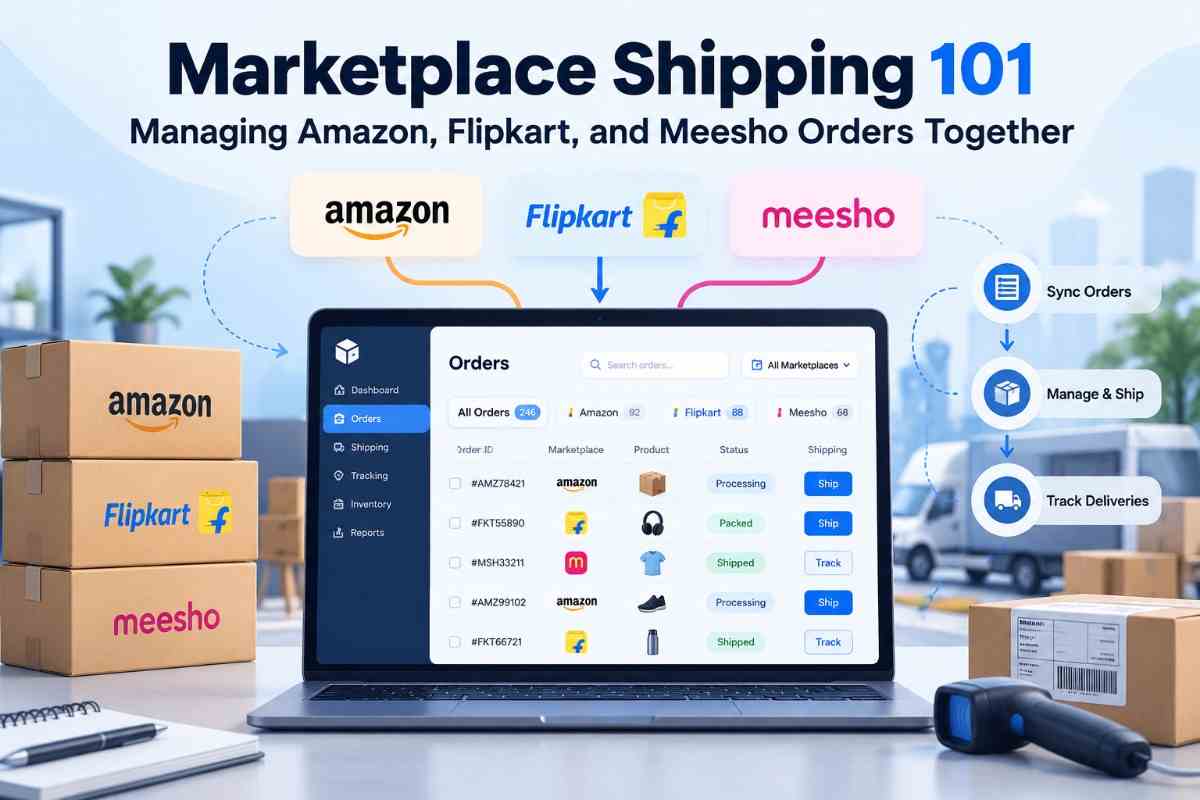
Managing orders from Amazon, Flipkart, and Meesho can help a seller reach more customers, but it also creates a daily logistics challenge. Each marketplace may have different order timelines, packaging expectations, shipping labels, pickup processes, return rules, and seller dashboards. When these tasks are handled separately, missed dispatch deadlines, duplicate entries, delayed pickups, and tracking confusion become more likely.
Marketplace shipping management india is the process of organising orders from multiple online marketplaces, preparing them for dispatch, assigning suitable carriers, tracking movement, and handling delivery exceptions through a coordinated workflow. It is not limited to booking a courier. It also covers inventory visibility, order verification, packaging, documentation, customer communication, returns, and reconciliation.
For a growing marketplace seller, the objective is simple: bring orders from different channels into a reliable operating process without losing control of cost or delivery quality. This guide explains how to build that process, where sellers commonly make mistakes, and how a logistics aggregation platform can reduce manual work.
For a broader view of the technology involved, see this guide to multi-channel fulfilment.
Marketplace shipping management india refers to the coordinated handling of shipments generated through more than one digital marketplace. In this context, Amazon, Flipkart, and Meesho are sales channels, while the seller remains responsible for preparing the right product, at the right time, in the right packaging, for the right destination.
A well-designed process connects five operational activities: order capture, fulfilment planning, carrier selection, shipment monitoring, and post-delivery handling. The seller must identify which orders are ready, confirm stock and customer details, print the correct label, pack according to product requirements, and hand over parcels within the applicable dispatch window.
The important distinction is between selling on multiple channels and operating multiple disconnected shipping systems. A seller can have three marketplaces but still run one disciplined logistics workflow.
Marketplace orders are time-sensitive. A delay in accepting or dispatching an order can affect seller performance, customer expectations, and the availability of stock for other channels. The problem becomes more visible during festive demand, product launches, flash sales, or periods when one channel generates a sudden increase in volume.
Each marketplace also creates a different information flow. An order may appear in one dashboard, the shipping label may be generated elsewhere, and tracking updates may be checked through a carrier portal. If the team copies information manually between systems, small errors can create large operational consequences. A wrong pincode, mismatched SKU, or duplicate shipment can result in a failed delivery or a difficult return.
Shipping is therefore part of marketplace performance, not merely a back-end activity. A product can win visibility and orders on a platform, but poor fulfilment can still damage the seller’s operating results.
For sellers evaluating their current setup, these signs of shipping complexity can help identify when manual coordination is no longer practical.
A coordinated system gives marketplace sellers better control over the complete order journey. It does not remove every logistics issue, because carrier performance, customer availability, weather, address quality, and regional serviceability still affect delivery. However, it gives the seller better information and a more structured way to respond.
Instead of checking Amazon, Flipkart, and Meesho separately, the operations team can work from a consolidated order queue or a defined daily export process. This reduces repeated data entry and makes it easier to sort shipments by urgency, destination, product type, or fulfilment status.
Different parcels may require different shipping modes. A lightweight order going to a serviceable urban pincode may follow a different route from a bulky order travelling to a remote location. Using multiple carrier options allows the seller to consider serviceability, parcel characteristics, and delivery needs rather than applying one courier to every shipment.
Standardised shipment creation reduces the time spent copying addresses and order numbers. It also lowers the risk of placing the wrong label on a parcel, an error that can lead to failed delivery, customer complaints, and marketplace disputes.
When tracking events are monitored in an organised way, the seller can distinguish normal transit movement from an exception. This supports proactive action on non-delivery reports, delayed scans, address concerns, and failed attempts.
Returns should be treated as a separate operational flow, not as a simple reversal of the original shipment. The seller needs to track pickup status, parcel receipt, product inspection, stock updates, and marketplace closure. A structured approach helps prevent returned inventory from disappearing between logistics and warehouse records.
Seller teams that need a deeper operational reference can review this guide on simplifying order management.
The following workflow works for small and growing marketplace businesses. The exact marketplace settings may differ, but the operating principles remain useful across categories such as apparel, beauty, home products, electronics accessories, and packaged goods.
This workflow becomes more effective when roles are assigned clearly. One person may manage order review, another may supervise packing, and a third may monitor exceptions. In a smaller business, one team member can perform all roles, but the checkpoints should still be documented.
Good shipping performance comes from consistent controls rather than occasional firefighting. Sellers should document the process in a simple operating checklist and review it whenever a new marketplace, warehouse, product category, or courier is added.
Use consistent SKU names, dimensions, weights, and product descriptions across channels. Incorrect parcel dimensions can create billing disputes, while inconsistent SKU naming makes picking and return reconciliation harder. Keep a master product file and define who can change it.
Marketplace dispatch deadlines and seller requirements should be recorded alongside your own warehouse cut-off times. For example, an order may technically be accepted until a certain time, but the warehouse may need an earlier internal cut-off to complete packing and handover without rushing.
Track delivery attempts, delays, returns, pickup consistency, damage complaints, and weight discrepancies by carrier and destination type. Avoid judging a courier only by a single successful shipment or by the lowest visible rate. Operational reliability depends on the lane, product, and service level.
Cash-on-delivery orders require additional attention because delivery success and payment collection are connected. Confirm that COD values match the order record, monitor undelivered shipments, and reconcile remittances according to the applicable process. Returns should be inspected quickly so sellable inventory can return to the available stock pool.
Packaging is another cost-control area. Measure and record packed dimensions for common products, use right-sized cartons where practical, and avoid excess material that increases parcel size. Understanding volumetric weight helps explain why a light but large parcel can attract a higher charge.
Define when an issue moves from routine monitoring to active intervention. A delayed scan, repeated failed attempt, address mismatch, suspected loss, or order marked delivered but disputed by the customer should have a documented escalation path. Keep shipment IDs, photographs, manifests, and communication records available for investigation.
These measures help the seller make evidence-based decisions about packaging, carrier allocation, warehouse cut-offs, and customer communication.
Most shipping failures are not caused by one dramatic error. They usually result from several small gaps in data, ownership, and follow-up. Identifying these weaknesses early is especially important for sellers operating across multiple channels.
Separate dashboards can make the team feel busy without providing a complete view of pending work. This increases the risk of overlooking one channel during peak volume. Use a consolidated queue, shared tracker, or connected shipping system with clear status definitions.
A low quoted rate may not be the lowest operational cost if the service has poor coverage for a destination, limited pickup reliability, or a higher likelihood of return. Compare the complete shipment experience, including exceptions and reverse movement.
Using an assumed weight or standard box size can create a difference between expected and billed charges. Measure representative packed parcels and update product data when packaging changes.
A marketplace status, carrier scan, warehouse record, and payment status may not update at the same moment. If the team does not reconcile them, an order can remain open, a return can be missed, or stock can be shown as available when it is physically elsewhere.
An NDR, or non-delivery report, indicates that a delivery attempt did not complete. The reason may involve an unavailable customer, an incorrect address, or another delivery issue. Review the reason and follow the appropriate reattempt or contact process instead of allowing every exception to move automatically toward return.
Wrong products, missing accessories, and incomplete bundles are preventable when the packing team checks the SKU and quantity before sealing the parcel. For high-value orders, maintain a simple evidence process that supports internal review and marketplace claims.
If parcels are handed over without a manifest, scan, or internal record, it becomes difficult to prove whether an item left the warehouse. Record the shipment list and investigate missing first scans promptly.
Sellers can also review practical guidance on reducing avoidable returns when return-to-origin levels begin affecting margins.
There are two common operating approaches for sellers shipping marketplace orders. The first is to manage each marketplace and courier separately. The second is to use a coordinated multi-carrier process that brings shipment activities into one operational framework.
The right model depends on order volume, product range, warehouse capability, marketplace requirements, and the level of control the seller needs. A shipping aggregator can be useful when the seller wants access to multiple courier options without managing every courier relationship through a separate workflow.
Marketplace shipping management india becomes easier when Amazon, Flipkart, and Meesho orders are treated as one coordinated logistics operation rather than three unrelated tasks. Consolidate order information, protect dispatch timelines, verify stock and addresses, select carriers based on shipment needs, monitor exceptions, and reconcile returns and payments consistently.
Shipmozo supports marketplace sellers with B2C Shipping, Surface, Air, and International Shipping services, helping businesses plan shipping across different parcel requirements and destinations. The right setup still depends on your products, volumes, serviceability, and operational process, but a structured multi-channel workflow gives your team a stronger foundation for growth.
Start Shipping Today
Marketplace shipping management india is the coordinated handling of orders from multiple online marketplaces, including order consolidation, stock checks, packing, label creation, carrier allocation, tracking, exception management, returns, and reconciliation.
Yes. Sellers can bring order information from the three marketplaces into a shared operational queue or connected shipping workflow. The team must still follow each marketplace’s dispatch, packaging, and documentation requirements.
Consider destination serviceability, parcel weight and dimensions, product handling needs, delivery expectations, pickup reliability, tracking quality, return movement, and the total freight cost. The lowest quoted rate is not always the most suitable operational choice.
An NDR means that a delivery attempt did not complete. The seller should review the recorded reason, verify customer or address details where appropriate, and follow a reattempt or escalation process before the shipment moves toward return.
Parcel dimensions can affect volumetric weight, which is the space a shipment occupies compared with its actual physical weight. A large, lightweight parcel may therefore attract a higher charge than expected, making accurate packaging data important.


Kuldeep Karki is a Digital Marketing Manager at Shipmozo, specializing in performance marketing, SEO, and growth strategy. With over 6+ years of experience in digital marketing, he has worked extensively on scaling B2B and eCommerce brands through data-driven campaigns across Meta Ads and Google Ads.





.webp)