

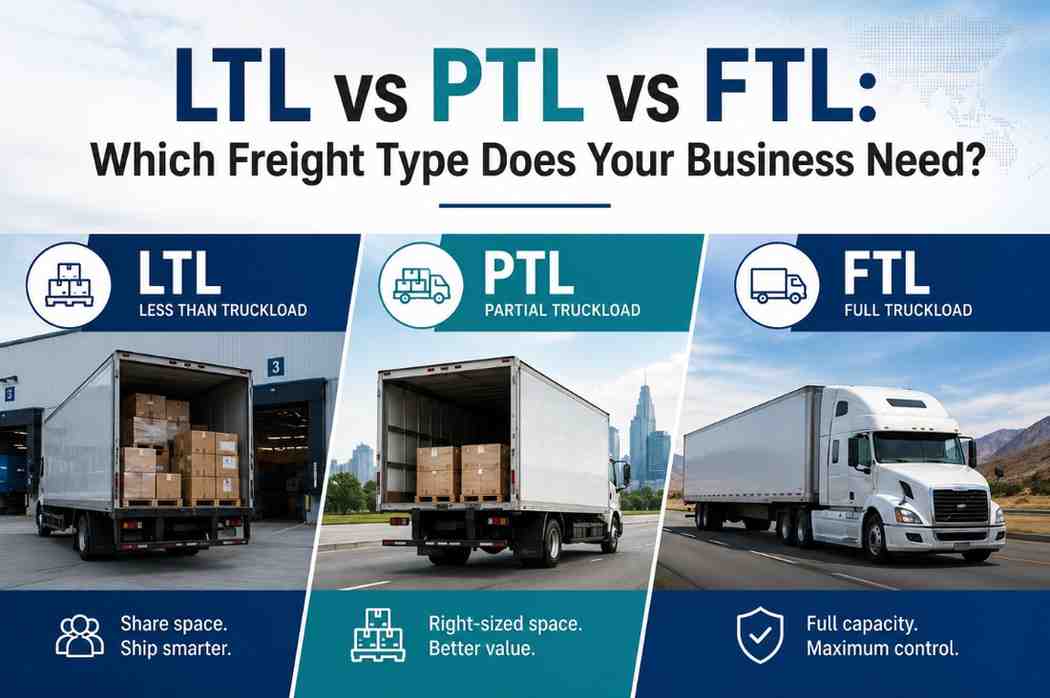
Manufacturers rarely have the same freight requirement for every dispatch. A few cartons of finished goods may not justify a dedicated vehicle, while a full production run may need one truck from pickup to delivery. Understanding ltl vs ptl vs ftl helps logistics teams match each shipment with the right use of vehicle space, handling process and transport budget.
The decision is not simply about choosing the lowest quoted rate. Shipment dimensions, weight, loading pattern, delivery location, urgency, material sensitivity and unloading constraints all influence the appropriate freight type. A wrong choice can create avoidable transshipments, delayed deliveries, underutilised vehicle capacity or unexpected handling charges.
This guide explains the three models in practical terms. It is designed for manufacturers, distributors and B2B shipping teams that need a repeatable framework for selecting transport for raw materials, components, machinery, finished products and replenishment orders.
For broader operational context, manufacturers can also review the fundamentals of B2B shipping, including how commercial shipments differ from standard consumer deliveries.
LTL, PTL and FTL describe how much of a truck or transport vehicle a shipment occupies. The terminology is common in road freight, although the exact weight and volume limits vary by carrier, route, vehicle type and operating region. The abbreviations should therefore be used as planning categories rather than universal fixed thresholds.
Less Than Truckload (LTL) is used when a consignment occupies only part of a truck and is moved along with freight from other shippers. It suits smaller commercial shipments that are larger or more structured than parcel orders but do not require a substantial share of vehicle capacity.
An LTL shipment may be consolidated at a hub or terminal and transferred between vehicles before reaching the consignee. This shared movement can improve vehicle utilisation, but it also means the freight may experience more handling than a dedicated load. Correct packaging, palletisation and clear labelling are important. Learn more about Less Than Truckload operations and their typical planning considerations.
Part Truckload (PTL) is generally selected when the shipment needs more space than a small LTL consignment but does not fill an entire truck. The load shares vehicle capacity with other shipments, often with fewer consolidation points or handling stages than standard LTL, depending on the carrier and route.
PTL is useful for manufacturers moving multiple pallets, bulky cartons or moderate quantities between plants, warehouses, distributors and project sites. It can offer a practical balance between dedicated capacity and shared transport. However, shippers must confirm how the provider defines PTL, because operating practices and capacity thresholds are not identical across logistics companies.
Full Truckload (FTL) means a vehicle is booked primarily for one shipper's consignment or one shipment movement. The load may fill the vehicle by volume or weight, or the shipper may choose dedicated capacity because the freight requires direct movement.
FTL normally involves fewer intermediate handling events and a more direct route. It is commonly used for high-volume dispatches, time-sensitive replenishment, fragile industrial goods, high-value cargo or shipments that need vehicle exclusivity. A Full Truck Load movement may still involve loading, unloading and route-related delays, so dispatch teams should avoid treating dedicated capacity as an automatic delivery-time guarantee.
Freight selection affects more than the transport line item on an invoice. It influences how inventory moves through the supply chain, how much coordination the warehouse team needs and how confidently a manufacturer can plan production or customer replenishment.
Choosing shared capacity for a shipment that needs a direct vehicle may increase handling exposure or create scheduling complications. On the other hand, assigning a full truck to a small load can leave much of the vehicle unused and raise the effective cost per unit. The best decision depends on the total operating impact, not only the initial rate.
Shared freight allows a business to pay for a portion of transport capacity instead of reserving an entire vehicle. This is useful when shipment volume changes from order to order. FTL can become more efficient when the load occupies most of the vehicle or when the cost of delays, handling and missed production schedules is significant.
A delayed component shipment can affect an assembly line, maintenance schedule or distributor commitment. Freight planning should consider the consequence of late arrival, not just the cargo size. A smaller shipment with a production-critical item may justify a more direct service than its physical volume suggests.
Every additional touchpoint creates another opportunity for packaging stress, misrouting or loading damage. Pallets, crates and protective materials reduce risk, but they do not eliminate the need to choose a suitable transport model. Shippers handling delicate or high-value goods should ask how many transfers are expected and whether the freight will be mixed with incompatible cargo.
The freight category affects dock scheduling, loading time, vehicle access and unloading resources. A full truck may require a dedicated dock slot and equipment such as a forklift. An LTL or PTL dispatch may require detailed piece counts, pallet dimensions and terminal documentation so that the carrier can plan consolidation correctly.
Each model solves a different capacity and service problem. Manufacturers should assess the benefits against the characteristics of their regular lanes rather than selecting one category for every shipment.
These benefits depend on accurate shipment data. In particular, businesses should confirm dead weight, package dimensions, pallet count, stackability and loading restrictions before requesting a quote. Volumetric weight can affect how transport providers assess space-intensive goods, even when the physical weight appears low.
A consistent selection process prevents teams from choosing freight based on habit or a single rate comparison. The following method can be applied to individual dispatches and later converted into lane-level shipping rules.
Freight performance improves when commercial, warehouse and transport teams use the same shipment information. Manufacturers should establish clear operating rules before volume increases or dispatches become urgent.
Create a shipment template containing product description, package dimensions, gross weight, pallet count, stackability, pickup timing, delivery contact and unloading requirements. Standard data reduces quote revisions and helps transport providers allocate appropriate capacity.
Shared freight can involve loading beside other cargo and, depending on the service, handling at terminals. Use strong cartons, stretch wrap, corner protection, strapping and pallets where suitable. Mark fragile, orientation and stacking instructions visibly, but do not treat labels as a substitute for proper internal protection.
Coordinate vehicle arrival with production completion, picking, staging and loading resources. For FTL, confirm vehicle type and loading sequence in advance. For LTL and PTL, ensure the shipment is ready within the agreed pickup window so it does not miss a consolidation movement.
Monitor pickup, in-transit movement, terminal arrival, out-for-delivery status and proof of delivery. Event-level visibility helps teams identify where delays occur and gives customer-facing staff a reliable basis for updates. A clear proof of delivery process also supports invoice closure and dispute resolution.
Freight selection should change when order patterns change. Review shipment size, frequency, damage incidents, delivery performance, accessorial charges and vehicle utilisation by lane. A route that was suitable for PTL during a growth phase may later justify FTL, while a declining lane may be better managed through shared capacity.
Maintain more than one workable transport approach for critical lanes. Weather, vehicle shortages, plant shutdowns and seasonal demand can affect availability. A backup plan may involve changing the freight category, splitting the consignment or adjusting dispatch timing after checking the business impact.
Most freight problems arise from incomplete shipment information or from treating transport categories as interchangeable. The following mistakes are common in manufacturing and distribution operations.
The following summary provides a starting point. Actual suitability depends on carrier definitions, route conditions, cargo characteristics and the service commitments available for the lane.
For a manufacturer, the practical answer may be a combination rather than a single permanent choice. Use shipment profiles and lane history to create thresholds for routine dispatches, then allow logistics managers to override those rules when production urgency, cargo sensitivity or delivery access requires it.
The right answer in ltl vs ptl vs ftl depends on how much space the shipment needs, how it can be handled, how urgent the delivery is and what a delay would mean for the business. LTL supports smaller shared loads, PTL suits moderate consignments and FTL provides dedicated capacity for larger or more sensitive movements.
Shipmozo supports manufacturers with B2B Logistics, Surface, Rail and PTL shipping options, helping businesses evaluate transport according to shipment profile and lane requirements. Use accurate weight and dimensions, compare the full transport scope and review completed shipments before standardising a freight rule.
For a clearer freight strategy across plants, warehouses and distributor locations, cargo shipping options can be assessed alongside your regular B2B dispatch workflow. ltl vs ptl vs ftl is ultimately a capacity decision, but the best result comes from connecting capacity with operational risk and customer commitments.
Talk to an Expert
LTL moves a smaller shipment with other shippers' freight, PTL uses a larger shared portion of vehicle capacity, and FTL reserves a vehicle primarily for one shipment. The exact thresholds vary by carrier and route.
It depends on shipment size and handling needs. LTL is generally suitable for smaller pallet or carton movements, while PTL is more appropriate for moderate or bulky loads that need more capacity than a typical shared LTL movement.
FTL is worth considering when the shipment fills much of a vehicle, needs direct movement, contains sensitive or high-value goods, or supports a production or customer commitment where additional handling creates unacceptable operational risk.
Not always. PTL may cost less when the shipment uses only part of a vehicle, but the comparison depends on the quoted route, vehicle capacity, handling, accessorial charges and the cost of any delay or additional transfer.
Provide package dimensions, gross weight, pallet count, stackability, cargo characteristics, pickup and delivery locations, unloading conditions, required timing and any special handling instructions. Accurate information makes quotes and capacity decisions more reliable.
Yes. Manufacturers commonly use LTL for smaller replenishment orders, PTL for medium-volume dispatches and FTL for large, urgent or sensitive movements. Reviewing shipment history by lane helps determine when each option is appropriate.


Nisshdeep Kaur is a logistics-focused content specialist with 5+ years of experience in eCommerce shipping and delivery optimization. She shares actionable insights to help businesses improve delivery success rates and scale efficiently with platforms like Shipmozo.





.webp)