

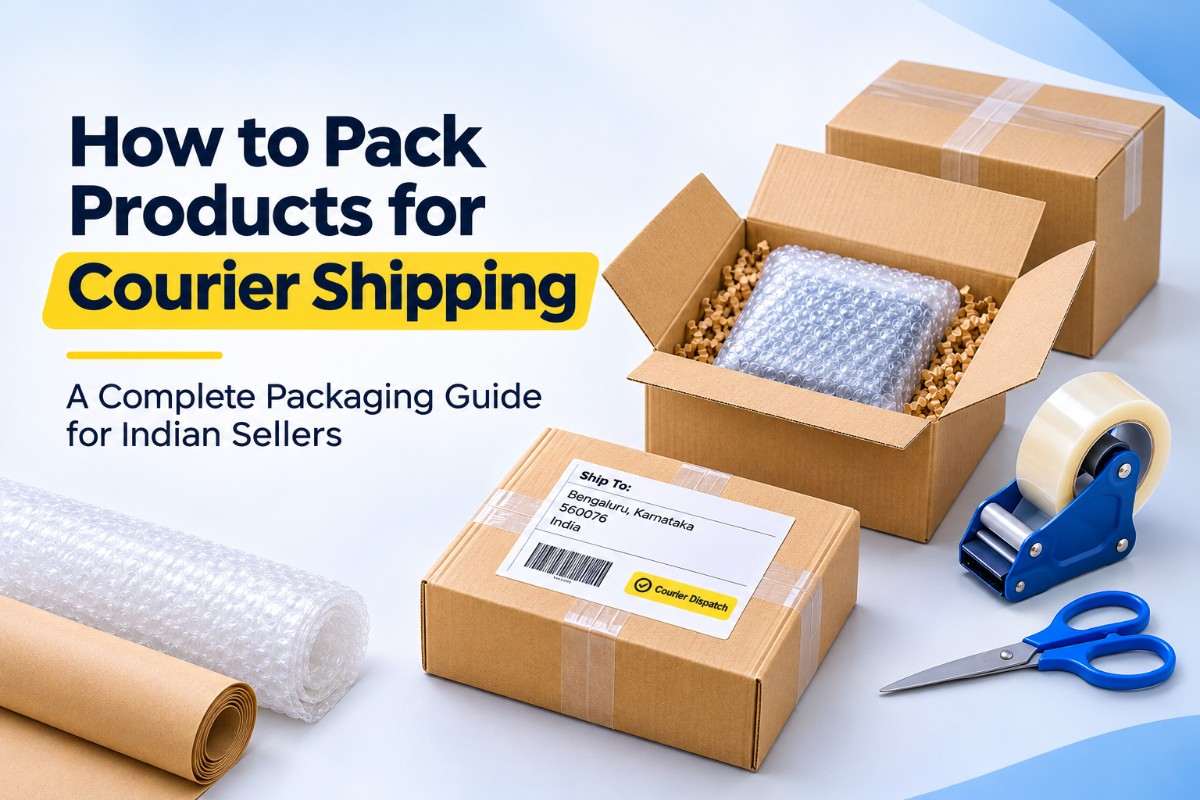
Quick answer: To pack a product for courier shipping, verify the order, choose suitable inner protection, cushion the item, place it in a sturdy right-sized outer package, seal it, measure its final weight and dimensions, attach a scannable shipping label and check the delivery details before handover.
A parcel can travel through pickup vehicles, sorting hubs, line-haul transport and last-mile delivery before reaching a customer. Even a good product can arrive damaged if its carton is oversized, its bottle leaks or its shipping label cannot be scanned. For Indian ecommerce sellers, effective packaging means protecting the order and controlling packed weight, dimensional charges and dispatch errors.
This practical guide explains how to pack courier parcels step by step, which materials to choose for different products, how to check actual versus volumetric weight, and what to verify before handing shipments to your courier partner. Use it to build a repeatable standard operating procedure (SOP) for your packing desk.
The right package depends on the product's weight, fragility, value, shape, liquid content and route. Most parcels involve three layers, although not every item needs all three separately:
Rule of thumb: First protect the product, then select the smallest outer package that fits that protection without squeezing the item. A decorative gift box alone is rarely a substitute for transit protection.
Use this eight-point checklist at every packing station:
Keep a basic packing station ready with right-sized corrugated cartons, sturdy mailers, cushioning or dividers, packaging tape, suitable inner pouches, a barcode label printer, a weighing scale and a measuring tape. Stock specialty materials only for products that need them.
Use the table as a starting specification. Test packaging against the real product and check carrier acceptance rules for restricted categories.
Couriers commonly compare the physical weight of the sealed package with its volumetric (dimensional) weight. Large boxes can occupy costly vehicle space even when their contents are light. A common illustrative formula is:
Worked example: A sealed box measures 30 × 20 × 15 cm and weighs 0.8 kg on a scale. Its volumetric weight is 9,000 ÷ 5,000 = 1.8 kg. Because 1.8 kg exceeds 0.8 kg, the preliminary chargeable weight is 1.8 kg; the courier may then apply its own weight-slab rules. Measure after taping and cushioning, not before.
Why the divisor matters: The same 9,000 cm³ parcel would calculate to 1.5 kg with an illustrative divisor of 6,000, compared with 1.8 kg using 5,000. These are examples, not universal courier rate rules. Confirm the selected carrier's divisor and billing slab before booking.
Try the Shipmozo volumetric weight calculator, read the shipping weight guide or explore ways to reduce volumetric weight. Always check the applicable courier's measurement, weight-slab and pricing terms in your shipment quote; do not assume any volumetric-weight waiver applies universally.
Packaging alone does not make restricted or dangerous goods shippable. Batteries (including lithium batteries within devices), aerosols, perfumes, flammable substances, chemicals, medicines, food and valuables may be subject to carrier rules, mode restrictions, additional declarations or legal requirements. Do not assume a product accepted by one courier can travel on every route or by air.
For electronics, immobilise the device, protect exposed contacts where required and use packaging appropriate to the battery type and carrier policy. For permitted liquids, tighten caps, add suitable leak-resistant containment and cushion the container against impact. For glass, wrap pieces individually and prevent contact with carton sides. Ask the courier or shipping-platform team about acceptance before creating a label for a questionable product.
Illustrative seller scenario (not a Shipmozo customer case study): A seller ships a ceramic mug in a roomy carton. On inspection, the mug can touch the side wall and the box has unused space. The seller wraps the mug, adds dividers or cushioning that keeps it away from all carton walls, then selects the smallest sturdy carton that accommodates the protected mug. The team records the packed dimensions and tests the method before applying it to recurring orders. This reduces uncontrolled movement and avoids unnecessary box volume; it does not guarantee that no breakage will occur.
Create a short packaging SOP for each high-volume SKU family: approved outer carton or mailer, inner protection, number of units per parcel, final packed dimensions, sealing method and a reference photo. Train packers on that specification, then review damage claims, weight disputes and customer feedback every month. If a package repeatedly fails, change the specific material or procedure and test it before rolling the change across every order.
Retain consistent packing photos and measurement records for high-value or dispute-prone shipments where permitted by your business policies. These records can assist investigation, but do not guarantee a claim will be accepted by a courier.
Good courier packaging is a balance of protection, right-sized materials, accurate shipping data and repeatable final checks. Start with the product's physical risks, protect it against normal handling, measure the finished parcel and verify the label before handover. This reduces avoidable errors without assuming that more packaging is always better.
Pack Smarter. Ship Better with Shipmozo.
Once your parcel is packed and measured, connect with Shipmozo to discuss suitable B2C or business shipping options for your orders.
Talk to Shipmozo About ShippingIt depends on the product. Use strong poly mailers for suitable soft goods, rigid cartons for fragile or crush-sensitive items and cushioning or dividers to control movement.
Choose the smallest carton that fits the fully protected product without compressing it. Remove unnecessary empty space, but keep enough cushioning to protect weak points.
Not always. Secure sealing is essential, while tamper-evident tape or bags are especially useful for higher-value or dispute-prone orders. They indicate possible opening; they do not guarantee prevention.
After the parcel is completely packed and sealed. Record its actual weight and external length, width and height, then check the selected courier's volumetric and slab rules.
No. Apparel, documents, glass, electronics and liquids have different risks and carrier restrictions. Create a packing specification for each major product category.


Diveya Mehta is a marketing and content specialist with 3+ years of experience, currently working with Shipmozo. With 1 year of hands-on experience in logistics, she creates practical, insight-driven content focused on shipping, courier performance, and eCommerce growth.