

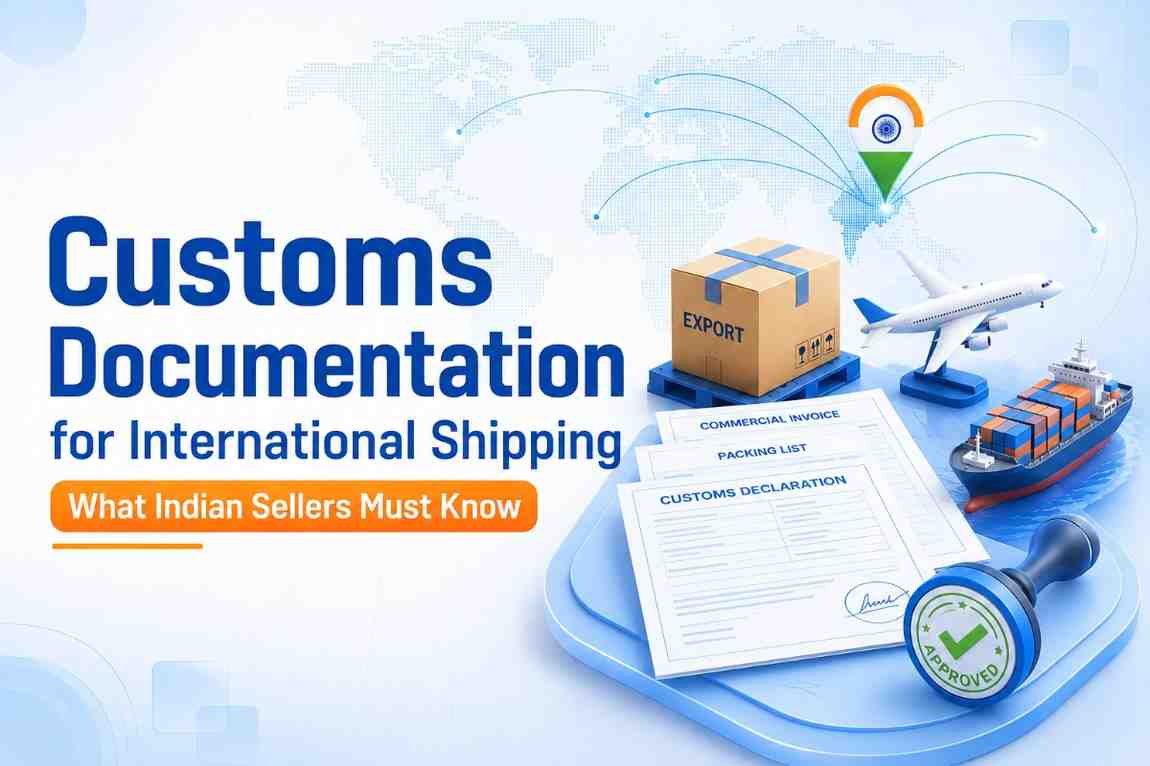
Customs documentation international shipping requirements can appear complicated when an Indian seller starts exporting. In practice, most clearance problems come from a few preventable issues: an incomplete commercial invoice, an inaccurate product description, a mismatch between the declared value and the shipment contents, or missing regulatory paperwork.
International parcels are checked by customs authorities in India and in the destination country. These authorities use the documents to identify the goods, calculate duties and taxes, verify export eligibility, and determine whether the shipment needs additional inspection. The courier or freight partner may help submit the paperwork, but the seller remains responsible for providing accurate commercial information.
This matters for manufacturers, distributors, wholesalers, D2C brands, and ecommerce sellers that are shipping samples, commercial orders, or consumer products outside India. A shipment can be physically packed and ready for pickup yet still remain stuck because its paperwork does not clearly explain what is inside.
This guide explains the main documents, the information each one should contain, the preparation process, and the operational checks that reduce avoidable customs queries. It also highlights situations where requirements vary by product, destination, shipment value, or export model.
Customs documentation is the set of commercial, transport, regulatory, and identity records used to move goods across an international border. The documents tell authorities what is being shipped, who is sending it, who is receiving it, how much it is worth, and why it is being exported.
For an Indian seller, the paperwork usually begins with the commercial invoice and packing list. Depending on the shipment, it may also include an airway bill, shipping bill, export declaration, certificate of origin, product-specific licence, inspection certificate, insurance document, or tax-related record.
The exact list is not identical for every parcel. A low-value document shipment, a B2C ecommerce order, a commercial sample, and a bulk export of regulated goods may follow different procedures. Courier mode, destination-country rules, Incoterms, product category, and the seller’s export registration status can all affect the requirements.
A useful way to understand the process is to separate documents into four groups:
The commercial description should be specific. “Items,” “samples,” or “gifts” is rarely sufficient for a product that has a clear name and purpose. A better description identifies the product, its material or composition where relevant, quantity, intended use, and country of origin.
Customs paperwork directly affects whether a shipment moves smoothly or requires manual intervention. Authorities need enough information to classify the goods and assess their admissibility. If the description is vague or the declared value appears unreasonable, the shipment may be held for clarification.
Delays create operational costs beyond the initial freight charge. Customer support teams may need to answer repeated delivery questions, warehouse staff may need to resend documents, and the seller may face storage, rebooking, return, or disposal charges depending on the carrier and destination. A delayed parcel can also miss a customer’s expected delivery window.
Accurate declarations are equally important for financial control. Customs duties and import taxes are often calculated using the declared value, product classification, origin, and destination rules. Under-declaring may create compliance exposure, while over-declaring can increase the recipient’s landed cost and make the order commercially unattractive.
There is also a relationship between paperwork and shipment visibility. The carrier needs consistent information across the label, invoice, electronic booking, and transport record. If the consignee name, address, phone number, weight, or product details differ across documents, the shipment may be flagged or require correction.
Indian sellers should pay special attention to these areas:
Rules change, and a logistics platform or courier cannot replace advice from customs, tax, or trade-compliance professionals. Sellers should verify current requirements before shipping regulated or high-value goods.
The following documents cover the most common requirements for parcel and commercial exports. Not every shipment needs every document, but a seller should know when each one applies.
The commercial invoice is the primary document used to understand the transaction. It should normally include the exporter’s legal name and address, consignee details, invoice number and date, product description, quantity, unit price, total value, currency, country of origin, reason for export, and applicable delivery terms.
Descriptions should be written in plain, precise language. For example, “100% cotton men’s knitted T-shirts, 10 pieces” is more useful than “garments.” The declared value should represent the actual transaction or an appropriately supported value for samples, replacements, or non-sale shipments.
The packing list explains how the goods are arranged inside the shipment. It can include carton count, package dimensions, gross weight, net weight, product quantity, SKU or item references, and the contents of each package.
It is particularly useful when a shipment contains multiple products or cartons. The packing list should agree with the invoice and physical package. Sellers should understand the distinction between net and gross weight: net weight is the product weight, while gross weight includes packaging and other shipment materials.
An airway bill, often called an AWB, is issued for air shipments and acts as the carrier’s transport record. It contains the tracking number, shipper and consignee information, origin, destination, package details, and routing information.
The AWB is not a substitute for the commercial invoice. Instead, it connects the physical parcel and transport movement with the commercial and customs records. The name, address, phone number, and shipment details should be checked carefully before handover.
A shipping bill or related export declaration records the export of goods from India. The filing method and document requirements can differ according to the export channel, product, value, and whether the shipment is moved through courier or cargo procedures.
For regular commercial exports, sellers should confirm the applicable process with their authorised courier, customs broker, or trade-compliance adviser. Do not assume that the process used for a small parcel also applies to a pallet, bulk consignment, or freight shipment.
A certificate of origin identifies the country where the goods were produced or manufactured. The destination country may request it to apply tariff treatment, enforce trade controls, or satisfy the importer’s internal compliance process.
Country of origin is not necessarily the same as the country from which the parcel is dispatched. A product manufactured in one country and shipped from India may need to be described accordingly, subject to the applicable origin rules.
Food, supplements, cosmetics, medicines, medical devices, batteries, chemicals, plant products, animal products, and certain electronics may need additional documentation. Examples can include health certificates, safety data sheets, test reports, import permits, fumigation certificates, or regulatory approvals.
Requirements depend on the product composition, destination, quantity, and intended use. Sellers should check the destination authority and the courier’s prohibited or restricted goods policy before accepting an order.
For valuable shipments, sellers may consider shipping insurance subject to the carrier’s terms. Keep purchase records, product invoices, payment evidence, photographs, packing records, and any inspection documents. These records can support a customs query or a claim, but they do not remove the need for accurate declarations.
A repeatable preparation workflow is more reliable than creating paperwork from memory for each order. The process below works well for ecommerce parcels and can be adapted for larger commercial consignments.
For sellers handling orders from more than one channel, an ecommerce shipping integration can help keep order and shipment information connected. It does not make the seller’s declaration automatically correct, so the underlying product data still needs review.
Good customs performance comes from disciplined data management, not from choosing a courier based only on the lowest displayed rate. The following practices are useful for Indian sellers building a repeatable export process.
Businesses comparing courier options can also review international shipping through courier aggregation. A multi-carrier approach may provide operational flexibility, but sellers should still compare destination coverage, restricted-goods handling, claims processes, and documentation support.
Most documentation failures are not caused by complicated legal issues. They result from hurried order processing, copied templates, poor product data, or assumptions that the courier will correct everything after pickup.
Before sealing the package, match the physical contents to the paperwork. This simple check catches quantity errors that may not be visible when the invoice is created from an online order.
Documentation requirements vary by shipment type. The table below is a practical starting point, not a replacement for checking current customs and destination-country rules.
For Indian sellers, customs documentation international shipping is not merely a paperwork task. It is part of the shipment’s operational data. Accurate product descriptions, consistent values and weights, complete consignee details, and destination-specific compliance checks can make clearance more predictable and reduce avoidable exceptions.
Start with a standard invoice and packing-list template, maintain reliable SKU information, verify restricted categories before booking, and keep supporting records for every export. When shipment volumes grow, using a logistics platform with International Shipping, Air, and Surface shipping services can help organise transport choices across different order requirements. Shipmozo also supports B2B Logistics and B2C Shipping, allowing businesses to align the shipping method with the nature of the order.
Documentation still needs human review, especially for regulated products and unfamiliar destinations. Treating compliance as part of order fulfilment—not as an afterthought at the airport or customs station—gives your team a stronger foundation for cross-border growth.
Talk to an Expert
The commercial invoice is usually the central document because it identifies the goods, value, seller, buyer, origin, and transaction terms. It must be supported by a waybill and, where relevant, a packing list, export declaration, certificate, or product-specific approval.
Not every small parcel requires a separate formal packing list, but package contents, quantity, weight, and dimensions must still be accurately available. A packing list becomes especially useful for multiple products, multiple cartons, commercial exports, or shipments that may be inspected.
No. A shipment should be declared according to its actual purpose. A commercial sale should not be described as a gift merely to reduce duties or taxes. Incorrect declarations can result in customs queries, reassessment, penalties, delays, or return handling.
HS-code requirements vary by shipment channel, product, value, and destination. Many commercial shipments need a correct classification, particularly when customs duties or product controls apply. If the classification is unclear, consult a customs broker or trade-compliance professional instead of guessing.
The responsible party depends on the agreed delivery terms, transaction structure, and destination-country process. In many ecommerce shipments, the recipient may be asked to pay import duties, taxes, or clearance charges. Sellers should clarify this before dispatch and communicate it to the buyer.
Respond through the courier, freight forwarder, or customs broker using accurate and complete records. Provide the requested invoice, product information, payment evidence, certificate, or licence promptly. If the request concerns classification or valuation, obtain professional guidance before submitting a revised declaration.


Ankit Debnath is a sales and marketing professional with 4+ years of experience in the logistics industry, specializing in managing B2B and B2C key accounts. At Shipmozo, he focuses on driving growth through client acquisition, lead generation, and strategic relationship management. Passionate about building strong client relationships and delivering results, he brings a practical, growth-oriented approach to logistics and business expansion.





.webp)