

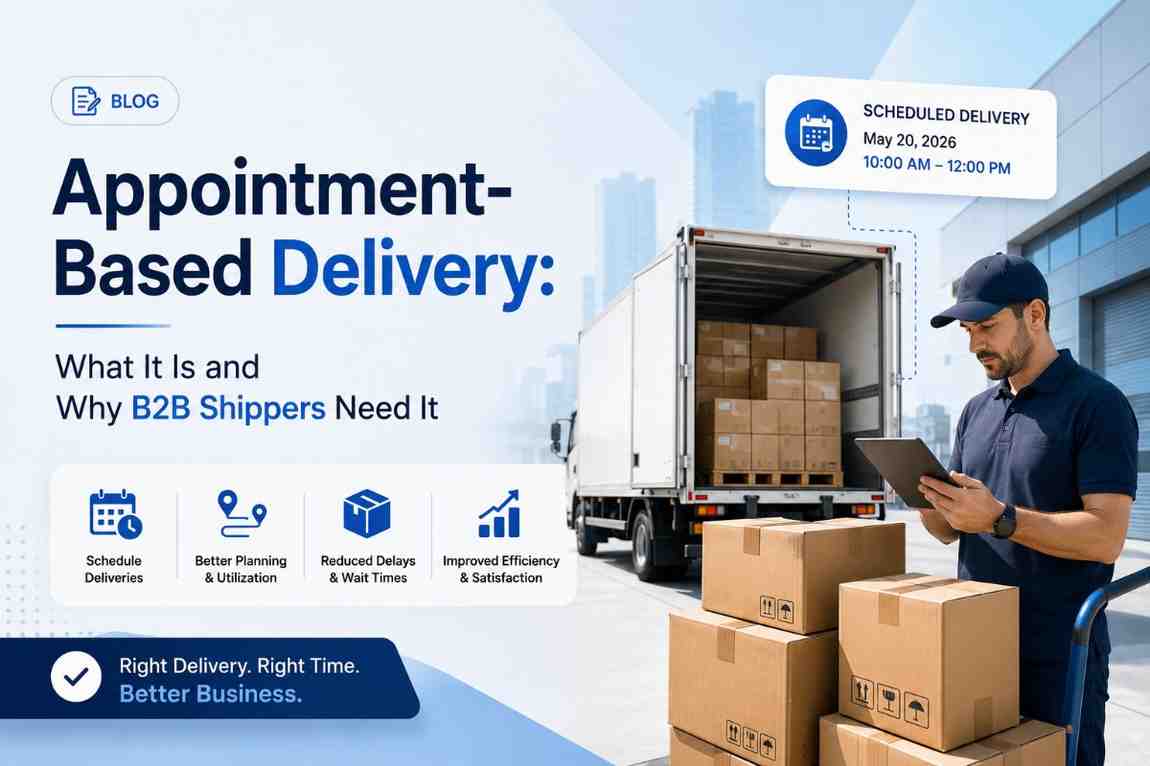
For manufacturers, delivery is rarely complete when a truck reaches the destination city. The receiving warehouse may have fixed unloading slots, limited dock capacity, safety checks, purchase-order verification, or a team available only during specific hours. If the vehicle arrives outside that window, the shipment may wait, incur detention, require another attempt, or return to the origin.
Appointment-based delivery addresses this operational gap by coordinating the delivery time with the consignee before the vehicle reaches the facility. Instead of treating delivery as an unplanned arrival, the shipper, carrier, and receiving location agree on a practical date and time slot.
This model is particularly relevant for manufacturers shipping raw materials, components, finished goods, machinery, spare parts, and palletized consignments. It helps connect transportation planning with warehouse operations, production schedules, and customer service commitments.
The process requires more than a phone call to the recipient. It depends on accurate consignee information, shipment visibility, realistic transit planning, and clear handling of delays. This guide explains the model, its benefits, implementation steps, and the mistakes that can disrupt scheduled B2B deliveries.
Appointment based delivery is a transportation process in which the receiver and delivery team agree on a specific delivery date and time window before the shipment is delivered. The appointment may be arranged by the shipper, carrier, warehouse, or a third-party logistics provider, depending on the operating model.
In a standard B2B movement, the carrier may receive the delivery address, contact details, shipment dimensions, and expected transit date. The receiving facility then confirms when it can accept the cargo. The carrier plans the route and communicates any change that could affect the agreed slot.
The arrangement can apply to a fixed hour, a two-hour window, a morning or afternoon slot, or a larger receiving period. The appropriate format depends on the facility’s dock rules, shipment size, vehicle type, and unloading requirements.
It is different from ordinary doorstep delivery. A business receiving a full truckload, less-than-truckload shipment, heavy equipment, or multiple pallets usually cannot accept an unexpected vehicle in the same way a household can receive a parcel. The delivery must fit into the facility’s working process.
For manufacturers, this method often involves several parties:
Manufacturing logistics is closely tied to timing. A delayed input can affect production, while an unplanned finished-goods arrival can occupy staging space or create congestion at a distribution centre. Scheduled receiving gives the destination more control over when labour, equipment, and storage space are used.
The requirement becomes more important when the shipment is large, high-value, fragile, regulated, or difficult to unload. A machine part may need a forklift. A palletised consignment may require a dock leveller. A chemical or temperature-sensitive product may need a designated receiving process. A retail or industrial customer may also reject vehicles that arrive without a slot.
Operationally, a missed slot can create several connected problems:
Manufacturers also need a reliable record of what happened. A time-stamped delivery update, receiver confirmation, and documented exception make it easier to investigate delays and reconcile transport performance. A B2B shipping process that includes scheduled receiving is therefore not only a delivery choice; it is part of broader supply chain control.
Scheduled delivery does not remove every transport risk. Traffic, weather, loading delays, incorrect addresses, and vehicle breakdowns can still affect execution. Its value comes from creating a shared operating plan and giving every party a clearer response when conditions change.
The receiving facility can assign a dock, forklift, crane, unloading crew, or inspection team before the truck arrives. This reduces last-minute coordination and helps the warehouse use its capacity more deliberately.
A confirmed receiving window makes it less likely that a vehicle will arrive when the site is closed or unable to accept the cargo. It does not eliminate failed attempts, but it gives the shipper an opportunity to identify conflicts before dispatch.
When the delivery slot is known, route planners can account for the expected waiting and unloading process. The carrier can assign a suitable vehicle and avoid treating a complex industrial delivery like a standard parcel drop.
Business customers often need delivery information for production, sales, procurement, and warehouse teams. A confirmed appointment, followed by timely status updates, gives them information they can act on rather than a vague estimated arrival.
Production and warehouse teams can align expected receipts with purchase orders, stock levels, and dispatch plans. This is useful when materials are delivered directly to a plant or finished goods move to a distributor or institutional customer.
If the truck is delayed, the consignee is unavailable, or the facility rejects the vehicle, the appointment record provides context. The team can reschedule, escalate, or document the event instead of relying on informal messages and memory.
For commercial shipments, delivery confirmation should show that the right goods reached the right location and were accepted by an authorised person. Combining appointment details with real-time shipment tracking and delivery proof gives the shipper a more complete shipment record.
A workable process begins before the vehicle is assigned. Manufacturers should treat receiving coordination as part of order fulfilment, not as an informal task performed after dispatch.
For higher shipment volumes, an orderorder management system can help centralize order information and reduce dependence on disconnected spreadsheets, calls, and messaging applications.
The quality of scheduled delivery depends on the information exchanged between the shipper, carrier, and receiving site. Small gaps in address data or handling instructions can create large operational delays, especially when a vehicle has travelled a long distance.
Keep receiving hours, holiday closures, dock instructions, contact roles, paperwork rules, and vehicle restrictions against each regular customer location. Update this information when the site changes its process. A customer may have different requirements for its plant, depot, and regional warehouse.
Before dispatch, confirm that the goods are packed, labelled, invoiced, and ready for loading. The destination should also be ready to receive them. This prevents a vehicle from arriving while the order is still under quality inspection or awaiting missing documents.
An estimated time is a planning forecast. A confirmed appointment is an agreed receiving commitment. Teams should use different labels and communication templates so that customers do not treat an early estimate as a guaranteed slot.
Traffic, loading queues, toll delays, weather, and route restrictions can affect a journey. Reasonable buffer time gives the carrier room to handle normal variation while still protecting the receiving window.
Document who contacts the consignee when a delay occurs, who approves a new slot, and how the change is recorded. Without clear ownership, the driver, warehouse, customer service team, and transporter may all assume someone else is handling the issue.
Review appointment adherence, arrival-before-slot rate, waiting time, failed delivery attempts, reattempts, unloading duration, and the reasons for rescheduling. These measures show whether the problem is route planning, warehouse readiness, inaccurate information, or carrier execution.
Not every delivery requires the fastest option. Planned and less urgent movements may suit surface or rail services, while time-critical production inputs may need air movement. The decision should consider cargo value, urgency, handling requirements, destination access, and the cost of a missed receiving slot.
Send the consignee the shipment reference, expected arrival, vehicle details where available, required documents, and a contact route for changes. Clear messages reduce repeated calls and give the receiving team enough information to prepare.
Many scheduled delivery failures are caused by process weaknesses rather than a lack of transport capacity. Manufacturers can reduce these problems by identifying the common failure points before rolling out the model across plants and customers.
Manufacturers should also avoid assuming that every customer needs the same process. A distributor may accept a broad delivery window, while an automotive plant or large retail distribution centre may require strict slot booking and advance documentation.
The right model depends on the receiver, shipment profile, and consequences of a missed arrival. The following comparison helps manufacturers choose a practical approach.
Scheduled receiving does not always require a dedicated vehicle. A manufacturer can use a shared or consolidated service when the carrier can meet the agreed window and the cargo is compatible with the route. The key distinction is the level of coordination at the destination, not simply whether the vehicle carries goods for one customer.
For companies managing several transport partners or service types, multi-courier shipping can support a more flexible operating model. The shipper can evaluate available services according to lane, cargo, urgency, and delivery requirements instead of applying one carrier to every order.
Appointment based delivery gives manufacturers a structured way to align transport arrivals with receiving capacity. It is most valuable when shipments are palletised, high-value, production-critical, oversized, or sent to facilities with strict dock and gate procedures.
Successful implementation depends on accurate consignee information, confirmed time windows, suitable transport planning, proactive delay communication, and complete delivery records. It should also be measured through waiting time, slot adherence, reattempts, delivery exceptions, and proof-of-delivery quality.
Shipmozo supports business shipping requirements across B2B Logistics, Surface, Air, and Rail, helping manufacturers select transport options according to shipment urgency and operating needs. Its multi-service logistics approach can be useful when planned freight and time-sensitive consignments need to be managed within a coordinated shipping workflow.
To discuss your manufacturing logistics requirements, Talk to an Expert
Standard delivery usually works with a broad estimated arrival period, while scheduled delivery requires the receiver to confirm a specific date or time window. Scheduled receiving is more suitable for facilities with limited dock capacity, fixed working hours, or special unloading requirements.
Manufacturing inputs, palletised freight, machinery, spare parts, oversized cargo, high-value goods, and production-critical materials often benefit most. The model is also useful when the destination requires advance paperwork, gate entry, lifting equipment, or a dedicated unloading team.
Typical information includes the complete delivery address, exact gate or dock, consignee contact, operating hours, preferred date and time window, shipment weight and dimensions, vehicle restrictions, unloading requirements, purchase-order details, and required documents.
The shipper or carrier should inform the consignee before the slot is missed, record the reason for the delay, and obtain a revised appointment. Sending the vehicle again without confirmation can lead to another failed attempt or additional waiting time.
Yes. Scheduled receiving can be used with shared or consolidated transport when the carrier can meet the agreed delivery window and the shipment is compatible with the route. A dedicated vehicle is not automatically required.


Neha Pant works in business development at Shipmozo, where she focuses on helping eCommerce and D2C brands simplify their logistics and scale operations efficiently. She is passionate about understanding real shipping challenges and connecting businesses with the right solutions.





.webp)