

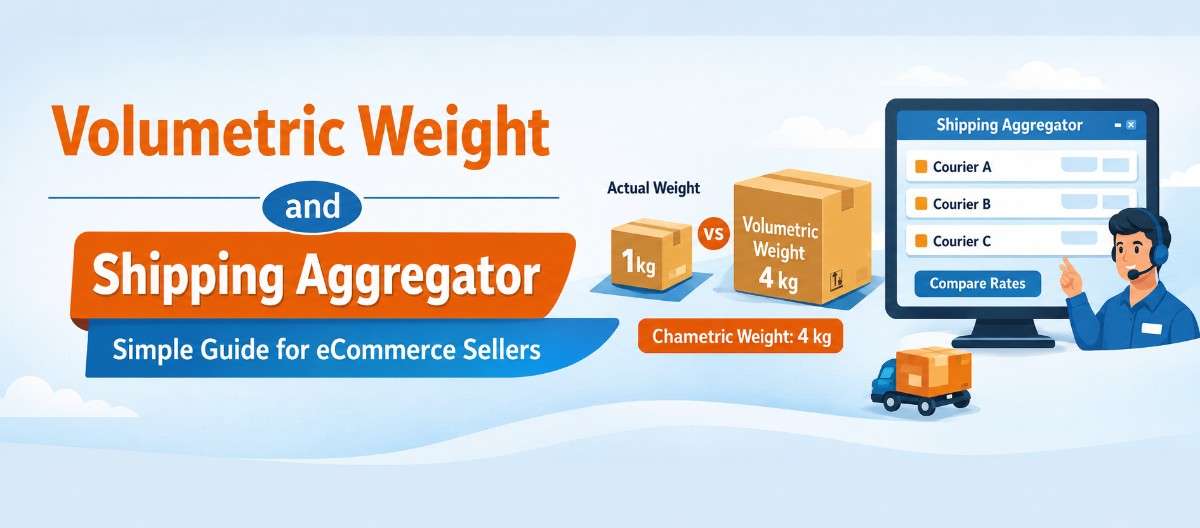
If your courier bill is consistently higher than expected, volumetric weight is almost certainly the reason. It is one of the most common — and most avoidable — hidden costs in ecommerce shipping, silently eating into margins for D2C brands, Shopify sellers, and marketplace sellers across India.
This guide explains what volumetric weight is, how to calculate it correctly across India's major couriers, and exactly how to reduce it. It also covers Shipmozo's no-volumetric-weight slab up to 2 kg — a genuine differentiator for lightweight, bulky products.
Volumetric weight (also called dimensional weight or DIM weight) is a calculated weight based on the physical size of a package — not how much it physically weighs on a scale.
Couriers introduced volumetric weight because large, lightweight parcels occupy space in delivery vehicles, sorting belts, and aircraft just like heavy ones do. A box of cotton balls that weighs 300 grams still takes up the same cubic space as a 5 kg box of steel tools. Charging only by actual weight would make large parcels unprofitable for couriers to handle.
The rule is simple: couriers charge whichever is higher — actual weight or volumetric weight.
This matters most for product categories like:
For these categories, sellers are routinely billed for 2x to 5x the actual weight of the product.
The standard formula used by most Indian couriers is:
Volumetric Weight (kg) = Length (cm) × Width (cm) × Height (cm) ÷ DIM Factor
The DIM factor (also called the divisor) is a number set by each courier. A lower DIM factor gives a higher volumetric weight — which means you pay more.
You are shipping a pair of sneakers in a box measuring 40 cm × 30 cm × 15 cm. The actual weight of the box is 0.9 kg.
You are billed for 3.6 kg despite the parcel weighing under 1 kg. At a typical inter-zone rate of ₹55/kg, that is ₹198 in freight versus the ₹49 you might expect based on actual weight. Multiplied across thousands of orders, this becomes a significant margin leak.
Different couriers use different DIM factors, which means the same package can have a different chargeable weight depending on who you ship with. This is the table sellers should use before choosing a courier for bulky-light products:
Note: DIM factors can vary by service type (air vs surface), contract tier, and courier-specific rules. Always verify with your courier or aggregator before booking high-volume bulky shipments.
Shipmozo's official terms confirm these divisors for key couriers on their platform:
Always cross-check the applicable divisor before booking, especially for surface and B2B shipments.
Step 1: Measure your package dimensions in centimetres (L × W × H)Measure after packing — include all packaging, padding, and wrapping.
Step 2: Calculate volumetric weightMultiply L × W × H and divide by your courier's DIM factor.
Step 3: Weigh the packed parcelUse a calibrated digital scale. Accuracy to 10 grams is recommended for parcels under 2 kg.
Step 4: Compare actual vs volumetric weightWhichever is higher becomes your chargeable weight.
Step 5: Apply the minimum weight ruleMost Indian couriers have a minimum chargeable weight of 0.5 kg. Even if your actual and volumetric weight both calculate to 0.3 kg, you are billed at 0.5 kg.
The third row (25 × 15 × 8) is an example where actual weight equals volumetric weight — chargeable weight is the same either way. The fifth row (20 × 15 × 10) is where actual weight is higher — a dense, heavy small product like a metal component.
Shipping costs are typically the second-largest variable expense for D2C brands in India, after product cost. For sellers in fashion, footwear, and home décor, volumetric charges can add ₹30 to ₹150 per shipment over what actual weight would suggest.
At 500 orders per month, a ₹60 average volumetric overcharge versus a right-sized packaging setup equals ₹30,000 per month — ₹3.6 lakh per year — in preventable shipping costs.
The problem is compounded when sellers:
The single highest-impact change most sellers can make. Saving 5 cm in each dimension on a 40 × 30 × 20 box reduces volumetric weight from 4.8 kg to 2.9 kg — nearly 40% less, potentially dropping into a lower weight slab.
Create 3 to 5 standard box sizes that cover 90% of your SKUs. Measure chargeable weight for each SKU-box combination and record it. This eliminates guesswork at the time of booking.
Clothing, lingerie, sarees, scarves, accessories, and similar soft products can often ship in poly mailers instead of rigid boxes. A saree that weighs 0.4 kg and ships in a poly mailer at 30 × 25 × 2 cm has a volumetric weight of 0.3 kg — chargeable at 0.5 kg (minimum slab). The same saree in a 30 × 25 × 8 cm box has a volumetric weight of 1.2 kg. The difference is ₹35 to ₹55 per shipment on a typical metro route.
Air pillows, excess bubble wrap, and oversized inserts all add dimensions without adding product protection proportionally. Use right-sized packaging instead of void fill wherever possible. If product protection requires it, switch to form-fitting inserts that add minimal height.
For lightweight, large products, a courier using a DIM factor of 5000 will always produce a lower chargeable weight than one using 4000 or 4500. Before booking, calculate chargeable weight under each courier's divisor for your package. The rate-per-kg difference between couriers often matters less than the weight-slab difference.
Always measure and declare dimensions after the product is packed, sealed, and ready for pickup. Never declare the product dimensions alone. Differences between declared and actual dimensions at the courier hub lead to weight discrepancy charges on top of the volumetric billing.
Shipmozo offers no volumetric weight billing up to 2 kg on selected courier partners. This means if your package's volumetric weight calculates to 1.8 kg but actual weight is 0.7 kg, you are billed at actual weight (0.7 kg) — not the volumetric figure.
This is a significant advantage for sellers in fashion, accessories, footwear, home décor, and electronics accessories — product categories where volumetric weight routinely inflates shipping costs beyond actual weight.
Beyond that, Shipmozo's rate comparison dashboard shows the chargeable weight and shipping cost across all active courier partners before you confirm booking — so there are no surprise bills after pickup.
Despite accurate declaration, courier hubs sometimes apply different measurements. If you receive a weight discrepancy charge after pickup, here is how to dispute it:
Note per Shipmozo's T&C: images without a visible measuring tape are deemed invalid. A dispute can be raised only once per AWB number, so ensure your documentation is complete before submitting.
Volumetric weight is the most common hidden cost in Indian ecommerce shipping. The formula is straightforward — L × W × H ÷ DIM factor — but the financial impact at scale is significant, particularly for sellers in fashion, footwear, home décor, and electronics accessories.
The two highest-impact actions are: right-sizing your packaging, and choosing couriers with DIM factors that match your typical product dimensions. Using a shipping aggregator like Shipmozo lets you compare chargeable weight and total cost across 27+ courier partners before every booking — so the most cost-effective option is always visible.
For products under 2 kg where volumetric weight would otherwise inflate your bill, Shipmozo's no-volumetric-weight slab on selected courier partners is a direct cost saving per shipment.
Q1. What is the difference between volumetric weight and actual weight?
Actual weight is the physical weight of your packed parcel on a digital scale. Volumetric weight is a calculated figure based on your package's dimensions (L × W × H ÷ DIM factor). Couriers bill the higher of the two.
Q2. Which Indian couriers have the lowest volumetric weight charges?
Couriers with higher DIM factors produce lower volumetric weights for the same package. India Post (international) uses 6000. Most major domestic couriers — Blue Dart, Xpressbees, Delhivery B2C, DTDC — use 5000. Ekart and some Delhivery services use 4500. Shadowfax uses 4000.
Q3. Does Shipmozo charge volumetric weight?
Shipmozo offers volumetric-free billing slabs up to 2 kg on selected courier partners. For packages where volumetric weight exceeds 2 kg, standard courier-specific DIM factors apply.
Q4. How do I calculate volumetric weight quickly?
Multiply your box's length, width, and height in centimetres. Divide by 5000 (for most Indian couriers). Compare to actual weight. Whichever is higher is your chargeable weight.
Q5. Can I avoid volumetric weight charges legally?
Yes — by using right-sized packaging, poly mailers for soft goods, and eliminating excess void fill. You cannot avoid the calculation, but you can reduce your package dimensions to the point where actual weight exceeds volumetric weight for most shipments.
Q6. What is the minimum chargeable weight in India?
Most Indian couriers have a minimum chargeable weight of 0.5 kg. Even if your actual and volumetric weight both calculate lower, you are billed at 0.5 kg.


Neha Pant works in business development at Shipmozo, where she focuses on helping eCommerce and D2C brands simplify their logistics and scale operations efficiently. She is passionate about understanding real shipping challenges and connecting businesses with the right solutions.





.webp)