

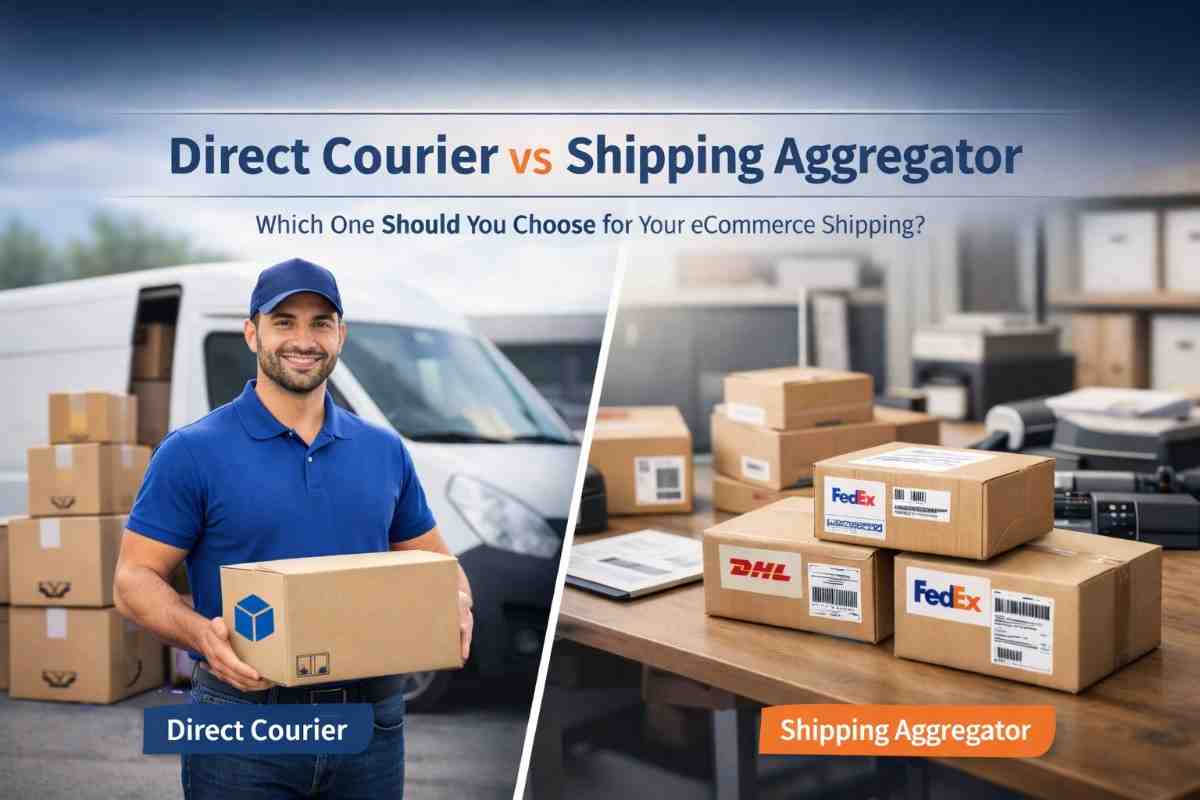
In the rapidly growing eCommerce and D2C ecosystem, shipping plays a critical role in customer experience, operational efficiency, and business profitability. Whether you run a D2C brand, marketplace store, or online business, choosing the right shipping method can significantly impact delivery speed, shipping costs, and operational workflow.
Many sellers face a common question:
Should you ship directly through courier companies, or use a shipping aggregator platform?
Both options have advantages and limitations depending on your business scale, order volume, and logistics requirements.
In this guide, we will break down the difference between direct courier services and shipping aggregators, helping you decide which option works best for your business.
A direct courier service means partnering directly with a logistics company such as DHL, FedEx, Delhivery, or Blue Dart to ship your orders.
Instead of using a platform that connects multiple courier partners, you create an individual contract with each courier provider.
1. Dedicated courier relationship
Businesses with very high shipping volumes can negotiate better rates and service agreements.
2. Custom logistics solutions
Large enterprises can build custom integrations and workflows with specific courier companies.
3. Direct support from courier providers
Companies may get a dedicated account manager depending on shipment volume.
1. Limited courier options
If one courier service fails in a specific region, switching becomes difficult.
2. Operational complexity
Managing multiple courier dashboards, contracts, and integrations can become operationally heavy.
3. Higher costs for small sellers
Small and mid-scale sellers often cannot negotiate competitive rates.
4. No centralized shipping dashboard
Orders, tracking, and courier comparisons are handled separately across different systems.
For these reasons, many growing eCommerce businesses prefer using a shipping aggregator platform.
A shipping aggregator is a logistics platform that connects multiple courier companies into one unified shipping dashboard.
Instead of signing contracts with individual courier partners, businesses can access multiple courier services from one platform.
Shipping aggregators allow sellers to compare courier rates, automate shipping workflows, manage tracking, and optimize delivery performance.
A shipping aggregator acts as an intermediary between sellers and courier partners.
Typical workflow:
All operations are managed through one centralized shipping dashboard.
As eCommerce logistics becomes more complex, shipping aggregators help businesses simplify operations.
Instead of depending on one courier, sellers can choose from multiple providers based on:
This improves delivery success rates and reduces shipping delays.
Modern shipping platforms offer automated courier selection algorithms that help choose the best courier based on:
This reduces logistics decision-making and operational friction.
Shipping aggregators allow businesses to:
This helps eCommerce sellers reduce shipping costs significantly.
Shipping aggregators bring all logistics operations into one dashboard, including:
This makes logistics operations easier to manage as order volume increases.
When discussing reliable shipping aggregators, Shipmozo has emerged as a strong platform for eCommerce brands, D2C sellers, and growing online businesses looking for better control over their logistics operations.
Shipmozo is designed to simplify shipping, reduce operational complexity, and optimize delivery performance through a unified shipping platform.
Multi-Courier Shipping Platform
Shipmozo provides access to 17+ verified courier partners, allowing sellers to choose the best delivery option for each order.
Smart Rate Comparison
The platform allows sellers to compare shipping rates instantly, helping businesses select the most cost-efficient courier.
Pan-India Delivery Coverage
Shipmozo supports delivery across 29,000+ pincodes, making it suitable for both metro and remote locations.
Reduced RTO with Smart Logistics Tools
With features like WhatsApp COD verification and advanced NDR management, businesses can reduce return-to-origin shipments.
Cost-Effective Shipping for eCommerce Sellers
Shipmozo offers competitive pricing, starting from ₹21 for 500 grams, making it attractive for D2C brands and marketplace sellers.
No Volumetric Weight up to 2KG
One of Shipmozo’s unique advantages is no volumetric weight charges up to 2kg, helping sellers save money on lightweight shipments.
Direct courier partnerships may be suitable if:
Large enterprises with strong logistics teams sometimes prefer direct courier partnerships.
Shipping aggregators are ideal if:
For most growing online businesses, shipping aggregators provide greater flexibility and operational efficiency.
Both direct courier partnerships and shipping aggregators serve different business needs.
However, for the majority of eCommerce sellers, marketplace merchants, and D2C brands, shipping aggregators offer clear advantages.
They simplify logistics operations, reduce costs, and provide access to multiple courier networks from a single platform.
Platforms like Shipmozo enable businesses to streamline their shipping workflow, improve delivery performance, and scale operations without managing multiple courier systems.
Shipping is no longer just about delivering packages—it’s about efficiency, automation, and cost optimization.
While direct courier partnerships can work for large enterprises, most modern eCommerce businesses benefit from using a shipping aggregator platform.
By leveraging platforms like Shipmozo, sellers can simplify shipping operations, improve delivery success rates, and create a more scalable logistics infrastructure.


Kuldeep Karki is a Digital Marketing Manager at Shipmozo, specializing in performance marketing, SEO, and growth strategy. With over 6+ years of experience in digital marketing, he has worked extensively on scaling B2B and eCommerce brands through data-driven campaigns across Meta Ads and Google Ads.





.webp)