

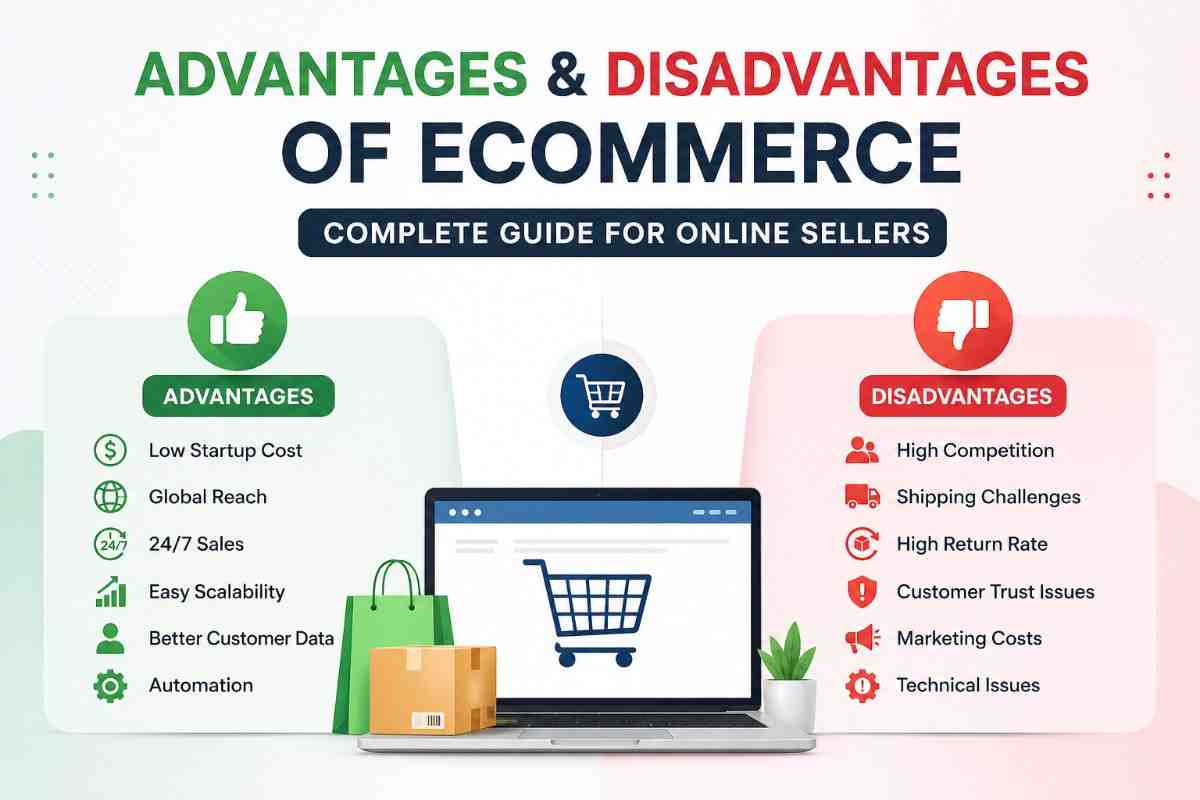
eCommerce has changed how businesses sell, scale, and serve customers. From small startups to global brands like Amazon and Shopify, online selling has become the fastest-growing business model worldwide.
But here’s the reality:
eCommerce is not just about launching a website and getting orders.
It comes with strong advantages—but also operational challenges like shipping delays, high return rates, customer trust issues, inventory management, and rising acquisition costs.
If you are planning to start an eCommerce business or already running one, understanding both the advantages and disadvantages of eCommerce can save you money, improve operations, and increase profitability.
This guide covers everything.
E-commerce (electronic commerce) is the process of buying and selling products or services online through websites, apps, or online marketplaces.
Common eCommerce models:
Popular e-commerce platforms include the following:
Traditional businesses require:
eCommerce reduces these costs significantly.
Instead of opening a physical store, you can start with:
A clothing brand can start online with ₹20,000–₹50,000 instead of spending lakhs on a physical store.
Lower investment = lower risk.
Physical stores are limited by geography.
eCommerce allows businesses to sell nationally and internationally.
You can sell to:
This expands market opportunities.
International shipping complexity.
Solution:
Use shipping aggregators like Shipmozo to simplify international fulfillment.
Physical stores have fixed timings.
eCommerce stores operate 24/7.
Customers can buy anytime.
Benefits:
Example:
A customer places an order at 2 AM.
Your business still makes revenue.
Scaling offline is expensive.
Scaling online is easier.
Ways to scale:
eCommerce supports rapid growth.
Offline stores struggle with data collection.
eCommerce tracks:
This improves marketing decisions.
Useful tools:
Automation reduces workload.
Automatable processes:
This improves efficiency.
You can sell through:
Omnichannel selling increases revenue.
Platforms:
Want to test a product?
eCommerce makes it easier.
Test quickly:
Lower testing cost.
Higher business agility.
Biggest challenge.
Thousands of sellers sell similar products.
Problems:
Seller struggle:
“How do I stand out?”
Solution:
Shipping directly impacts customer experience.
Common issues:
This affects customer trust.
Shipping costs can kill profit margins.
Smart shipping management becomes critical.
Return to Origin (RTO) is one of the biggest eCommerce losses.
Reasons:
Impact:
This is a major disadvantage.
New brands struggle with trust.
Customers worry about:
Trust-building requires:
Website downtime affects sales.
Problems:
This directly impacts conversion.
Platforms like Shopify reduce technical complexity.
Traffic is not free.
Major costs:
Customer acquisition costs are increasing.
This impacts profitability.
Managing stock across channels is difficult.
Problems:
Inventory errors create customer dissatisfaction.
Online customers expect:
Poor support increases negative reviews.
Shipping can reduce profit margins heavily.
Especially for:
Late delivery increases cancellations.
Customers want speed.
Fast delivery matters.
One courier cannot serve every location efficiently.
Need multi-courier flexibility.
COD increases fake orders and refusals.
Major RTO trigger.
Customers want real-time tracking.
Poor tracking creates a support load.
Returns are operationally expensive.
Reverse logistics matters.
Do not depend on one courier.
Compare performance.
Choose the best courier based on:
Automate:
Reduces errors.
Use:
Faster delivery = higher trust.
Focus on customer experience.
Many sellers focus only on marketing.
But shipping is the backend engine.
Bad shipping causes:
Good shipping creates the following:
This is where shipping platforms like Shipmozo become valuable because they centralize operations, improve courier allocation, reduce RTO risk, and optimize delivery performance.
Yes.
eCommerce is one of the biggest opportunities for businesses.
Advantages:
✔ Low cost
✔ Global reach
✔ Scalability
✔ Automation
✔ Data-driven growth
Disadvantages:
✘ High competition
✘ Shipping issues
✘ Returns
✘ Trust-building challenges
Success depends on operations.
Not just products.
Not just ads.
Execution wins.
The main advantages are the following:
Main disadvantages:
Yes, if managed properly.
Profitability depends on:
Shipping and return management are among the biggest challenges.
They directly affect profits.
Ways:
Common reasons:
COD increases conversions but also increases RTO risk.
Balance is important.
Popular options:
Choose based on business needs.
Very important.
Shipping affects:
Yes. Small businesses can scale fast with the right systems, products, and logistics strategy.


Diveya Mehta is a marketing and content specialist with 3+ years of experience, currently working with Shipmozo. With 1 year of hands-on experience in logistics, she creates practical, insight-driven content focused on shipping, courier performance, and eCommerce growth.





.webp)