

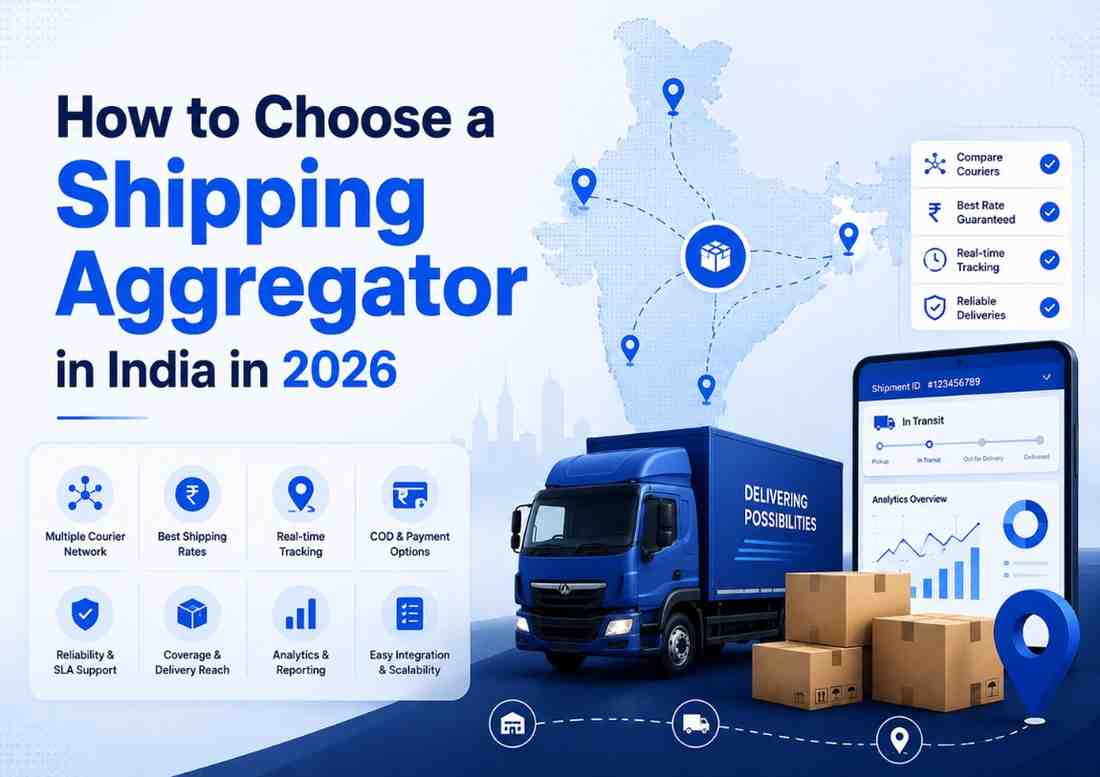
If you sell online in India, your shipping partner shapes your business more than almost any other vendor decision. It touches your delivery speed, your Return-to-Origin (RTO) rate, your cash flow, and ultimately, how much your customers trust you enough to buy again.
That's where a shipping aggregator comes in. Instead of signing separate contracts with Delhivery, Blue Dart, XpressBees, DTDC, and a dozen other couriers, you plug into one platform that manages all of them for you—rate comparison, label generation, tracking, NDR handling, and COD reconciliation, all from a single dashboard.
The challenge in 2026 isn't finding a shipping aggregator in India. It's finding the right one. With dozens of platforms all promising the lowest rates, the widest pincode coverage, and AI-powered everything, the differences that actually matter can get buried in marketing copy. This guide breaks down exactly what to evaluate so you can choose with confidence.
A shipping aggregator (also called a courier aggregator or logistics aggregator) is a platform that partners with multiple courier companies and gives eCommerce sellers access to all of them through one API integration or dashboard. Rather than negotiating rates and managing accounts with each carrier individually, you manage everything through the aggregator, which typically secures bulk, volume-discounted rates and passes a portion of that discount on to you.
India's logistics market is large and still growing steadily, and shipping aggregators have become core infrastructure for the millions of small and mid-sized eCommerce sellers and D2C brands operating in the country.
India's eCommerce logistics landscape has a few quirks that make aggregator choice higher-stakes than in most markets:
With that backdrop, here's what to actually look for.
Most aggregators advertise pincode counts in the 20,000–29,000 range and 15–40+ courier partnerships. But raw numbers hide the real question: does the aggregator route your specific shipments to the best-performing courier for that specific pincode, weight, and order type? Look for platforms offering AI-based or rule-based courier allocation — the smarter aggregators assign each order the courier statistically most likely to deliver it successfully, rather than relying on a single default partner.
What to check: Ask for delivery success rates by region, not just total pincode count.
This is often the single biggest lever for profitability. Non-Delivery Report (NDR) automation — automatic reattempts, customer SMS/WhatsApp nudges, and smart escalation — can meaningfully cut RTO rates. Some platforms report RTO reductions in the 30–45% range through a combination of smarter courier selection and structured reattempt workflows.
What to check: How many automatic reattempts are included, and what proactive communication (SMS, WhatsApp, IVR) happens before a shipment is marked RTO?
If a meaningful share of your orders are COD remittance speed is a cash flow issue, not a nice-to-have. Faster aggregators now offer D+1 or D+2 COD settlement (payment one or two days after delivery), compared to the older industry norm of a week or more. Faster remittance means faster reinvestment into inventory and ads.
What to check: Confirm the actual remittance cycle in writing, not just marketing claims — and check if it's flat or varies by courier.
Weight discrepancy billing is one of the most common sources of frustration with Indian shipping aggregators—a courier "re-weighs" a package and bills extra after the fact, often with little recourse. Look specifically for aggregators offering flat-rate or guaranteed weight policies, and read the fine print on the following:
What to check: Ask for a sample invoice, not just a rate card. Rate cards rarely show the full picture.
Your aggregator should plug cleanly into wherever you already sell—Shopify, WooCommerce, Magento, Amazon, Flipkart, or Meesho—without requiring manual order re-entry. Look for:
What to check: Ask how long onboarding and integration realistically takes for a business like yours, not a generic timeline.
Anyone can publish a delivery SLA. Fewer platforms actually back it up. Some newer entrants differentiate on accountability — automatic reimbursement if an on-time delivery guarantee is missed, rather than requiring you to file a claim and wait. This kind of structural accountability is worth more than a marginally lower per-shipment rate, especially at scale.
What to check: Is there an automatic penalty/reimbursement if the aggregator misses its own SLA, or is the SLA just a marketing number?
Branded tracking pages, proactive delivery notifications, and self-serve returns portals increasingly matter for D2C brand experience, not just logistics operations. Some aggregators are strong on core shipping but weaker here — if post-purchase experience is a differentiator for your brand, weigh this more heavily.
What to check: Can tracking pages and notifications be white-labeled with your brand, or do they show the courier/aggregator's branding?
Shipment exceptions and billing disputes happen no matter which aggregator you choose. Support quality—real humans, fast turnaround, and a dedicated account manager at higher volumes—is a recurring differentiator in user reviews across almost every major Indian aggregator. It's worth checking recent (not just curated) reviews on G2 or Capterra before committing.
What to check: What's the average resolution time for a shipment exception, and is a dedicated account manager included at your expected volume?
Here are warning signs to watch for before you commit:
A strong platform should make your team feel more confident after the demo — not more confused.
For sellers evaluating shipping aggregators in India in 2026, Shipmozo stands out as a platform built for execution, not just booking. Rather than treating shipping as a single transaction, it centralizes the full shipping workflow—multi-courier management, shipment visibility, and post-shipping tracking—into one operational layer, giving sellers real control over delivery performance instead of just access to courier rates.
That distinction matters because the strongest aggregators in this space aren't won on any single standout feature; they're won on how reliably they support day-to-day shipping operations at scale. For growing D2C and eCommerce brands that need consistency as order volume increases, Shipmozo's focus on operational depth over basic booking makes it a platform worth shortlisting.
Choosing a shipping aggregator in India in 2026 isn't a logistics decision you can make on price alone — it's a business decision that compounds over every single order you ship. The cheapest per-shipment rate can quietly cost you far more in RTOs, hidden weight charges, and slow COD remittance than a slightly pricier platform that's transparent and accountable from day one.
Take the time to pilot two or three shortlisted aggregators with a small batch of real orders before committing at scale. Real performance data on your actual order mix will tell you more in two weeks than any sales call will.
For new or early-stage sellers, prioritize aggregators with quick, low-commitment onboarding, transparent starter pricing, and no minimum order volume requirement over aggregators built for high-volume enterprise sellers. Simplicity and low switching risk matter more than advanced automation at this stage.
Pricing varies by weight slab, courier, zone, and COD vs. prepaid, but per-order fulfillment costs on major platforms commonly start in the range of ₹15–₹30 for lightweight domestic shipments, before COD or RTO charges. Always request a full sample invoice rather than relying on the advertised starting rate.
Yes. Aggregators with strong NDR (Non-Delivery Report) automation — automatic reattempts, proactive SMS/WhatsApp alerts, and smarter courier allocation — can materially cut RTO rates compared to working with a single courier with no fallback options.
Many leading platforms offer cross-border shipping to 190+ countries alongside domestic delivery, though international courier depth and customs documentation support vary significantly between aggregators, so confirm this specifically if you export.
Leading aggregators now offer D+1 or D+2 COD settlement (funds released one to two days after delivery), though many still operate on longer weekly cycles. Confirm the exact remittance timeline in writing, since this directly affects your working capital.
It can be if you're consistently seeing high RTO rates, slow COD remittance, unexplained weight discrepancy charges, or unresponsive support. Run a side-by-side pilot with a small batch of real orders on a new aggregator before migrating your full volume.
Yes, most major shipping aggregators in India offer native plugins for Shopify, WooCommerce, and Magento, plus API access for custom-built storefronts, along with marketplace integrations for Amazon, Flipkart, and Meesho.


Kuldeep Karki is a Digital Marketing Manager at Shipmozo, specializing in performance marketing, SEO, and growth strategy. With over 6+ years of experience in digital marketing, he has worked extensively on scaling B2B and eCommerce brands through data-driven campaigns across Meta Ads and Google Ads.





.webp)