

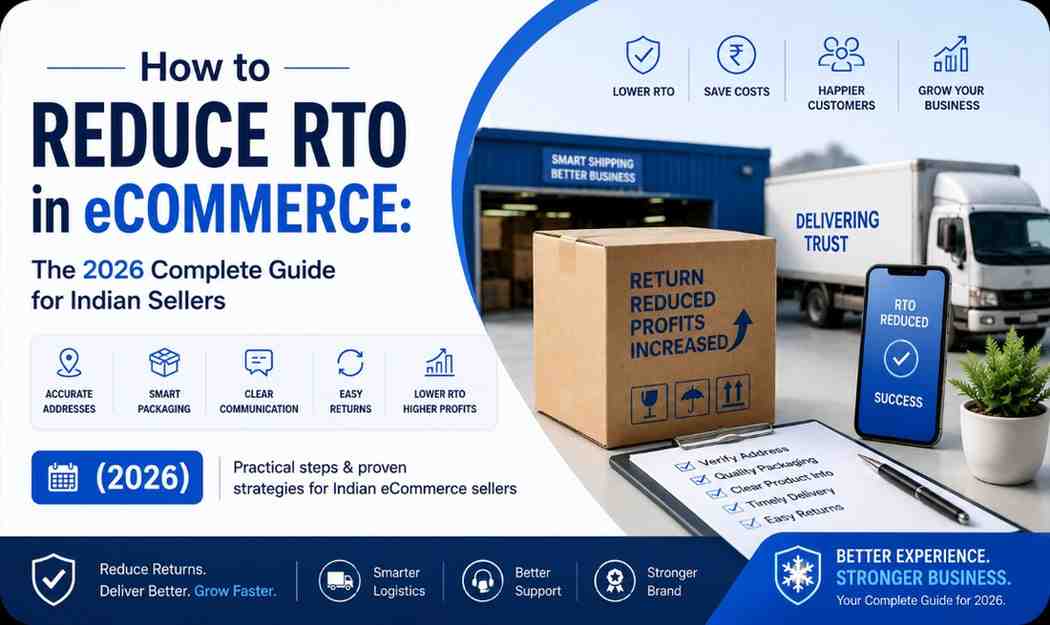
RTO costs Indian sellers ₹150–300 per order—and for high-volume D2C brands, that silent drain can wipe out months of profit. If you're asking, "How do I reduce RTO?"—here's the short answer: Verify addresses at checkout, confirm every COD order with an automated call or WhatsApp message before dispatch, and track NDR (Non-Delivery Reports) in real time to act within 24 hours.
Return to Origin happens when a shipment dispatched from your warehouse comes back to you undelivered. Every RTO order triggers:
Total per-order loss: ₹150–300, before you account for marketing spend to acquire that customer in the first place.
India's eCommerce RTO rate averages 25–35% vs a global benchmark of 8–12%. The gap exists because of COD dominance (~65% of orders), tier-2/3 address quality, and low buyer intent on impulse purchases.
Bad addresses are the single largest driver of RTO. Fix them before the order ships.
What to do:
Tools: WooCommerce Address Validation plugins, and a custom Shopify app via Google Maps API
Target: Eliminate ~15% of RTO caused by incorrect/incomplete addresses
Fake or impulsive COD orders are the second-biggest RTO driver. A simple confirmation step before dispatch filters them out.
What to do:
Tools: Exotel, Knowlarity, Interakt (WhatsApp Business API), MSG91
Target: 8–12% reduction in RTO from cancelled fake/impulsive orders—before you spend ₹1 on shipping
COD orders have 3–5× higher RTO than prepaid. Every COD order you convert to prepaid is a near-guaranteed RTO prevention.
What to do:
Tools: Razorpay Magic Checkout, custom Shopify discount scripts
Target: Move prepaid share from 35% → 55%+; each percentage point = significant RTO drop
Not all orders carry equal risk. Predictive scoring lets you intervene selectively — no need to annoy low-risk customers.
What to do:
Tools: Razorpay's fraud signals for COD
Target: Catch 60–70% of high-probability RTO orders before they ship
Most RTO is preventable at the NDR stage — when the courier attempts delivery and fails. The typical window to act is 24–48 hours. Most sellers miss it.
What to do:
Tools: Vamaship, EasyEcom, Shipmozo NDR management, and custom webhook → Freshdesk/Zendesk
Target: Convert 30–40% of NDR orders to successful delivery before they become RTO
A significant slice of RTO—especially in fashion, electronics accessories, and home décor—comes from customers refusing delivery because the product didn't match expectations.
What to do:
Target: Reduce "refused on delivery" RTO (typically 8–15% of total RTO) by 50%
Not all courier partners perform equally in all pincodes. A courier that's excellent for the Mumbai metro can have 35% RTO in rural Rajasthan.
What to do:
Tools: Shipmozo, Vamaship, Pickrr
Target: 4–8% RTO reduction from smarter courier allocation alone
Most brands go silent after dispatch. That silence costs you. Customers who know exactly where their order is—and feel cared for—are far less likely to refuse delivery.
What to do:
Tools: Interakt, Gupshup, PostShip, Shipmozo-branded tracking page
Target: Reduce delivery refusals and "customer unavailable" RTO by 20–25%
One platform worth knowing for Indian D2C sellers is Shipmozo, which aggregates multiple courier partners—Delhivery, Ekart, Xpressbees, and others—under a single dashboard with built-in pincode-level rate comparison and delivery performance tracking.
What makes Shipmozo particularly relevant to RTO reduction is its multi-courier auto-routing logic: it automatically assigns the best-performing courier for each order based on destination pincode, helping you avoid the high-RTO zones that come with locking into a single logistics partner.
For growing brands shipping 500–5,000 orders a month that don't yet have a dedicated logistics tech stack, Shipmozo offers a practical starting point—and as your volume scales, you can layer on advanced NDR management and risk-scoring tools on top of it.
High RTO isn't bad luck. It's the compounded result of gaps across checkout, pre-dispatch, last mile, and post-purchase—and every gap has a fix. Start with the two highest-impact changes: COD order verification before dispatch and real-time NDR management within 4 hours of a failed attempt.
Those two alone can move your RTO rate by 10–15 percentage points. Then layer in address validation, risk scoring, prepaid nudges, and smarter courier routing over the next 60 days.
Brands that treat RTO reduction as an ongoing ops discipline—not a one-time project—consistently hold rates under 12%, even at scale. Use the checklist above as your weekly audit and revisit your pincode-level courier data every month. The ₹150–300 you save per order compounds fast.
Anything under 12% is considered best-in-class for Indian D2C. The national average sits at 25–30%. Target 12–15% in your first 90 days of implementing these steps.
Yes. COD orders have 3–5× higher RTO than prepaid. The single highest-impact thing you can do is add a prepaid incentive (₹20–50 discount) and a COD verification step before dispatch.
NDR (Non-Delivery Report) is raised when a courier attempts delivery and fails. Unresolved NDRs automatically become RTO. Effective NDR management—responding within 4 hours with redelivery options—can convert 30–40% of potential RTOs into successful deliveries. See our NDR Management Guide →
Most brands see measurable improvement in 30–45 days after implementing COD verification and NDR management. Full results (12–15% RTO) typically take 60–90 days as risk-scoring models train on your order data.
Yes, tier-2/3 pin codes have higher RTO due to address quality, courier partner limitations, and lower digital literacy. For these zones, prioritize address validation, use hyperlocal delivery partners, and invest more heavily in phone-based NDR resolution (WhatsApp and IVR).


Neha Pant works in business development at Shipmozo, where she focuses on helping eCommerce and D2C brands simplify their logistics and scale operations efficiently. She is passionate about understanding real shipping challenges and connecting businesses with the right solutions.





.webp)