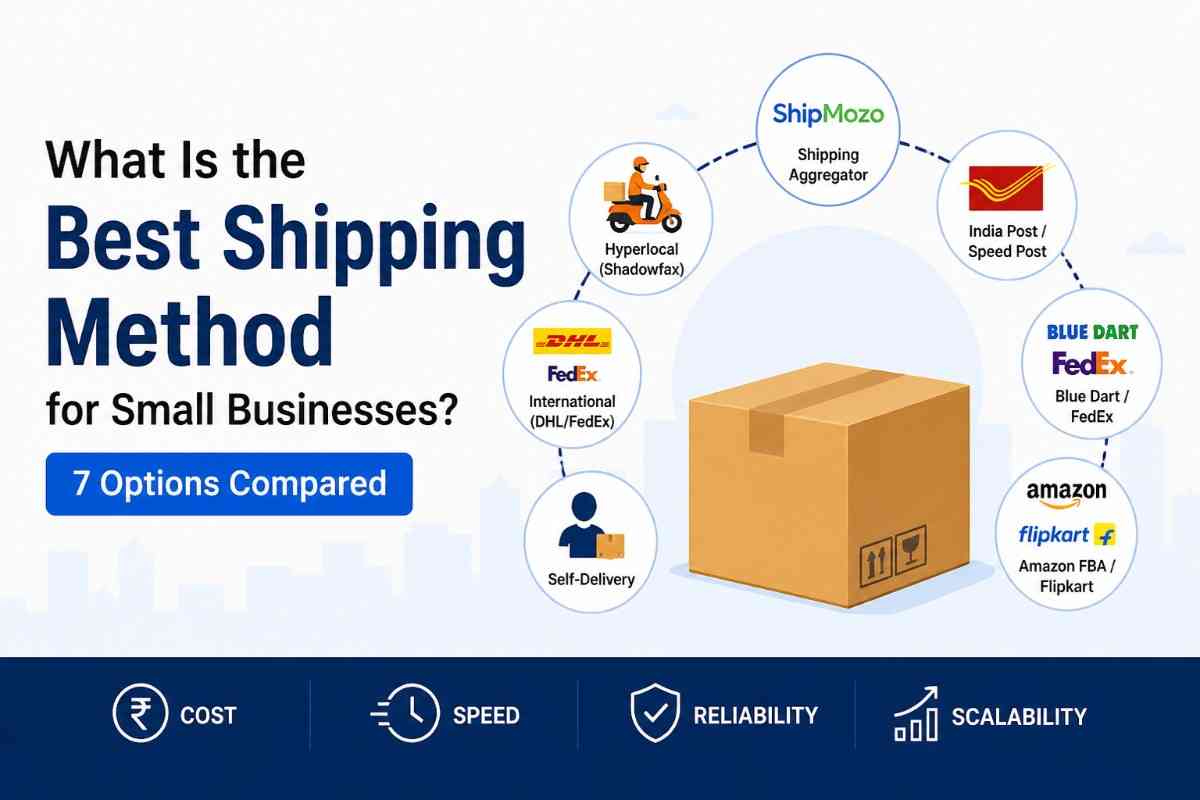
What Is the Best Shipping Method for Small Businesses? 7 Options Compared
Why Choosing the Right Shipping Method Matters for Small Businesses
If you run a small business, shipping is not just a logistics decision—it is a customer experience decision.
Studies show that 83% of online shoppers say a positive delivery experience makes them more likely to buy again. Yet most small business owners are still guessing when it comes to picking a shipping method — paying too much, delivering too slowly, or losing customers to avoidable delays.
The right shipping method for your small business can:
- Cut your shipping costs by up to 40–70%
- Improve delivery speed and customer satisfaction
- Automate label creation, tracking, and returns
- Scale with your business without adding operational headaches
In this guide, we compare 7 of the best shipping methods for small businesses — covering domestic, international, express, and tech-powered options — so you can make an informed choice today.
What to Look for in a Shipping Method for Your Small Business
Before diving into the options, here's what every small business owner should evaluate:
- Cost per shipment — flat rate vs. weight-based pricing
- Delivery speed — same day, next day, 2–7 days
- Coverage — local, pan-India, or international shipping
- Tracking & visibility — real-time updates for you and your customers
- Return management — ease of handling reverse logistics
- Integration — compatibility with Shopify, WooCommerce, Amazon, etc.
- Customer support — quick resolution for lost or delayed parcels
7 Best Shipping Methods for Small Businesses
1. Shipping Aggregators (Best Overall for Small Businesses)
Best for: E-commerce sellers, D2C brands, SMEs shipping 10–10,000+ orders/month
A shipping aggregator is a platform that connects you to multiple courier partners — Delhivery, DTDC, Ekart, Blue Dart, and more — under one dashboard. Instead of managing multiple courier accounts, you get:
- Discounted rates negotiated in bulk
- Automated courier selection based on price, speed, and pin code serviceability
- Single dashboard for labels, tracking, NDRs, and returns
- COD remittance management
Shipmozo is a great example of a modern shipping aggregator built specifically for small and growing businesses in India. With Shipmozo, small business owners can access pre-negotiated discounted shipping rates across multiple top courier partners without needing high monthly volumes. It simplifies everything — from booking a shipment to tracking it and managing returns — making it one of the most practical shipping solutions for small businesses looking to scale without complexity.
Pros:
- Lowest effective shipping cost
- No need to negotiate individually with couriers
- Centralized tracking and analytics
- Supports both prepaid and COD shipments
Cons:
- Requires onboarding and setup
- Best value unlocked at moderate volumes
2. India Post / Speed Post
Best for: Hyperlocal sellers, budget-conscious businesses, rural delivery
India Post remains one of the widest-reaching courier networks in the country, with access to over 1.55 lakh post offices and deep rural penetration.
- Speed Post delivers in 1–6 days depending on the destination
- Very low cost for lightweight parcels
- Ideal for government tender shipments and rural deliveries
- COD not widely supported for e-commerce
Pros:
- Extremely affordable
- Nationwide and international reach
- Reliable for documents and lightweight packages
Cons:
- Tracking is basic compared to private couriers
- No real-time NDR management
- Limited e-commerce integrations
3. Blue Dart / FedEx (Premium Express Shipping)
Best for: High-value products, time-sensitive deliveries, B2B shipments
If your small business ships premium, fragile, or time-critical goods, express couriers like Blue Dart and FedEx offer:
- Next-day and same-day delivery in metros
- Superior tracking and proof of delivery
- Strong international shipping network
- Dedicated account managers for businesses
Pros:
- Industry-leading delivery speed and reliability
- Excellent customer support
- Ideal for high-value goods like electronics, jewellery, pharma
Cons:
- Significantly higher shipping rates
- Not cost-effective for low-value or high-volume small businesses
4. Marketplace Fulfillment (Amazon FBA / Flipkart Fulfillment)
Best for: Sellers primarily operating on Amazon or Flipkart
If your small business sells primarily on marketplaces, fulfillment-by-marketplace programs let you store inventory in their warehouses and outsource picking, packing, and shipping entirely.
Amazon FBA (Fulfilled by Amazon):
- Prime badge boosts your product visibility
- Amazon handles returns and customer service
- Higher fees but improved conversion rates
Flipkart Advantage:
- Similar model for Flipkart-first sellers
- Preferred listing placement
Pros:
- Zero shipping management headache
- Faster delivery = better seller ratings
- Access to Prime/Flipkart Plus customers
Cons:
- High fulfillment fees eat into margins
- Loss of direct customer relationship
- Not suitable for multi-channel sellers
5. Local & Hyperlocal Delivery (Dunzo, Porter, Shadowfax)
Best for: Food, grocery, pharmacy, same-day local delivery
Hyperlocal delivery platforms are perfect if your small business serves customers within a 10–30 km radius and needs same-day or 2-hour delivery.
Popular options include:
- Shadowfax — strong in tier-2/tier-3 cities
- Porter — great for intra-city logistics and B2B
- Dunzo Business — ideal for food and grocery retail
Pros:
- Ultra-fast local delivery
- Ideal for perishable or urgent goods
- Growing customer expectation for instant delivery
Cons:
- Not suitable for pan-India or long-distance shipping
- Higher per-delivery cost vs. standard courier
- Limited to specific cities and pin codes
6. International Shipping (DHL, FedEx, ShipMozo International)
Best for: Exporters, cross-border e-commerce, handmade/artisan product sellers
India's D2C export market is booming, with handmade, ethnic, and niche products finding strong demand globally. For international shipping, key players include:
- DHL Express — fastest international delivery, premium pricing
- FedEx International — reliable global network
- Aramex — competitive for Middle East and South Asia routes
- ShipMozo — also offers international shipping integrations with discounted rates through its aggregator model, making global expansion accessible even for small businesses without large volumes
What to check for international shipping:
- Customs documentation support
- HS code classification
- Duties and taxes handling (DDP vs. DAP)
- Prohibited item lists by destination country
Pros:
- Opens your business to global customers
- High-value, high-margin opportunity for niche products
Cons:
- Complex customs and compliance requirements
- Higher shipping costs
- Longer delivery windows
7. Self-Delivery / In-House Logistics
Best for: Ultra-local businesses, boutiques, bakeries, subscription boxes
Some small businesses — especially in the food, gifting, or fashion space — build their own micro-delivery fleet using:
- Own delivery staff or freelancers
- Apps like Tookan or Track for fleet management
- Bike couriers for same-day local drops
Pros:
- Full control over delivery experience
- Brand touchpoint — delivery staff represent your brand
- No per-shipment courier fees
Cons:
- Scalability is limited
- High operational complexity
- Not viable beyond a small geographic radius
Quick Comparison Table: Best Shipping Methods for Small Businesses
| Shipping Method |
Best For |
Avg. Cost |
Speed |
COD Support |
Scalability |
Shipping Aggregator
(ShipMozo) |
All e-commerce sellers |
₹35–₹100+ |
1–7 days |
✅ Yes |
⭐⭐⭐⭐⭐ |
| India Post / Speed Post |
Budget, rural delivery |
₹20–₹60 |
1–6 days |
❌ Limited |
⭐⭐⭐ |
| Blue Dart / FedEx |
Premium, B2B |
₹150–₹500+ |
1–2 days |
✅ Yes |
⭐⭐⭐⭐ |
| Amazon FBA / Flipkart |
Marketplace sellers |
Variable |
1–2 days |
✅ Yes |
⭐⭐⭐⭐ |
Hyperlocal
(Shadowfax) |
Local same-day |
₹40–₹120 |
Same day |
✅ Yes |
⭐⭐ |
International
(DHL/FedEx) |
Exporters |
₹500–₹3000+ |
3–10 days |
❌ |
⭐⭐⭐⭐ |
| Self-Delivery |
Local boutiques |
Operational cost |
Same day |
✅ Yes |
⭐ |
So, What Is the Best Shipping Method for Small Businesses?
The honest answer: It depends on your business model.
But here's a simple decision framework:
- You sell on your own website or multiple channels → Use a shipping aggregator like Shipmozo for the best rates and automation
- You sell only on Amazon/Flipkart → Use their fulfillment programs
- You ship premium or time-sensitive goods → Use Blue Dart or FedEx
- You deliver locally → Use hyperlocal platforms
- You export internationally → Use DHL, FedEx, or an aggregator with international support
- You're just starting out with tight margins → India Post + ShipMozo combination works well
For most growing small businesses doing multi-channel e-commerce in India, a shipping aggregator is the smartest starting point — and ShipMozo is designed exactly for this use case.
How to Reduce Shipping Costs for Your Small Business
Even with the right shipping partner, here's how to squeeze more savings:
- Optimize packaging — reduce dimensional weight by using appropriately sized boxes
- Use zone-skipping — ship in bulk to regional hubs to cut last-mile costs
- Negotiate COD remittance cycles — shorter cycles improve cash flow
- Monitor NDR rates — undelivered orders are expensive; use NDR management tools
- Use shipping insurance wisely — only insure high-value shipments
- Analyse courier performance — drop couriers with high RTO (Return to Origin) rates
FAQ: Best Shipping Methods for Small Businesses
Q1. What is the cheapest shipping method for small businesses in India?
India Post Speed Post is the most affordable option for lightweight parcels. However, for e-commerce businesses with moderate volumes, shipping aggregators like Shipmozo often offer cheaper effective rates with better tracking and COD support than individual courier accounts.
Q2. Which courier is best for small business COD orders?
For COD (Cash on Delivery) orders, you need a courier with strong last-mile delivery and fast remittance cycles. Delhivery, DTDC, Ekart, and Shadowfax are popular choices. Using a shipping aggregator lets you automatically route COD orders to the best-performing courier for each pin code.
Q3. How do shipping aggregators help small businesses?
Shipping aggregators give small businesses access to:
- Pre-negotiated bulk rates with multiple couriers
- A single dashboard for booking, tracking, and returns
- Automated courier selection based on cost and serviceability
- NDR and RTO management tools
- COD remittance tracking
This saves both money and operational time, especially for businesses handling 50–5,000 shipments per month.
Q4. Is it worth using FedEx or DHL for a small business?
Yes — but only for specific use cases. If you're shipping high-value items, time-sensitive goods, or international orders, FedEx and DHL are worth the premium. For everyday domestic e-commerce, their rates are too high compared to aggregators.
Q5. What shipping method is best for international small business orders?
DHL Express is the gold standard for international speed and reliability. FedEx and Aramex are strong alternatives. If you want competitive international rates without negotiating directly, some shipping aggregators including ShipMozo offer international shipping options suitable for small businesses.
Q6. How do I choose the right shipping partner for my small business?
Ask these five questions:
- What is my average shipment weight?
- Where are most of my customers located?
- Do I need COD support?
- What is my monthly shipment volume?
- Do I need e-commerce platform integration?
Your answers will narrow down the best-fit option significantly.
Q7. What is RTO and how can small businesses reduce it?
RTO (Return to Origin) happens when a delivery attempt fails and the parcel is returned to the seller. This is one of the biggest cost leaks in e-commerce logistics. To reduce RTO:
- Verify customer addresses before shipping
- Enable SMS/WhatsApp delivery alerts
- Use NDR management tools offered by aggregators
- Identify high-RTO pin codes and switch couriers for those zones
Final Thoughts: Pick the Shipping Method That Grows With Your Business
There is no single "best" shipping method for every small business — but there is a best method for your business right now.
Start by auditing your current shipping spend, delivery speed, and return rates. If you're an e-commerce seller looking to scale without overpaying for logistics, a tech-enabled shipping aggregator like ShipMozo is likely your smartest move — giving you multiple courier options, automated workflows, and savings that compound as you grow.
The right shipping partner is not just a vendor. It's a growth enabler.









.webp)